Interior design styles: 23 styles explained, with a comparison table and a try-on on your photo
Interior design styles: 23 styles from Scandinavian to Brutalism. How to spot each one, its palette, who it suits, how similar styles differ and how to choose.
An interior design style is a set of recognizable choices: palette, materials, furniture shapes and how much decor you keep. This guide covers the 23 styles you can try in Desow Redesign, from Scandinavian and Japandi to Memphis and Brutalism. For each one you'll see how to spot it, where it works and which style people most often confuse it with.
Style roundups are usually shot in spacious homes with tall windows. A typical apartment is smaller: in January-February 2026, the average new-build apartment sold in Russia was 44.5 m², about 479 sq ft (Kommersant, citing CIAN data). So the descriptions below cover both the features of each style and how it behaves in a room of 15-20 m² (160-215 sq ft).
What interior design styles are there?
Reference books list dozens of styles. For an apartment, it helps to think in four families: light and natural, classic and historical, bold and mixed, industrial and coastal. The grouping is ours, since there is no standard classification of styles. The table lists all 23 Desow styles.
| Style | How to spot it | Palette | Who it suits |
|---|---|---|---|
| Scandinavian | white walls, light wood, textiles, little decor | white, light gray, beige, light oak | small rooms, north-facing windows |
| Minimalism | flat surfaces, hidden storage, clear tabletops | white, gray, graphite | people who keep things out of sight |
| Japandi | low furniture, light wood, ceramics, order | sand, warm gray, gray-green | bedrooms and living rooms meant for calm |
| Wabi-sabi | uneven plaster, aged wood, handmade ceramics | clay, ash, ochre | people who prefer lived-in things to perfect finishes |
| Biophilic | lots of plants, wood, stone, natural shapes | green, beige, terracotta | bright apartments, plant lovers |
| Alpine Chalet | wood on the walls, wool, fur, warm light | honey, brown, cream | bedrooms and country houses |
| Classic | symmetry, plaster moldings, carved furniture, chandelier | ivory, gold, warm wood | large rooms with high ceilings |
| Neoclassic | wall moldings, symmetry, calm colors, light furniture | beige, gray-blue, white | apartments with regular room shapes |
| Art Deco | geometry, brass, velvet, deep colors | emerald, black, gold, burgundy | living rooms with an evening mood |
| Manor | dark wood, framed paintings, rugs, leather armchairs | ochre, tobacco, dark green | living rooms and studies |
| English Country | floral textiles, plaid, painted furniture | cream, sage, muted red | kitchens and cozy living rooms |
| Romantic | pastels, soft fabrics, lace, curved furniture | powder pink, cream, lavender | bedrooms |
| Dark Academia | bookcases, dark walls, leather, desk lamps | bottle green, brown, burgundy | studies, owners of big libraries |
| Slavic | wood, embroidery, painted dishes, folk patterns | red, white, light wood | kitchens and country cottages |
| Mid-century | furniture on slim legs, walnut, smooth curves | walnut, mustard, olive, orange | almost any apartment, small ones included |
| Memphis | geometric patterns, bright blocks, odd shapes | pink, yellow, turquoise, black | kitchens, kids' rooms, creative people |
| Dopamine | saturated colors, soft rounded shapes | hot pink, orange, grass green | anyone bored with beige |
| Boho | rattan, macrame, rugs, plants, lots of textiles | terracotta, sand, olive | rentals, lovers of things with a story |
| Eclectic | pieces from different eras tied by color | any, with 2-3 recurring colors | people who already own favorite pieces |
| Loft | brick or concrete, metal, exposed utilities | terracotta, graphite, rust | studios and open layouts |
| Brutalism | concrete, massive simple shapes, almost no decor | concrete gray, dark wood, black | fans of severity and texture |
| Coastal | white walls, linen, jute, bleached wood | white, sand, sky blue, turquoise | bright rooms with a vacation mood |
| Yacht | varnished wood, navy, brass, leather | navy, white, teak, brass | bedrooms and studies, people who love order |
Contemporary and Provence are not on the list, although they are two of the most popular directions. Contemporary style is a broad idea of how people furnish homes today, and in Redesign it is closest to Minimalism, Scandinavian, Mid-century and Japandi. Provence is the rural style of southern France, closest to English Country, Manor and Romantic.
Other popular styles aren't in Redesign either, but each has an article with the closest Desow style: Art Nouveau, country, Baroque, French, contemporary, Japanese and high-tech. American, retro, Italian, shabby chic, eco, Oriental and Moroccan are collected in our roundup of retro, eco and other styles.
Light and natural styles
These six styles rely on a light base and natural materials. They are the easiest to fit into a small apartment and an ordinary budget.
Scandinavian
You recognize Scandinavian style by white or light gray walls, light wood, wool and linen textiles and nearly empty surfaces. It reflects light, so it works well in rooms with north-facing windows and in small bedrooms. How to put it together from ordinary furniture is covered in our article on Scandinavian style.
Minimalism
Minimalism means flat surfaces, floor-to-ceiling cabinets with plain fronts and two or three colors for the whole room. It suits people who are ready to put things away. In a small apartment it adds air, but it takes discipline: one stack of magazines on the table already breaks the look. Storage and how to keep the room from feeling like a hospital ward are covered in the article on minimalism.
Japandi
Japandi combines Japanese restraint with Scandinavian comfort: low furniture, light and dark wood, ceramics, linen and muted natural colors. Order matters more than decor, and every object has its place. The style fits bedrooms and living rooms where you want quiet. Palettes and furniture for it are in the article on Japandi.
Wabi-sabi
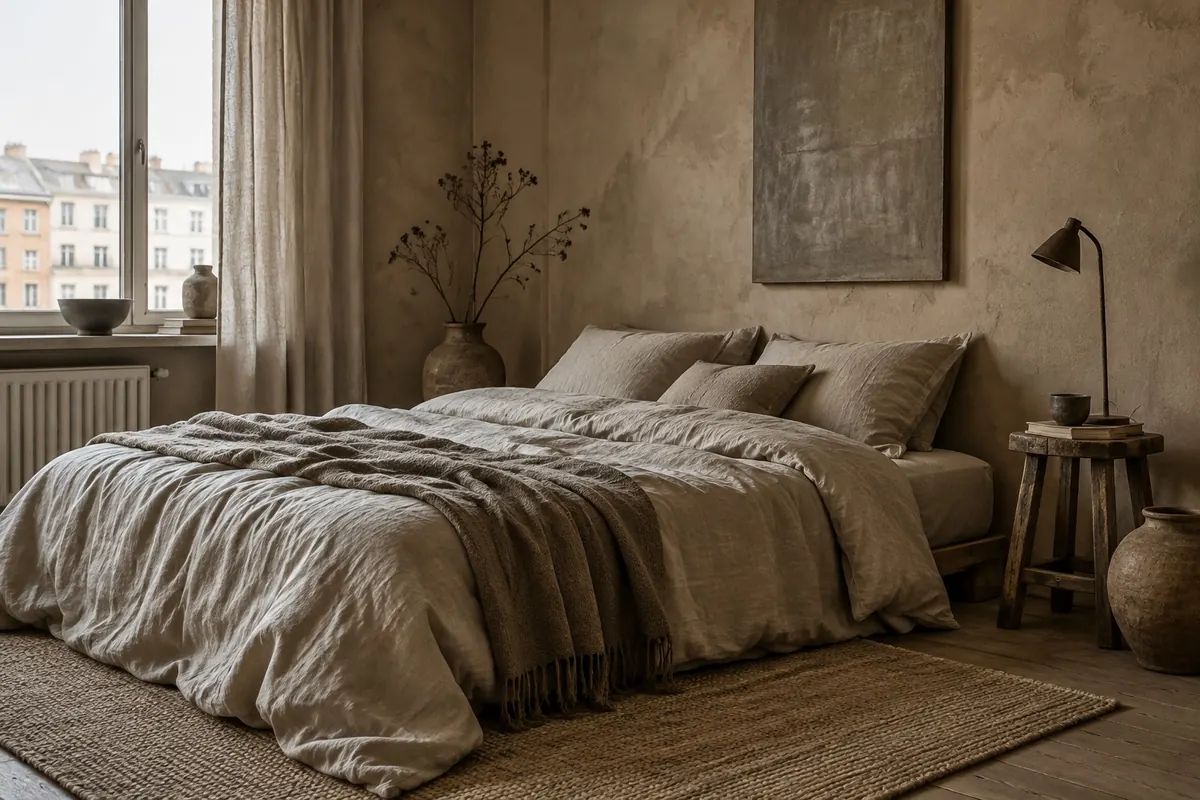
Wabi-sabi values imperfection: uneven plaster, worn wood, rumpled linen and handmade ceramics with irregular rims. The palette is earthy, with clay, ash and ochre. People confuse it with Japandi more than with anything else. Japandi is neat and composed, while wabi-sabi leaves the marks of time in plain sight. More in our wabi-sabi article.
Biophilic
Biophilic design brings nature indoors: live plants, wood, stone, soft natural lines and plenty of daylight. The plants are planned into the layout, with a shelf for pots, planters by the window and a tree-sized plant in the corner. The style works in bright rooms where greenery can survive. How to pick plants for your window - in our biophilic design article.
Alpine Chalet
A chalet is a mountain house: wood on the walls or ceiling, rough beams, wool throws, fur, warm light and a fireplace or an electric stand-in. In an apartment with a ceiling of about 2.6 m (8.5 ft), a wooden ceiling eats up height, so chalet is often used in part: a wood wall behind the bed, warm textiles, an armchair by the window. How to do chalet in an apartment without the sauna look - in our chalet style article.
Classic and historical styles
The eight styles in this group draw on the past: palaces, country estates, libraries and folk life. They need careful finishes, and some need a high ceiling.
Classic
Classic style is built on symmetry, plaster moldings, carved furniture, patterned fabrics and a crystal chandelier in the center. It is the most demanding style on the list when it comes to space: in a 12 m² (130 sq ft) room with a 2.6 m ceiling, heavy decor quickly feels oppressive. How to adapt it to an apartment is covered in the article on classic style.
Neoclassic
Neoclassic takes symmetry and moldings from Classic but makes them thinner and calmer: light walls, furniture with graceful lines, very little gilding. It lives more easily in an ordinary apartment than Classic does, as long as the room has a regular shape. Moldings, colors and budget are in the article on neoclassic style.
Art Deco
You spot Art Deco by its geometry (fans, stepped lines, chevrons), brass, velvet, lacquer and deep colors like emerald and black. For a long time it was called the "1925 style" after the Paris exhibition of decorative arts, and the term "Art Deco" only appeared in the 1960s (The Art Newspaper Russia). In an apartment, Art Deco works well in a living room or entryway where you want impact. How to dose Art Deco in a regular apartment - in our Art Deco article.
Manor
Manor is the style of an English or European country estate: dark wood, paintings in heavy frames, rugs, leather and upholstered armchairs, books and floor lamps. The palette is warm and dark, with ochre, tobacco and dark green. It suits a living room or study meant for cozy evenings. Manor, Romantic and Dark Academia are covered in detail in our guide to rare styles.
English Country
English Country is a village house in England: floral and plaid fabrics, painted furniture, open shelves with dishes, wicker baskets. It is simpler and lighter than Manor, with less wealth on display and more homey comfort. It works well in kitchens and living rooms. More in our English style article.
Romantic
Romantic style is soft and light: powder and cream tones, lace, floor-length curtains, furniture with curved legs and flowers. It is most often chosen for bedrooms. The main risk is sweetness: with too many pastels and ruffles, the room starts to look like a dollhouse.
Dark Academia
Dark Academia grew out of the look of old universities: floor-to-ceiling bookcases, dark walls, leather armchairs, desk lamps with green shades, globes and paintings. It suits a study or a living room with a large library. In a room with one small window it gets very dark, so plan the lighting in advance.
Slavic
Slavic style draws on folk motifs: wood, embroidery, painted dishes, red and white patterns, a stove or something that evokes one. In an apartment it is usually used as accents, like embroidered linen tablecloths, dishes and wooden benches in the kitchen. In a country cottage it can be used in full. How to avoid the folk-souvenir look - in our Russian and Slavic style article.
Bold and mixed styles
In these five styles, color, shape and a mix of things matter more than a calm base. They are often used for one room or one wall.
Mid-century
Mid-century (as in the middle of the 20th century) means furniture on slim legs, walnut and teak, smooth curves and bright accents like mustard, olive and orange. The furniture is light and low, so the style works well in small apartments. It is one of the most versatile directions on the list. More, including how Soviet 1960s furniture fits in, - in our mid-century article.
Memphis
Memphis means geometric patterns, bright blocks of color, plastic and oddly shaped furniture. The name comes from a group of Milan designers: it formed in December 1980 around Ettore Sottsass and lasted until 1988 (Interior.ru). A full Memphis room gets tiring, so people use it for a kitchen, a kids' room or one accent wall. How much Memphis a room can take - in our Memphis style article.
Dopamine
A dopamine interior is built on saturated, mood-lifting colors: pink, orange, grass green, electric blue. Shapes are soft and rounded, patterns are large. Memphis plays with geometry and provocation, while Dopamine relies on color and softness. How to keep a bright room from wearing you out in a month is covered in the article on dopamine decor.
Boho
Boho is assembled from rattan, macrame, rugs, cushions, plants and things from travels. The palette is warm, with terracotta, sand and olive. The style is good for a rental because it rests almost entirely on textiles and furniture and barely needs renovation. Pieces to look for and common mistakes are in the article on boho style.
Eclectic
Eclectic style mixes pieces from different eras and styles: a grandmother's sideboard, a modern sofa, a vintage chandelier. It works when the pieces share 2-3 recurring colors or one material. Without that link, the room looks like a storage unit full of random things. The rules for tying pieces together - in our eclectic style article.
Industrial and coastal styles
The last group has two styles about texture and two about the sea. The sea styles get confused more than the rest, so we cover them in more detail.
Loft
Loft came from former factory floors: brick or concrete, metal, exposed pipes and wiring, large light fixtures. In a regular apartment, one textured wall, track lighting and metal accents are enough, and you don't need to knock down walls. How to do a loft with a low ceiling is in our article on loft style.
Brutalism
Brutalism borrows concrete, massive simple volumes and an almost complete lack of decor from architecture. The palette is concrete gray, dark wood and black metal. Loft reminds you of an old factory, while Brutalism feels like sculpture: heavy shapes and texture with no backstory. How to make concrete feel warm - in our brutalism article.
Coastal vs. Yacht: what's the difference?
Coastal and Yacht are both tied to the sea, but they are different interiors. Coastal is a house by the sea where you go to relax. Yacht is the cabin of an expensive yacht, where everything is custom-made and fixed in place.
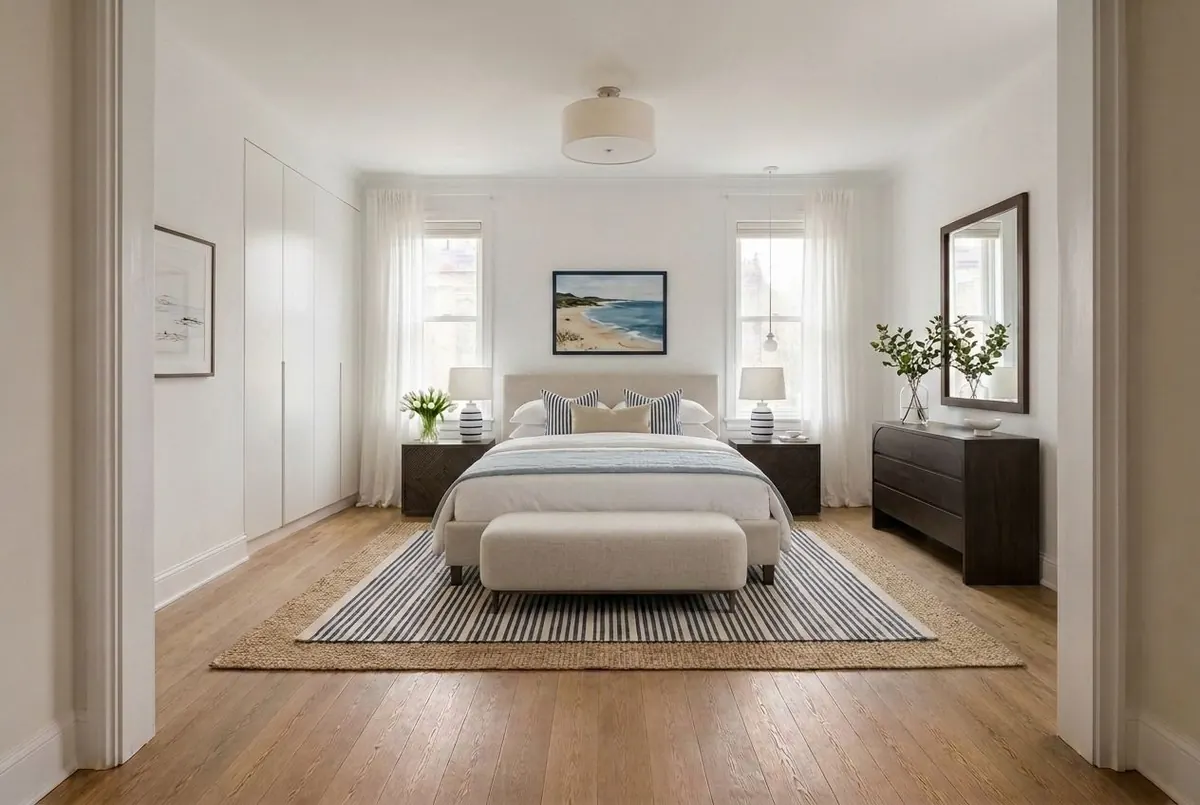
Coastal style means white and sand walls, bleached wood, linen, jute, stripes and blue accents. A related direction is Mediterranean and beach interiors: plaster, terracotta and blue tile, like a house on a Greek island. The mood is light and vacation-like, and the pieces are simple.
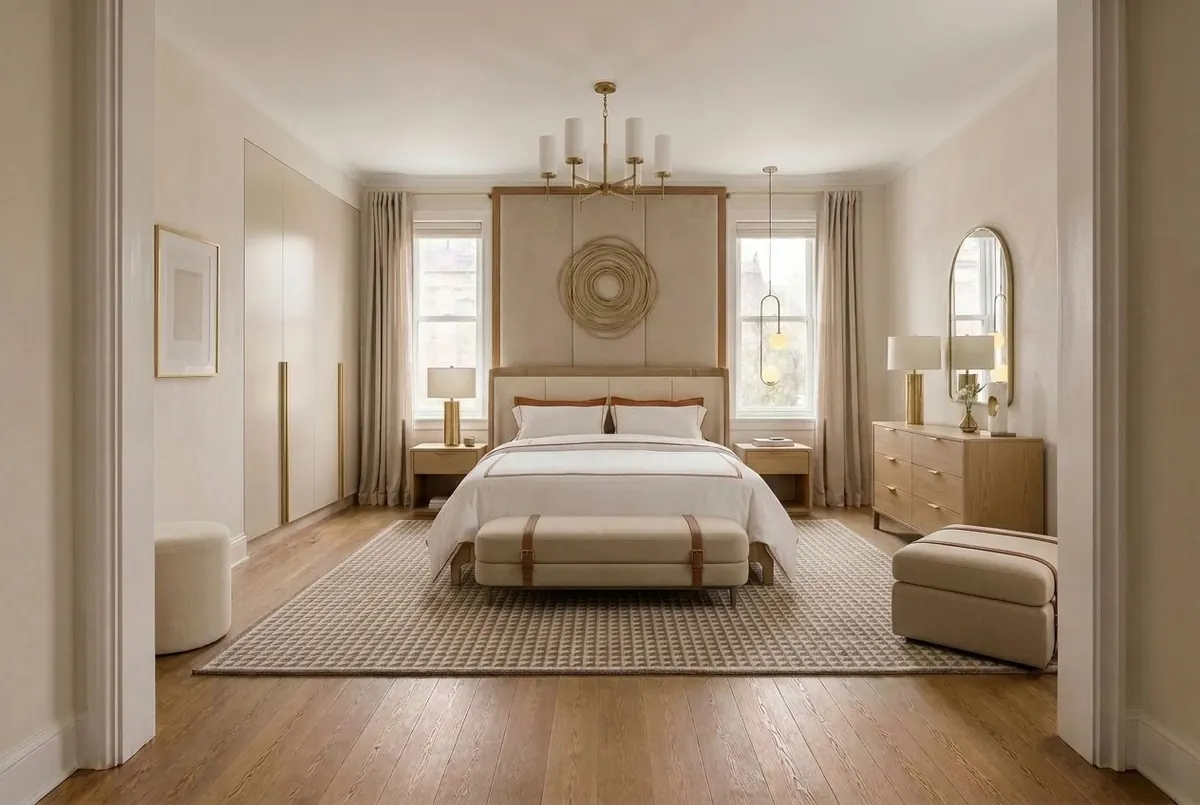
Yacht style is stricter and looks more expensive: varnished wood such as teak, navy and white, brass, leather and built-in furniture with a precise fit. Stripes and seashells don't belong here, since the style rests on precise details and order.
If you want the smell of the sea and bare feet, choose Coastal. If you want understated luxury, choose Yacht. The photos above show the same bedroom in two styles: Redesign changed the finishes, furniture and decor, and the windows and layout stayed in place. How to make the Mediterranean version work in a cloudy climate - in our Mediterranean style article. The yacht version without seashells and ship wheels - in our nautical style article.
How do similar styles differ?
Similar styles usually differ in one or two details: finishes, the amount of decor or the mood. The table shows the pairs people confuse most often.
| Pair | What they share | How to tell them apart |
|---|---|---|
| Minimalism and Scandinavian | light base, few things | Scandinavian has more textiles and wood, Minimalism is cooler and stricter |
| Japandi and Wabi-sabi | wood, ceramics, natural colors | Japandi is neat, Wabi-sabi loves irregularity and the marks of time |
| Classic and Neoclassic | symmetry, plaster and wall moldings | Neoclassic has thinner decor, lighter furniture, less gilding |
| Manor and English Country | English house, wood, fabrics | Manor is dark and solid, English Country is lighter and simpler |
| Memphis and Dopamine | bright color | Memphis is about geometry and patterns, Dopamine about soft shapes and mood |
| Boho and Eclectic | lots of different things | Boho has one warm palette and textiles, Eclectic mixes eras |
| Loft and Brutalism | concrete, metal, little decor | Loft is about an old factory and brick, Brutalism about massive volumes |
| Coastal and Yacht | the sea, white and blue | Coastal is light and relaxed, Yacht is strict and custom-made |
A description helps, but a picture settles it. Upload a photo of your room to Redesign and try both styles from a pair on it: the difference between wabi-sabi and Japandi in your own bedroom is obvious at once. The room stays yours, only the direction changes.
How do you choose a style for your apartment?
First, write down what won't change in your apartment: ceiling height, windows and which way they face, floors, kitchen, your daily routine and your budget ceiling. After that list, some styles drop out on their own. With a ceiling of about 2.6 m, Classic, Manor and Chalet with a wood ceiling will struggle most. Dark Academia and Art Deco need well-planned lighting, and Minimalism needs the habit of putting things away.
From the styles that remain, pick 3-4 and try them on the same photo of your room taken from one angle. A Redesign option is usually ready in under a minute. Compare the images side by side and again a few days later, and show them to your family without style names. The step-by-step method with a scoring table is in the article on choosing an interior style before renovation. What's in fashion this year is collected in the overview of 2026 interior trends.
If you need a style for one room, it's easier to start with a room-by-room guide. Loft: kitchen, living room, bedroom. Scandinavian: kitchen, living room, bedroom. Classic: kitchen, living room. Country: kitchen. Provence: kitchen, bedroom. Modern: kitchen, living room, bedroom.
Frequently asked questions
How many interior design styles are there?
There is no single list. Popular roundups count anywhere from two dozen to a hundred styles, because some authors split directions finely and others merge them. Two or three dozen are enough for an apartment renovation, and Desow Redesign has 23.
Which interior style works for a small apartment?
Light styles with light furniture handle small spaces best: Scandinavian, Minimalism, Japandi and Mid-century. They don't need a high ceiling, and a light base makes the room look larger. Bold styles also work in small doses: one wall, a rug or an armchair.
Can you mix interior styles?
Yes, if one style leads. Keep the walls, floor and large furniture in one style and add the second as accents: a light fixture, textiles, a couple of pieces. When two styles split the room evenly, you get Eclectic, and it needs recurring colors, or the room looks random.
Why doesn't Desow have Contemporary or Provence?
Contemporary is too broad an idea, so in Redesign it is covered by Minimalism, Scandinavian, Mid-century and Japandi. Provence is closest to English Country, Manor and Romantic. Our blog has detailed articles on both directions.
How do I know a style fits my room and not just a pretty picture?
Try it on a photo of your own room. Someone else's photo has different windows, ceiling and light, while yours shows whether the room becomes darker, more cramped or more spacious. A Redesign image is a concept, not a plan: you use it to choose a direction, and you build from drawings.
Key takeaways
- Desow Redesign has 23 styles, which fall into four families: light and natural, classic, bold and mixed, industrial and coastal.
- For a small apartment, light styles are easiest: Scandinavian, Minimalism, Japandi, Mid-century.
- Classic, Manor and Chalet need a high ceiling or partial adaptation, and dark styles need well-planned lighting.
- Coastal is a relaxed house by the sea, Yacht is a strict cabin with brass and teak.
- Contemporary and Provence are covered in Redesign by close styles from the list.
- Similar styles are easiest to tell apart on one photo of your own room after trying both.