Classic living room: what to keep in a 16-20 m² room with a 2.7 m ceiling
A classic living room in a standard 16-20 m² room with a 2.6-2.7 m ceiling: sofa, TV wall, storage, chandelier and drapes - what works and what feels heavy.
In a 16-20 m² (170-215 sq ft) living room with a 2.6-2.7 m (8.5-9 ft) ceiling, classic style rests on a single axis with matching pairs on either side, furniture of classic shape on visible legs, and heavy fabrics. Deep plaster moldings, a tiered crystal chandelier, valances and a carved wall unit across a whole wall weigh such a room down the most. Designers usually save them for ceilings of 3 m (about 10 ft) or more.
What classic style is and how strict classic differs from neoclassical is covered in our article on classic interior design. The order of decisions for any living room, from the focal point to storage, is in our article on living room design. This one is about which classic pieces a standard living room can carry.
A standard room here means something like a room in a P-44T series building, a common Moscow panel design: ceilings are 2.70-2.75 m, and the room in a one-bedroom apartment is 19 m² (Yandex Realty, in Russian). The advice below also works with a 2.5 m ceiling; just pick an even flatter chandelier.
Which parts of classic style fit a 16-20 m² living room?
At eye level, classic style can be complete, and the higher an element sits, the lighter it should be. The sofa, armchairs, rug and drapes make the style, and the walls and ceiling simply stay out of their way.
| Living room element | How to do it in classic style | What to avoid |
|---|---|---|
| Focal point | One axis: a framed TV, an electric fireplace surround or the window, with matching pairs on the sides | A fireplace on one wall and the TV on another |
| Sofa | Three-seater with a tall straight back, rolled arms and wooden legs | A modular cloud sofa with a deep seat |
| Armchairs | Two identical ones, facing each other or flanking a table | A single armchair in a corner |
| TV wall | A low paneled chest, the screen in a thin molding frame | A black glossy TV stand |
| Storage | Two narrow glass-front cabinets on either side of the axis, or a floor-to-ceiling closet painted to match the walls | A carved wall unit along the whole long wall |
| Chandelier | Flat, with candle arms, on a short rod | Tiered crystal on a chain |
| Drapes | Heavy fabric to the floor, rod right under the ceiling, tiebacks | Valances and gathers above the window |
| Walls | Thin moldings in the wall color, frames where they relate to furniture | A wide plaster cornice, frames around the whole room |
| Rug | Patterned, under the front legs of the sofa and armchairs | A small rug in the middle of the room |
| Floor | Oak parquet or oak-look laminate, herringbone, medium tone | A dark floor together with dark furniture |
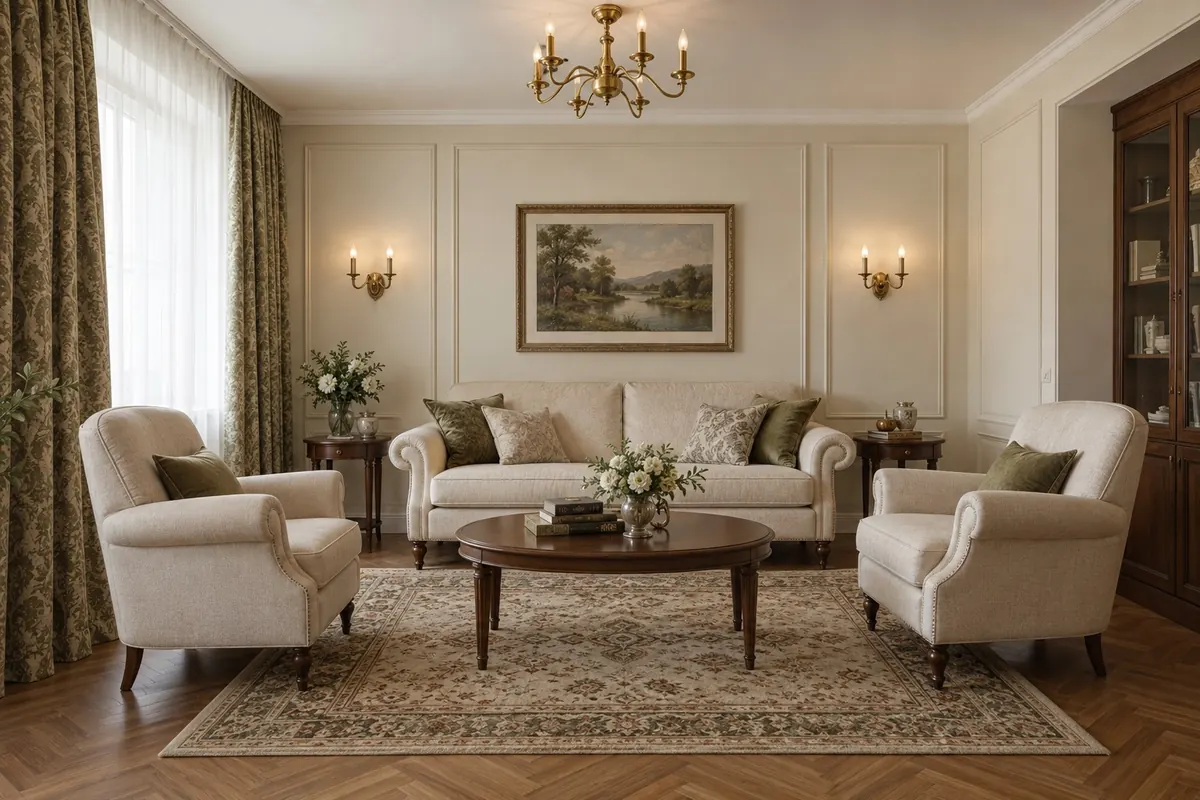
Where should the axis go: TV, fireplace or window?
In a grand living room, the fireplace sets the axis. In a standard apartment it is usually the TV. Few people are ready to move the TV out of the living room, so the screen becomes part of the composition.
TV
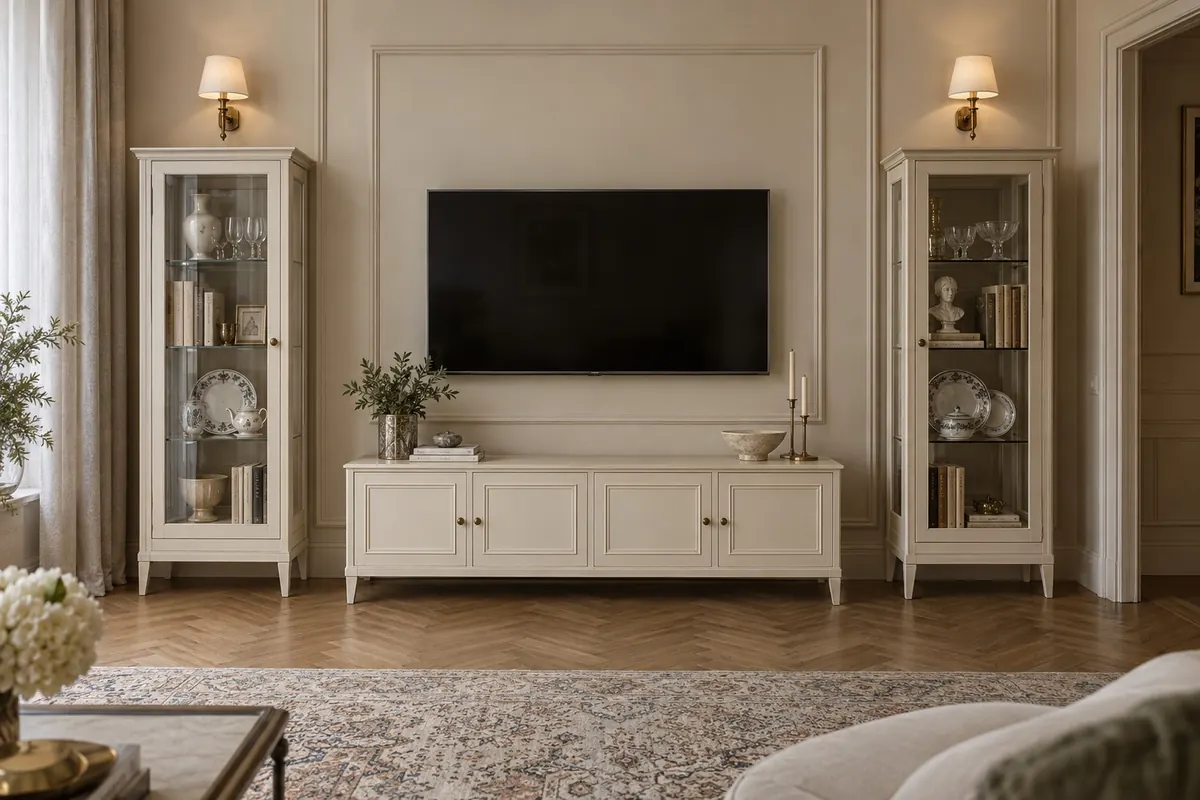
Hang the screen in the center of the wall opposite the sofa and surround it with a thin molding frame painted the wall color. The dark rectangle then reads as a picture. Below the screen goes a low chest with paneled doors, and on the sides two matching glass-front cabinets or two sconces.
Electric fireplace surround
A surround gives classic style back its usual focal point. Put it on the same wall as the TV, or move the TV out of this room. In classic style a mirror hangs above the surround: a screen in that spot ends up above eye level, and watching it from the sofa is uncomfortable.
Window
If there is one window centered on the short wall, you already have an axis. Drapes hang symmetrically, a pair of armchairs and a table stand in front of the window, and the TV moves to a side wall or into a closet niche.
Which sofa suits a classic living room?
A classic sofa is usually a three-seater with a tall straight back, rolled arms and wooden legs. In a 16-20 m² room this shape has an advantage: the seat is shallow. The Russian furniture standard GOST 13025.2-85 sets sofa seat depth at 450-600 mm (about 18-24 in) and allows more only with extra back cushions, and seat width per person at no less than 500 mm (about 20 in) (GOST 13025.2-85, Table 2 and clause 3.1, in Russian). A soft sofa with a deep seat and a pile of cushions sticks out further from the wall, and in a narrow living room 3-3.3 m wide those extra centimeters come out of the walkway.
With a sofa on legs you can see the floor underneath, and the room feels roomier. Buy armchairs in pairs and place them symmetrically. Keep button tufting to one piece, the sofa back or an ottoman: when everything is tufted, the living room looks like a furniture showroom. Upholstery can be velour, jacquard or a basket-weave fabric in warm light tones. Dark velvet is beautiful, but in 17 m² it is enough for two armchairs.
If the living room is a walk-through or long and narrow, first choose a layout in our article on an 18-20 m² living room, then place the classic furniture according to it.
Storage: display cabinet, sideboard or wall unit?
A classic wall unit with carving and a cornice takes up the whole long wall and runs into the ceiling, and nothing in a standard living room is heavier. With a 2.7 m ceiling, separate pieces placed along the axis work better:
- two narrow glass-front display cabinets on either side of the TV: glass lightens the front, and the dishes and books behind it work as decor;
- a sideboard or buffet on the wall opposite the window, with a mirror or a painting above it;
- a floor-to-ceiling closet painted to match the walls, with paneled doors, if you have a lot of things.
A single corner cabinet breaks the symmetry. Put two in the corners of one wall or skip them.
Chandelier, drapes and rug with a 2.7 m ceiling
Chandelier
A tiered crystal chandelier on a chain hangs over your head with a 2.7 m ceiling, and the room looks lower. Choose a flat one with candle arms on a short rod. Where people walk under the chandelier, keep the bottom of the shades at least 2.1 m (about 7 ft) above the floor; this is a practical guideline, not a norm. Over the coffee table it can hang lower. Two sconces on either side of the axis and a floor lamp by the armchair support the symmetry. How to split lighting into layers and switches is covered in our article on interior lighting.
Drapes
Hang the rod right under the ceiling and wider than the window, and let the fabric fall to the floor, so the window looks taller. Valances and gathers on top take height from the wall, and in a standard living room they are the first thing to go. Tiebacks, tassels and sheers under the heavy drapes can stay. Fabric: jacquard, velvet or heavy linen, one shade darker or lighter than the walls.
Rug
A rug with a classic pattern pulls the sofa and armchairs into one group if at least their front legs stand on it. A small rug in the middle of the room breaks up the floor.
Where a classic living room turns heavy
- The furniture stands around the perimeter and the middle is empty. In classic style the group gathers around the table and the rug.
- Everything is dark: floor, furniture and burgundy drapes. In a 17 m² room with one window, keep only one thing dark, the floor or the fabrics.
- Gold on frames, handles, the chandelier and the upholstery pattern all at once. One metal in the details is enough, bronze or brass.
- A massive coffee table on a carved pedestal stands in the walkway. A table on four slim legs is easier to walk around.
Budget classic from mass-market stores
Regular stores sell a lot of it: polyurethane moldings (light, and you paint them together with the wall), a sofa and armchairs of simple classic shape on wooden legs, sconces, heavy drapes and a patterned rug. Spend money on what you can't change without renovation: the floor and the wiring for paired sconces. Mark the sconce outlets before the rough finish, or you'll end up with surface-mounted cords.
How to try classic style on a photo of your living room
In a standard room, a couple of extra details is already enough to make the walls feel heavy, so it helps to see classic style on a photo first.
- Photograph the living room in daylight from a corner, so the ceiling, the window and the wall where the axis will be are in the frame. How to get the shot right is in our article on photographing a room.
- Upload the photo to Desow Redesign, choose the "living room" room type and the "Classic" style. A version is usually ready in under a minute.
- Run the same photo through "Neoclassical" and "Manor" and compare how much detail your ceiling height can carry.
If the room looks lower in "Classic," take the neoclassical version as a base and add a sofa on legs, display cabinets and sconces to it. The image shows the style and mood; molding and furniture sizes are chosen from measurements.
Free in Desow means the Free plan: you get free credits once when you sign up, enough for several Redesign versions. Results are up to 1K with a watermark. Redesign also works on a phone.
Frequently asked questions
Can you do a classic living room with a 2.5 m ceiling?
A lighter version, yes: pairs along the axis, a sofa on legs, floor-length drapes on a rod under the ceiling and a flat chandelier. Moldings should be thin and in the wall color, and a ceiling cornice is better skipped. Strict classic with deep plaster moldings needs more height, so neoclassical will be closer.
Where should the TV go in a classic living room?
In the center of the wall opposite the sofa, in a thin molding frame, above a low chest. On the sides, a pair of display cabinets or two sconces. Above a fireplace surround the screen ends up above eye level.
What drapes suit a classic living room?
Heavy floor-length drapes in jacquard, velvet or heavy linen, with sheers and tiebacks. Hang the rod right under the ceiling and wider than the window. With a 2.6-2.7 m ceiling, better skip the valance.
How is a classic living room different from a classic kitchen?
In the living room, upholstered furniture, fabrics and the rug create the style, and the walls and ceiling can stay simple. A kitchen has almost no fabric, so the fronts, the countertop and the boxed-in range hood carry the classic look. More in our article on a classic kitchen.
In short
- In a 16-20 m² living room with a 2.6-2.7 m ceiling, classic style is built on an axis with pairs, furniture of classic shape and fabrics.
- There is one axis: a framed TV, an electric fireplace surround or the window.
- A classic sofa with a tall back is usually shallow and leaves a wider walkway. GOST 13025.2-85 sets sofa seat depth at 450-600 mm.
- Instead of a carved wall unit: two display cabinets along the axis, a sideboard or a closet painted to match the walls.
- A flat chandelier, floor-length drapes on a rod under the ceiling, no valance.
- Compare "Classic," "Neoclassical" and "Manor" on a photo of your living room in Redesign before buying furniture.