Neoclassical interior design: how to make it work with 8-9 ft ceilings
Neoclassical interior design for a regular apartment: moldings and lighting for 8-9 ft ceilings, how it differs from classic and Art Deco, mistakes, budget.
Neoclassical interior design is classic style without the weight: symmetry, moldings and a calm light palette, combined with modern furniture, simple lighting and very little decor. It works in a regular apartment with 2.5–2.7 m (about 8–9 ft) ceilings too, as long as you keep the proportions right: slim profiles, flush lighting, and wall frames placed with purpose rather than across every wall.
Most articles about neoclassical style show apartments with ceilings over three meters and arched windows. A typical building is different: a molding that looks great at three meters eats up height at two and a half. Below we cover how to bring the style into an ordinary apartment, what to skip, and where it gets expensive.
How is neoclassical different from classic and Art Deco?
Neoclassical style takes order from classic design, not luxury. Symmetry, wall frames and a crown molding stay. Gilding, carved legs, heavy drapes and crystal go.
| Feature | Classic | Neoclassical | Art Deco |
|---|---|---|---|
| Main idea | grandeur and wealth | order and calm | geometry and impact |
| Walls | ornate plaster, murals, fabric | slim moldings, solid paint | panels, contrasting colors, gloss |
| Palette | gold, burgundy, dark wood | white, milky, greige, powder pink | black, emerald, brass, dark tones |
| Furniture | carved, heavy | simple shapes, soft fabrics | rounded silhouettes, velvet, metal |
| Lighting | crystal chandelier | understated chandelier, sconces, floor lamps | globes, fans, brass fixtures |
| Ceiling | high, coffered | any height, if proportions are right | high or medium |
Like wall frames and calm walls but not a "palace" look? That is neoclassical. If you are drawn to brass, fluted fronts and dark color, Art Deco is the closer match, and it is covered in our article on 2026 interior trends. For a calm neutral base with no wall decor, look at modern style.
Will neoclassical style work with 2.5–2.7 m ceilings?
Yes. This height is typical for mass-market housing. Under the Russian building code SP 54.13330.2022, living rooms and kitchens must be at least 2.5 m high, and at least 2.7 m in some climate subzones (SP 54.13330.2022, clause 5.12). Developers give similar figures: according to a representative of the developer A101, economy-class apartments average 2.5 m, comfort class about 2.7 m, and only business and luxury class start at 3 m (Fontanka).
So neoclassical design for a typical apartment is planned for that 2.5–2.7 m. Photos of mansions are a poor reference here. The main rule: every element on the walls and ceiling should draw the eye upward, or at least not press down from above.
Moldings and proportions: rules for a lower ceiling
Moldings are the defining feature of the style and its biggest risk in a low room. A wide crown molding, a heavy ceiling medallion and frames across every wall make a room feel lower, even if each piece looks good on its own. The exact profile width is chosen from measurements: a piece of molding held up to the wall tells you more than a drawing.
Crown molding
Choose a narrow, flat profile instead of a stepped, multi-layer one. In a 2.5 m room you can skip the crown molding entirely and rely on wall frames. If you do want one, paint it the ceiling color: the line between wall and ceiling softens, and the height does not get "cut off".
Wall frames
Frames work when they are tied to something in the room: a sofa, a bed, a TV, a window. A frame centered above the sofa looks intentional. A grid of identical frames around the whole room looks like a hotel corridor. Vertical frames visually raise the ceiling, wide horizontal ones lower it.
Color
Moldings painted the wall color are the calmest option for a low room: the relief shows through shadow, not contrast. White frames on a dark wall look striking, but they break up the space. How to choose a calm palette for walls is covered in our article on color combinations in interiors.
Doors and openings
Floor-to-ceiling doors, or at least doors taller than standard, noticeably stretch a room. If replacing doors is not in the plan, add a slim-profile casing. It gives the same classic rhythm without extra weight.
Lighting: a chandelier without crystal
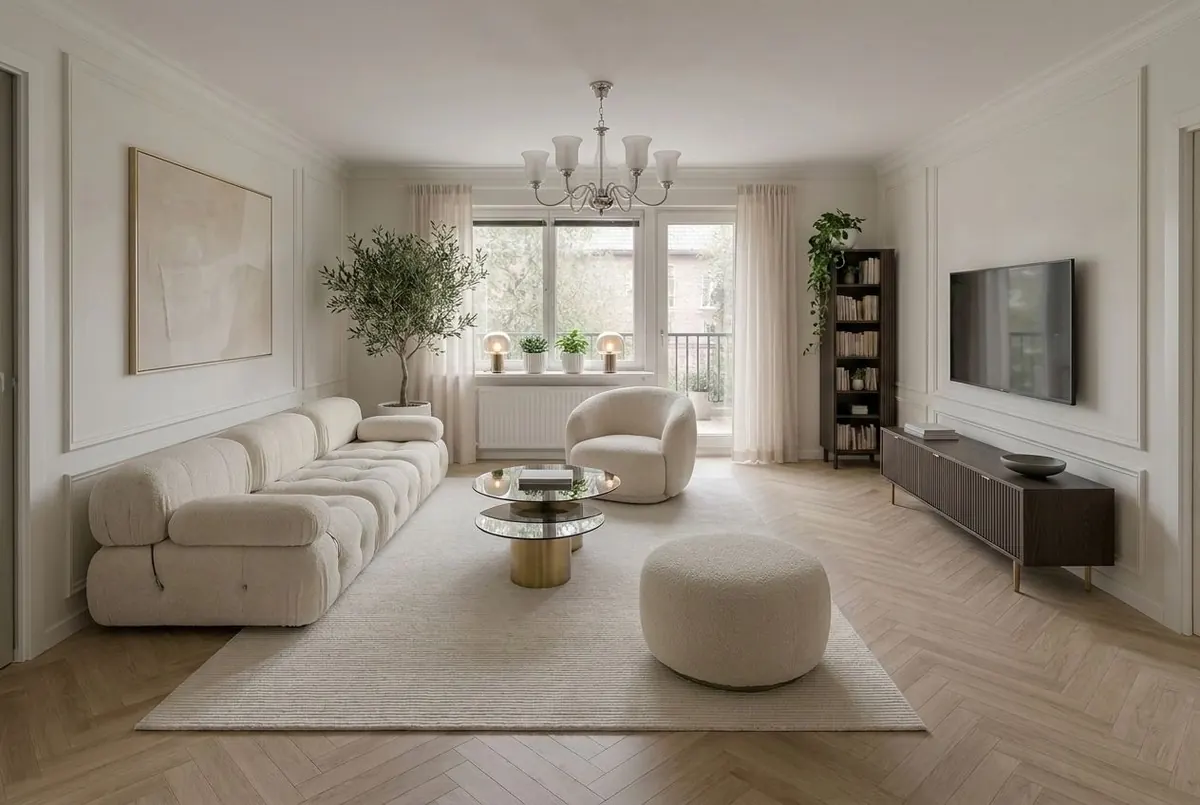
Lighting in neoclassical design is soft and layered: a chandelier in the center, sconces by the sofa or bed, a floor lamp in the corner, table lamps. With a 2.5 m ceiling, a pendant on a long drop hangs at head height. So choose a flush or compact model with a short rod. Warm white light brings out milky walls and textiles; cool light can make them look grayish.
What not to do with neoclassical style in a typical apartment
These mistakes turn neoclassical into a "budget palace". They are easier to spot in an image before the renovation than on finished walls.
- Using everything at once: crown molding, frames on every wall, a ceiling medallion and coffers. Pick one or two techniques per room.
- Choosing heavy crystal and gilding. That is classic style, and in a low room it feels oppressive.
- Placing frames by template instead of by furniture. A frame half-covered by a wardrobe looks like a mistake.
- Mixing many shades of white. Warm milky walls and cool white moldings clash.
- Hanging heavy drapes with valances. Light sheers and straight curtains hung from just below the ceiling make the window look taller.
Neoclassical style in the kitchen, living room and bedroom
In the kitchen, neoclassical style comes from fronts with a slim frame or raised panel, a marble-look countertop and backsplash, brass or bronze handles and faucet. Upper cabinets up to the ceiling remove the dusty shelf on top and stretch the kitchen upward. Upholstered chairs around the table carry the style from the living room into the kitchen-dining area. The same approach works for a small kitchen with a few adjustments, covered in our article on small kitchen design.
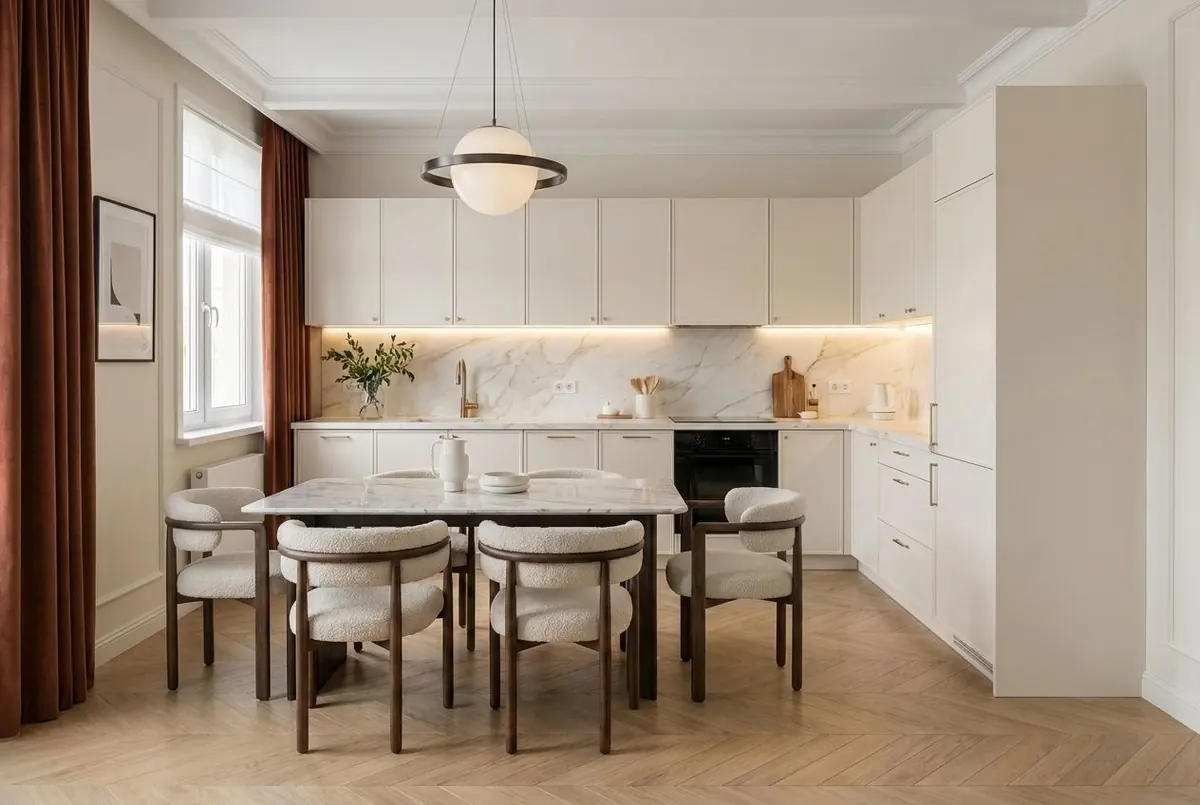
In the living room, the style rests on symmetry. A sofa in the center, a pair of armchairs or poufs, a coffee table on the axis, a frame or painting above the sofa. Herringbone parquet, or laminate with that pattern, adds a classic touch without a single molding.
In the bedroom, the bed sets the axis. A tall upholstered headboard, matching nightstands with sconces or pendants on each side, one frame or painting above the bed, and the style already reads. Hang curtains from the very top of the wall and keep textiles light. A wardrobe with plain or raised-panel fronts is better placed against a wall without moldings so it doesn't hide the frames.
How much does neoclassical style cost, and where can you save?
Neoclassical design usually costs more than a simple modern renovation of the same size: the money goes to wall decor, lighting and furniture. The exact amount depends on the scope of work and the region. A useful reference is a cost breakdown of a 38 m² neoclassical apartment published by the Russian magazine T-Zh: the renovation with furniture came to 3.74 million rubles, including 350,000 rubles for moldings, mirrors and a decorative panel, 200,000 rubles for lighting, and 810,000 rubles for furniture (T-Zh). This was a 2022 project with a 3.1 m ceiling, so the amounts should not be copied directly. The shares are more useful: wall decor took about 9% of the budget, lighting about 5%, and furniture about 22%.
| Cost item | Why it is expensive | Where to save |
|---|---|---|
| Moldings and wall decor | many linear meters, skilled manual work | frames only on accent walls, no crown molding in low rooms |
| Lighting | several scenes, sconces and floor lamps | a simple chandelier and a pair of sconces instead of a designer model |
| Furniture | upholstered pieces, symmetrical pairs | one statement sofa or table, simple shapes for the rest |
| Flooring | herringbone parquet or engineered wood | laminate or LVT with a herringbone pattern |
| Kitchen | raised-panel fronts, stone-look countertop | simple fronts with a slim frame, focus on handles and backsplash |
The most expensive mistake is redoing work. If the moldings go up and then you realize the frames "cut" the room, you pay twice: for removal and for new finishes.
How to test neoclassical style on your own room before renovating
Before you order moldings, photograph your room and look at it in several styles. On your own photo you can see right away how many frames a wall can take, how a crown molding looks above your window, and whether a chandelier is too heavy for your ceiling.
- Take the photo in daylight, hold the phone level, and get the floor, ceiling and window in the frame.
- Upload the photo to Desow Redesign and choose the Neoclassical style. For comparison, run the same room in Classic and Art Deco: you will see where the line between the styles falls in your room. If you are not sure you want decor at all, add Minimalism.
- If you like everything except the wall color or one item, fix that detail with Smart Edit: it changes the selected item, material or color. Smart Edit works in the desktop version.
One redesign version costs 10 credits. The Free plan gives 40 credits once at sign-up, which is enough for four versions. Keep in mind that the image shows style and mood, not exact molding dimensions. The profile and frame layout are chosen later from measurements. How to choose between several styles is covered in our article on choosing a style before renovating.
Frequently asked questions
Can you do neoclassical style with a 2.5 m ceiling?
Yes. Skip the wide crown molding and coffers, paint moldings the wall color, choose a flush chandelier and vertical frames. Taller doors and curtains hung from the very top of the wall add height.
How is neoclassical different from modern classic?
They are usually the same direction under different names: classic techniques in a calm, lighter version. Sometimes "modern classic" means a version with even less decor.
Which colors suit neoclassical style?
The base is white, milky, light gray, greige and powder pink. Accents come from dark wood, brass, and deep blue or green in textiles. There are few bright colors in neoclassical design.
Do you need wallpaper in a neoclassical interior?
Not necessarily. Walls are usually painted, and moldings provide the relief. Wallpaper with a fine stripe or small classic pattern fits a bedroom or hallway if the wall has no frames.
Will neoclassical style work in a small apartment?
Yes, if you keep decor to one or two spots and choose a light palette. How to plan a style for a studio or one-bedroom as a whole is covered in our article on one-room apartment design.
In short
- Neoclassical style means symmetry, moldings and a light palette without gilding or heavy decor.
- With 2.5–2.7 m ceilings you need slim profiles, moldings painted the wall color, a flush chandelier and frames tied to furniture.
- The main mistakes are using every technique at once, crystal, template frames and heavy drapes.
- Most of the money goes to furniture, lighting and wall decor; you can save on herringbone-look flooring and the number of frames.
- Before ordering moldings, see neoclassical style on a photo of your own room in Desow Redesign.