Minimalist interior design: start with storage and decluttering, not with buying furniture
Minimalist interior design starts with decluttering and storage. A step-by-step plan, warm vs. cold minimalism in a table, and a way to test it on your photo.
Minimalist interior design is a style where only the things you need stay in the room and everything else goes into closed storage. It doesn't start with buying a white sofa. It starts with decluttering and a storage plan: without them, new furniture will be covered in boxes and small items again within a month. Once storage is solved, what's left is simple shapes, a calm palette, and plenty of open floor.
Most articles about minimalism start with the palette and the furniture. We'll start with what gets in the way most often: things that have nowhere to go. After that come a step-by-step plan, a comparison of warm and cold minimalism, common mistakes, and a way to see the style on a photo of your own room before renovation.
What is minimalist interior design?
Minimalism is an interior where every visible object does a job or was chosen on purpose. Clutter doesn't get pushed into a corner: it's given away, sold, or put into a cabinet behind a smooth front.
You can check the signs of the style against your own room:
- Clear surfaces. Almost nothing sits on the countertop, windowsill, or dresser.
- Closed storage. Floor-to-ceiling cabinets, handleless fronts or barely visible handles, drawers under the bed.
- Simple shapes. Furniture without carving or ornate decor, straight or softly rounded lines.
- A calm palette. White, gray, beige, light wood, sometimes one accent color.
- Quiet finishes. Flush or slim baseboards, concealed-frame doors, matte paint. The fewer lines and joints, the calmer the background.
- Fewer, larger pieces. One big painting instead of ten small frames.
That doesn't make the room empty. It can have a rug, textiles, and plants, as long as there are only a few and they share one palette.
Why does minimalism start with storage, not furniture?
New furniture doesn't solve the problem of stuff. If your apartment has no place for winter clothes, documents, and the vacuum cleaner, they'll be in plain sight within the first week, and the minimalist room will turn back into an ordinary one.
Clutter affects more than how a room looks. In a study of 60 dual-earner couples, women living in clutter had higher levels of cortisol, the stress hormone, while clutter had almost no effect on men (Psychologies). The study shows a link, not a cause. Still, the takeaway for an apartment is clear: minimalism rests on a storage system that keeps things in order without daily effort.
Step 1. Go through the apartment zone by zone
Don't start with the hardest room. Take one zone: the entryway, the kitchen cabinets, or the wardrobe. Take out everything stored there and look at the whole pile. You'll see right away how much stuff you really have and how much space it needs.
Step 2. Sort things into four groups
| Group | What goes here | Where it goes |
|---|---|---|
| Used every week | dishes, in-season clothes, toiletries, chargers | close storage: at hand height, near where you use it |
| Used rarely | off-season clothes, suitcases, tools, holiday decorations | far storage: top shelves, the top of the wardrobe, a storage closet |
| Not used, but hard to let go | gifts, "might come in handy," souvenirs | a box with a date: unopened for six months, give it away or sell it |
| Broken or unneeded | old electronics, extra cables, empty boxes | disposal, resale, recycling |
The table leads to the main rule: only part of the first group stays in sight. The rest of your everyday things go into closed storage, but close to where you use them: dishes in a drawer by the sink, chargers in the nightstand.
Step 3. Plan closed storage
Now you know how much storage you need. A floor-to-ceiling wardrobe leaves no ledge on top for boxes and dust to collect, and it looks calmer. A bed with a lift-up base stores bedding. Deep kitchen drawers replace open shelves that always end up holding something.
Step 4. Only then furniture and decor
Choose furniture for the things that remain, not the other way around. Books you're keeping need a closed bookcase or a shelf of limited length. A bike needs a spot in the entryway or on the balcony, but not in the living room.
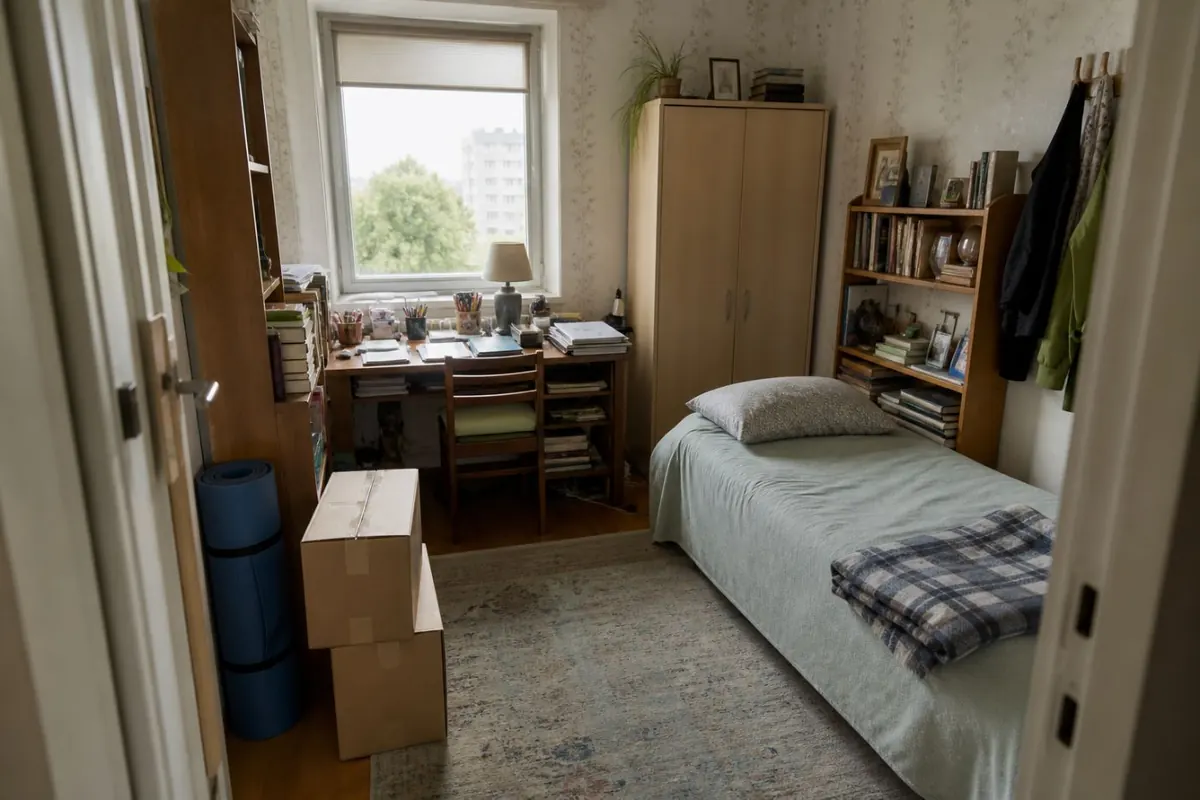
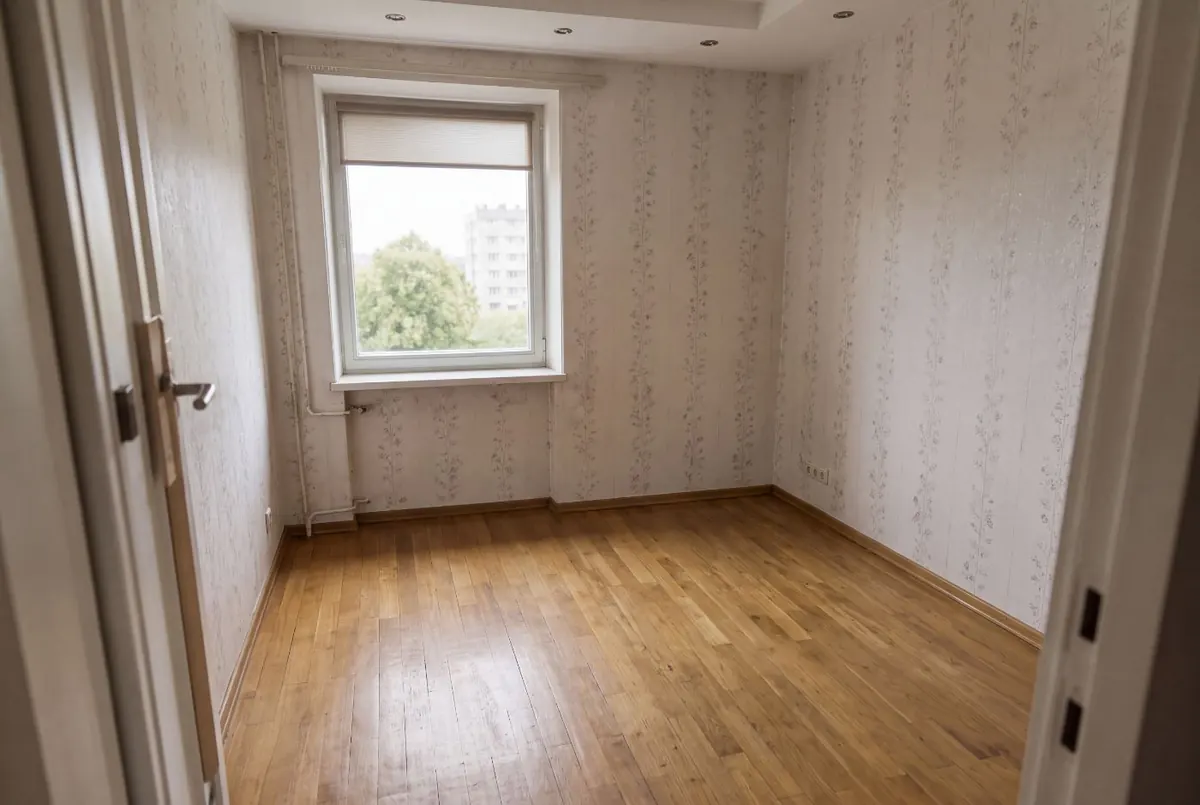
You can see your room without its contents before you even start emptying cabinets. The Declutter tool removes furniture and extra items from a photo. With an empty room in front of you, it's easier to decide what really needs to come back.
Cold or warm minimalism: which should you choose?
Cold minimalism is built on white, gray, glass, and metal. Warm minimalism adds wood, beige tones, textiles, and soft light. They share the core principle: few things in sight.
| Feature | Cold minimalism | Warm minimalism |
|---|---|---|
| Palette | white, light gray, graphite, black accents | milky white, beige, sand, wood tones |
| Materials | gloss or flat matte, glass, metal, concrete | wood, linen, wool, ceramics, stone |
| Light | even, neutral | warm, several sources at different heights |
| Textiles | minimal, smooth fabrics | a throw, a textured rug, linen curtains |
| Risk | the room looks like an office | the room fills up with decor and loses the style |
| Best for | people who like strictness and clean lines | families and people who spend a lot of time at home |
White stays the base of both. Pantone chose Cloud Dancer as its color of 2026, a neutral white the company calls a "key structural color" (RBC). How to match a shade of white with wood and textiles is covered in our article on color combinations in interior design.
If you can't decide between the two, compare them on the same room. Upload a photo to Redesign and choose the Minimalism style, and for a warmer version try Japandi or Wabi-sabi next to it. On your own walls the difference between strict and warm minimalism is easier to see than on someone else's photos.
Minimalism in an apartment, room by room
The principles are the same, but each room has its own weak spot.
Minimalist living room
In a living room, open shelving and the TV area usually break the order. Put cables, set-top boxes, and remotes into a closed media console. Keep one sofa without a pile of pillows, and choose a coffee table that things don't linger on.
Minimalist bedroom
In the bedroom, storage is needed by the bed and in the wardrobe. Nightstands with drawers hold small items, and a bed with a lift-up base stores bedding and off-season things. The wall behind the headboard is often the only place for an accent: a panel, textured plaster, or a single painting.
Minimalist kitchen
A kitchen needs smooth fronts and a clear countertop. A toaster or blender you don't use every day can go into a cabinet. For everyday appliances, a separate niche with outlets and a pull-out shelf works better: the kettle and coffee machine are switched on out in the open so steam doesn't reach the cabinet fronts. How to fit storage into a small space is covered in our article on small kitchen design.
Minimalist entryway
The entryway is the first thing a guest sees. A closed cabinet for coats and shoes, one bench, and a mirror are enough. Open hooks with five jackets on them break the style immediately.
What mistakes make minimalism feel empty?
It's easy to take minimalism to the point where the room is uncomfortable to live in. Most often, five mistakes are to blame:
- Buying furniture before sorting your things. There isn't enough storage, and things end up in sight again.
- Removing all textiles. Without a rug and curtains, the room echoes and looks cold.
- Keeping a single light source. A ceiling light in the center makes the room flat and uninviting in the evening.
- Making everything one color. White walls, white furniture, and a white floor with no texture blend together.
- Hiding everything, including what you need. If you have to take the charger out of a cabinet every evening, it will soon end up back on the nightstand.
How do you try minimalism on your own room?
Minimalism is easier to judge on your own photo than in a collection of other people's interiors. Here's the order:
- Photograph the room as it is. In daylight, from chest height, so the floor and two walls are visible.
- Remove the clutter in the photo. Declutter costs 7 credits and shows the room without furniture and small items.
- Try the style. Redesign costs 10 credits: choose Minimalism and, for comparison, Japandi or Scandinavian.
- Write down what repeats. Colors, materials, and the type of storage make a shopping list and a brief for a designer.
The Free plan gives you 40 credits once when you sign up. That's enough for one declutter and three redesign versions. If you're still choosing between styles, also look at Scandinavian style: it's close to minimalism but allows more wood and textiles.
Frequently asked questions
Does minimalism work in a small apartment?
Usually, yes. Floor-to-ceiling closed storage and open floor make a room look larger. If you have a lot of stuff and little room for cabinets, solve storage first, or the style won't last. For more on small apartment layouts, see our article on studio and one-bedroom apartment design.
How is minimalism different from Scandinavian style?
Scandinavian style is warmer and allows more wood, textiles, and decor. Minimalism is stricter: fewer objects in sight and more closed storage. Warm minimalism sits between the two.
Is minimalism expensive?
Not necessarily. What costs money is redoing things when furniture was bought before storage was figured out. If you sort your things and plan the cabinets first, you end up buying less.
Can minimalism feel cozy?
Yes. Add wood, textured fabrics, warm light from several sources, and one or two large pieces with character: a painting, ceramics, a plant.
Do I have to throw things away to switch to minimalism?
You don't have to throw everything away. What matters is that every item has a place in closed storage. Things you haven't used in six months are easier to put into a dated box first and decide on later. Seasonal and rarely used items like holiday decorations or a suitcase are the exception: they belong in far storage.
Summary
- Minimalist interior design starts with decluttering and a storage plan, not with buying furniture.
- Sort your things into four groups: only part of what you use every week stays in sight.
- Cold minimalism is built on white, glass, and metal; warm minimalism on wood, beige, and textiles.
- The main mistakes: furniture before storage, a single light source, giving up textiles entirely.
- Before renovating, look at your room without clutter and in two or three style versions on a photo in Desow.