Classic interior design: order, symmetry and which apartment it suits
Classic interior design explained: architectural order, symmetry, plaster moldings and natural materials. How it differs from neoclassical and Art Deco.
Classic interior design is a formal room built on the rules of the architectural order: strict symmetry, a wall divided into a dado, a field and a cornice, plaster moldings, natural wood and stone, heavy carved furniture and a crystal chandelier. It works best, as a designer rule of thumb rather than a building norm, in rooms with ceilings of 3 m (about 10 ft) or more and a floor area of at least 20 m² (about 215 sq ft). In a typical apartment with 2.5-2.7 m (8-9 ft) ceilings, neoclassical style is the more honest choice.
Below we cover what strict classic style is made of, how it differs from neoclassical, Art Deco and English country, and four questions that tell you whether your room can carry it.
What is classic interior design?
Classic style brings the logic of a building facade indoors. An architectural order is a system of proportions and a fixed arrangement of vertical and horizontal elements: a base, a column with its base, shaft and capital, and on top an entablature with a cornice (Wikipedia, "Classical order").
Indoors, an echo of this scheme is the three-part division of the wall. The match is loose, but it helps keep the proportions right. At the bottom sits a tall baseboard or wood paneling up to about windowsill height: that is the "base." Above it is the wall field with molding frames or fabric wallcovering: that is the "column." Under the ceiling runs a wide cornice: that is the "entablature." Pilasters on either side of a fireplace, door or mirror repeat the column literally. When all three tiers are in place and the proportions hold, a room reads as classic even without gilding.
How do you recognize strict classic style?
Symmetry
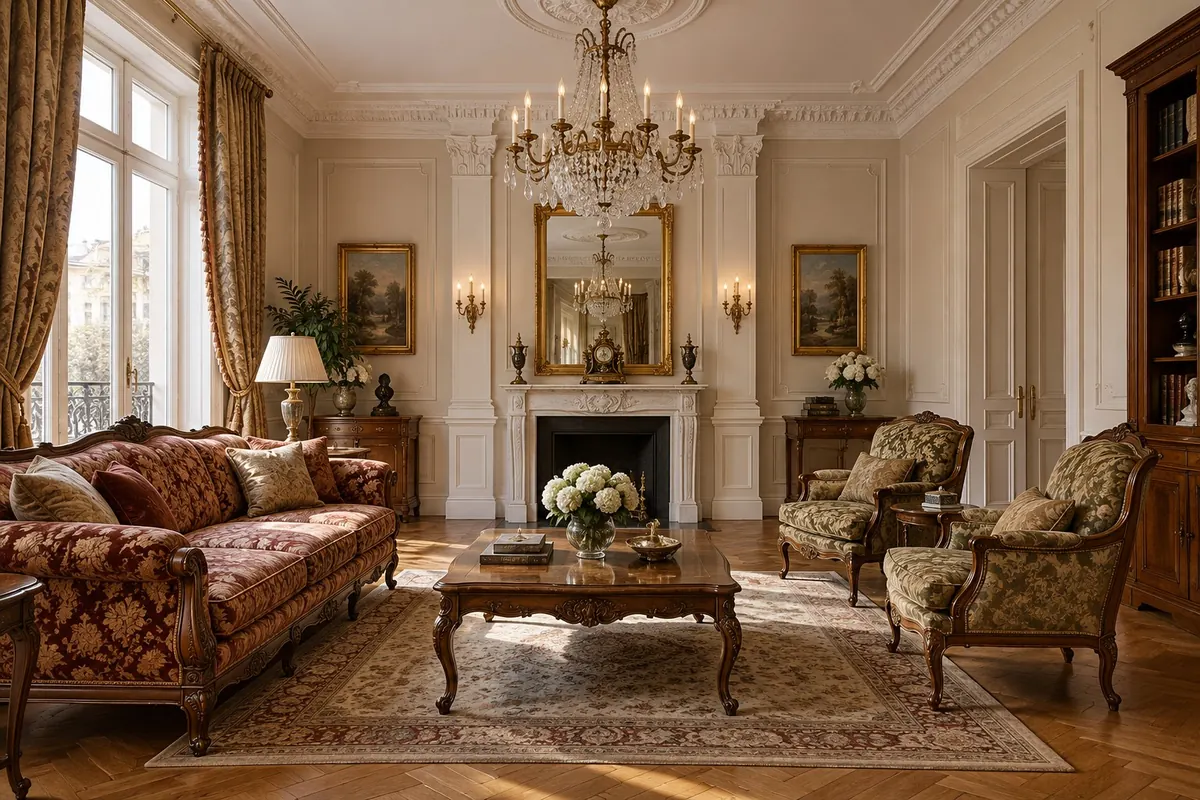
A classic room has an axis: a fireplace, a window, a sofa or a bed. Everything else comes in pairs on either side of it: two armchairs, two sconces, two nightstands, two paintings. Broken symmetry is the first thing that gives away an "almost classic" room.
Plaster moldings and cornices
A ceiling medallion under the chandelier, a stepped cornice, coffers or ceiling frames. In strict classic style the moldings are deep and cast strong shadows. Thin flat moldings already belong to neoclassical design.
Natural materials
Oak or walnut parquet, often herringbone or a decorative pattern. Marble on the fireplace and windowsills, solid wood in doors and furniture, silk, velvet, jacquard and damask in the fabrics. Imitations are acceptable, but they show up close, and close is exactly how people look at a classic room.
Heavy furniture
A carved sofa on curved legs, tufted armchairs, a solid wood sideboard and bookcase, a round table on a single heavy pedestal. This furniture takes up a lot of space and needs clearance around it.
Lighting and color
A crystal or bronze chandelier in the center, paired sconces on the walls. The palette is warm: ivory, beige, sand, dark wood, with accents of burgundy, olive and gold. How to put such a palette together without clutter is covered in our article on color combinations in interior design.
How is classic different from neoclassical, Art Deco and English country?
These four styles are often confused because all of them use moldings and wood. They differ in their main idea and in the kind of room they need.
| Feature | Classic | Neoclassical | Art Deco | English country |
|---|---|---|---|---|
| Main idea | formality and the order | order without the weight | geometry and shine | the comfort of a country house |
| Walls | plaster moldings, pilasters, fabric | thin moldings, paint | paneling, contrast, gloss | floral wallpaper, wood paneling |
| Furniture | carved, massive | simple shapes | rounded, velvet, metal | soft, mismatched, well worn |
| Palette | ivory, gold, dark wood | white, cream, greige | black, emerald, brass | green, terracotta, plaid |
| Lighting | crystal, bronze, paired sconces | simple chandelier, floor lamps | fans, globes, brass | lampshades, table lamps |
| Ceiling | 3 m (10 ft) and up | any, with slim profiles | high or medium | any |
All four styles are available in Desow Redesign, and for a country estate mood there is also Manor. Neoclassical style for an apartment with 8-9 ft ceilings is covered in detail in our article on neoclassical interior design.
Will classic style work in a regular apartment?
Most of the time it will not, and ceiling height is the reason. Under the Russian building code SP 54.13330.2022, living rooms and kitchens must be at least 2.5 m high, and at least 2.7 m in some climate subzones (SP 54.13330.2022, clause 5.12). According to a representative of the A101 group, economy-class apartments average 2.5 m ceilings, comfort class 2.7 m, and only business and luxury class start at 3 m (Fontanka).
Designers set the bar higher than the code. Tatiana Bezverkhaya, head of the TB.Design studio, writing in the Yandex Realty journal, lists the conditions even for a lighter version of classic style: a ceiling of at least 3 m, ideally 20 m² or more per living room, and a 10-12 m² kitchen (Yandex Realty). Strict classic style with deep moldings and carved furniture usually needs at least as much.
Check your room against four questions:
- Is the ceiling 3 m (10 ft) or higher? That is common in Stalin-era buildings, pre-revolutionary houses and business-class new builds.
- Is the room 20 m² (215 sq ft) or larger? Massive furniture needs walking space, or the room turns into a storage unit.
- Is there an axis? A window centered on the wall, a spot for a fireplace or mantel, a blank wall for the sofa.
- Are you ready to pay for materials? Parquet, stone and solid wood are on full display in a classic room, and cheap substitutes stand out.
Three or four yeses mean classic style fits. One or two mean you should go neoclassical: it keeps the symmetry and the frames but gets by with slim profiles and simpler furniture. Not sure? Take a photo of the room and run it through Redesign, first in Classic and then in Neoclassic. On your own ceiling the difference is obvious right away.
A classic living room, kitchen and bedroom
Living room
The living room is the main room of a classic home. A fireplace or mantel sets the axis, with pilasters on either side, a mirror above the mantel shelf, and a sofa and a pair of armchairs around a coffee table opposite. A patterned rug pulls the furniture into a group, and a solid wood bookcase balances the window.
How to fit classic style into a 16-20 m² living room with a 2.7 m ceiling is covered in our article on a classic living room.
Kitchen
In the kitchen, classic style comes from raised-panel cabinet fronts in ivory, a cornice running the cabinets up to the ceiling, a marble countertop and backsplash, and bronze pulls and faucet. The range hood is hidden in a corbel-supported surround that looks like a mantel, the range sits under it, and the other appliances go behind cabinet fronts. In a kitchen under 10 m² (about 108 sq ft) this set is too heavy, and the approach from our article on small kitchen design works better.
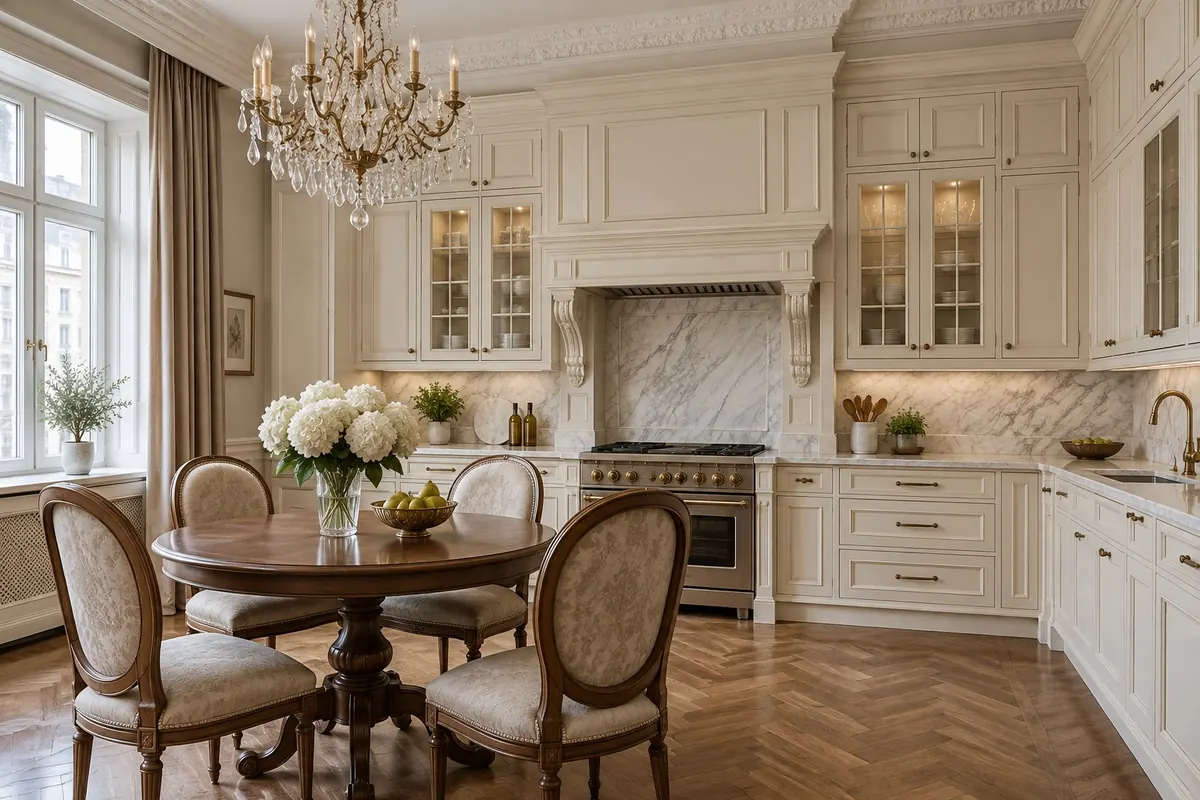
How to put this kitchen together in 65-100 sq ft with a standard 8.5 ft ceiling is covered in our article on a classic style kitchen.
Bedroom
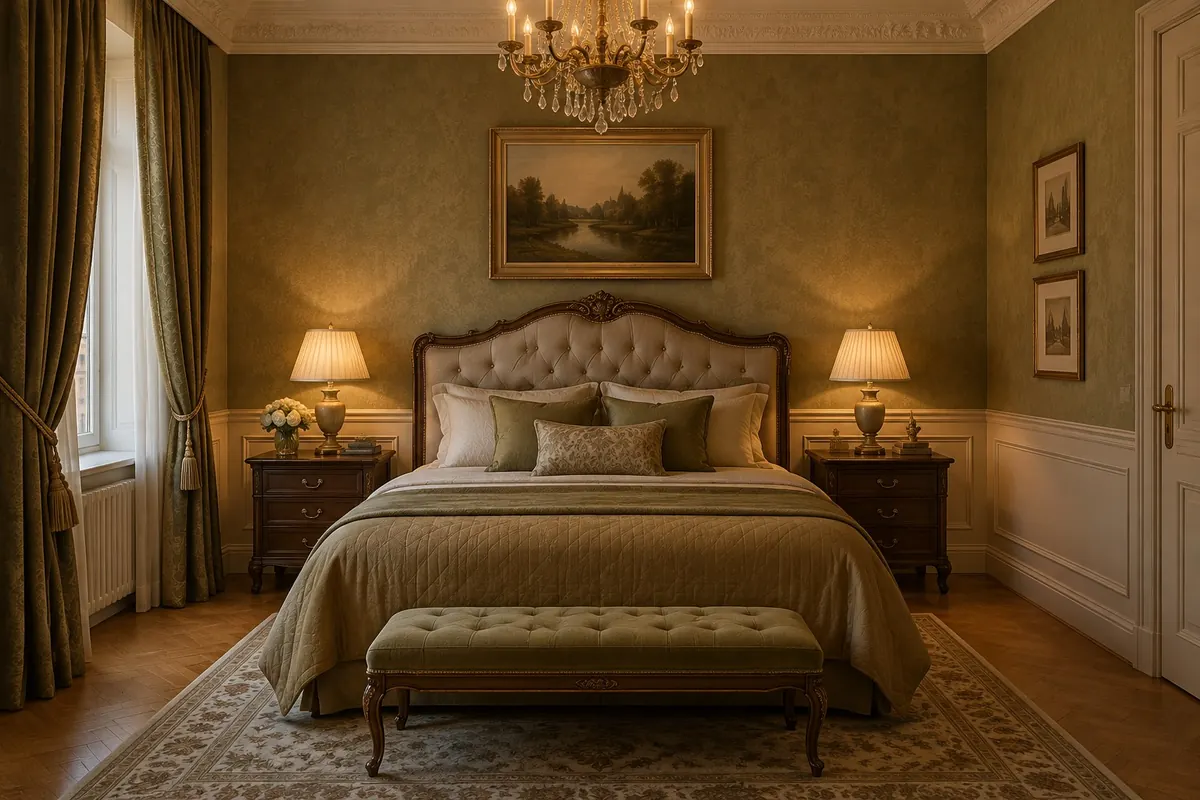
In the bedroom the bed is the axis, with a tall upholstered headboard in a carved frame. Matching nightstands with lamps stand on either side, and a painting in a gilded frame hangs above the bed. The wall is split into paneling below and wallpaper above, and the curtains are heavy, with tiebacks.
Common mistakes
- A cornice out of scale. An 8-inch profile under an 8.5 ft ceiling lowers the room, so the cornice size is chosen by wall height.
- Broken symmetry. A single armchair, a single sconce and an off-axis TV break the style faster than cheap laminate does.
- Mixed eras. Baroque, Empire and Victorian furniture in one room look like a furniture showroom. How Baroque differs from Rococo and Empire is covered in the article on Baroque style.
- Gloss and plastic. A glossy stretch ceiling and plastic windowsills clash with stone and wood.
- Bare walls. Classic style relies on wall relief, and a smooth wall with one painting reads as neoclassical.
How can you try classic style on your room before renovating?
Mistakes in classic style are expensive, because moldings, parquet and solid wood furniture are hard to redo. That is why it helps to see the style on a photo of your own room first.
- Take a photo of the room in daylight, hold the phone level, and get the floor, ceiling and window in the frame.
- Upload the photo to Desow Redesign and choose Classic. A version is usually ready in under a minute.
- Run the same room in Neoclassic, Art Deco and English country. That shows which style your ceiling height can carry.
One redesign version costs about 10 credits. The Free plan gives you free credits once at sign-up, enough for several versions. The image shows style and mood, and the molding dimensions are chosen later from measurements.
Frequently asked questions
Can you do a classic interior in an apartment with 2.7 m (9 ft) ceilings?
You can do strict classic style with deep moldings and crystal, but the room will feel heavy. Neoclassical style is a better fit: the same symmetry and frames, but slim profiles, a flush chandelier and simpler furniture.
What is the difference between classic and neoclassical style?
Classic style is formal: deep plaster moldings, carving, gilding, crystal and heavy fabrics. Neoclassical style takes only the order from it, meaning symmetry, wall frames and a light palette, and keeps the furniture and lighting modern.
What colors work for classic style?
The base is warm light shades: ivory, beige, sand and cream. Dark wood, burgundy, olive and navy in the fabrics add depth, and gold or bronze appear in the details.
Does classic style work with modern appliances and electronics?
It does, as long as you hide them. The TV is built into a panel or covered with a framed screen, kitchen appliances go behind cabinet fronts, and the air conditioner is boxed in under the cornice.
What is American classic style?
It is a lighter version of classic style from the American country house: symmetry and moldings stay, the furniture is simpler and more comfortable, the layout is open and the tones are light. In spirit it is closer to neoclassical than to strict classic.
Key takeaways
- Classic interior design is the order on the wall (dado, field, cornice), symmetry, plaster moldings, natural materials and heavy furniture.
- It needs ceilings of 3 m (10 ft) and rooms of 20 m² (215 sq ft) or more: Stalin-era buildings, old housing stock, business-class new builds.
- In a typical apartment with 8-9 ft ceilings, neoclassical style is the more honest choice.
- Build the palette with the rules from our article on color combinations, and browse other directions in our interior styles guide.
- Before ordering moldings, see classic style on a photo of your own room in Desow Redesign.