Baroque interior design: what to bring into an apartment with 2.7 m ceilings
Baroque interior design: key features and how it differs from Rococo, classic and Empire. What fits an apartment with 2.7 m ceilings and what to leave out.
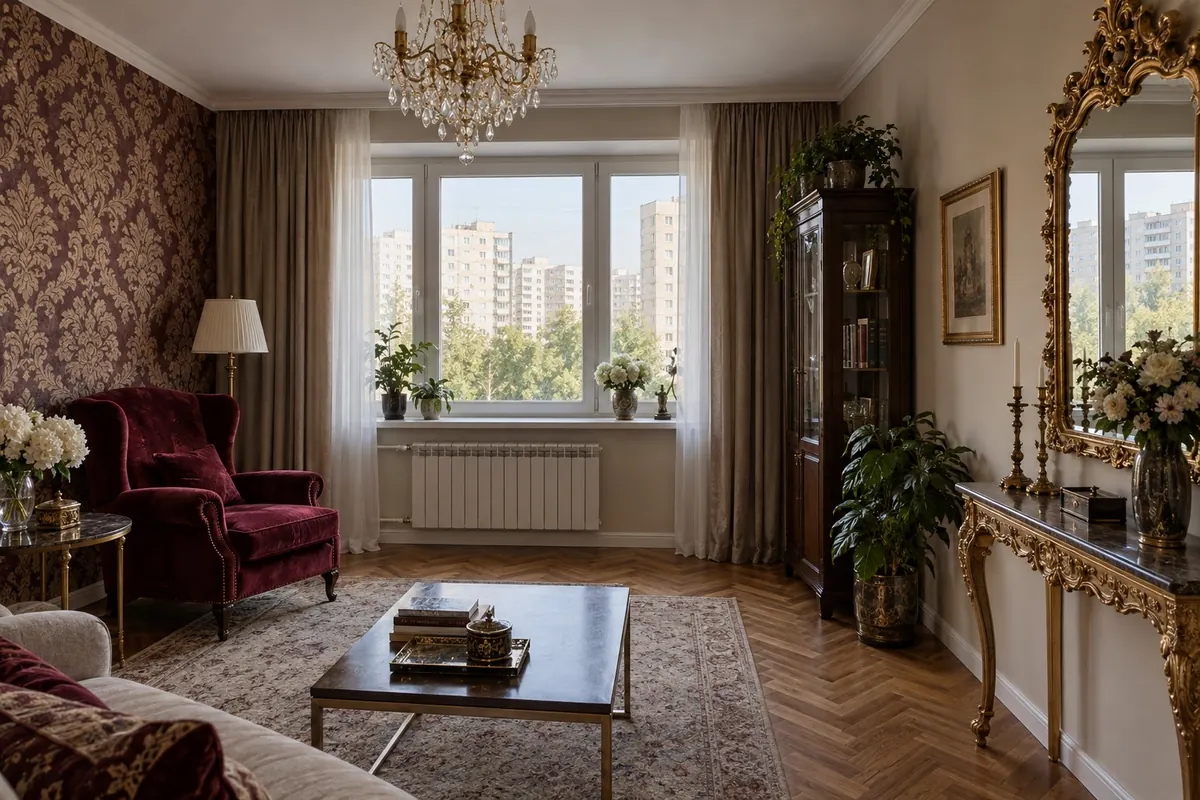
Baroque interior design is the palace luxury of the 17th and 18th centuries: curving lines, carving and gilding, mirrors in heavy frames, velvet and damask, and deep colors set against gold. The full style needs a hall with a high ceiling. In a typical apartment with 2.6-2.7 m (8.5-9 ft) ceilings, you borrow details from it: a mirror in a carved frame, one armchair with curved legs, velvet, and one damask wall. Plaster on the whole ceiling and a tiered chandelier belong in palaces.
Below we cover how to recognize Baroque, how it differs from Rococo, classic style and Empire, and how to build a Baroque-flavored room in an ordinary apartment building without turning it into a stage set.
What is Baroque interior design?
Baroque is the grand style of the 17th and 18th centuries, and Italy was its center. One theory traces the word to Portuguese: sailors and traders used "barroco" for a pearl of irregular shape. This theory is considered disputed, but the image fits, because Baroque loves an uneven, flowing outline. The late stage of the style became known as Rococo, which was later treated as a style of its own (Russian Wikipedia, "Baroque").
The most famous palace interior of the era is the Hall of Mirrors at Versailles, finished by 1685. The gallery is 73 m (about 240 ft) long and lit by seventeen tall arched windows, and arched mirrors on the opposite wall reflect the sunlight (Russian Wikipedia, "Hall of Mirrors"). The same trick works in an apartment: a mirror opposite a window or next to it adds daylight to the room.
How to recognize Baroque: five features
Curves instead of straight lines
Chair backs, console legs, mirror frames and headboards all curve. Volutes (scroll-shaped spirals), shells and acanthus leaves flow into one another, and there are almost no straight lines.
Gold on dark
Gilding sits next to deep colors: burgundy, emerald, dark blue, chocolate. The contrast between a dark background and shiny carving is what makes Baroque feel ceremonial.
Mirrors and light
Mirrors in carved frames, crystal drops, candles in bronze holders. Baroque plays with reflections and highlights, so a matte room without a single gleam does not read as Baroque.
Heavy fabrics
Velvet, jacquard, brocade, damask with a large pattern. Curtains fall to the floor in folds, and upholstery is dense, often with button tufting.
Carved furniture
Massive wardrobes and chests with bulging fronts, armchairs with gilded carving, tables with marble tops. Every piece is designed like a sculpture.
How does Baroque differ from Rococo, classic style and Empire?
People mix these four styles up because of the gilding and plasterwork. They differ in their lines and in what you can carry over into an ordinary apartment.
| Feature | Baroque | Rococo | Classic | Empire |
|---|---|---|---|---|
| Period | 17th to early 18th century | 18th century, late stage of Baroque | inspired by antiquity, the classical order | early 19th century, Napoleon's France |
| Line | curves, movement, contrast | light asymmetric scrolls | straight, symmetric around an axis | straight, strict, ceremonial |
| Ornament | acanthus, volutes, cartouches, large damask | rocaille shells, flowers, garlands | pilasters, cornices, molding frames | laurel wreaths, griffins, sphinxes, military symbols |
| Palette | gold with burgundy, emerald, blue | pastels: powder pink, pale blue, mint with white | ivory, beige, dark wood | red, green, blue with plenty of gold |
| Furniture | massive, carved, gilded | light, on thin curved legs | carved but with calm shapes | mahogany with bronze |
| What to take at 2.7 m | a mirror in a carved frame, velvet | one armchair or a dressing table | symmetry and slim frames | a bronze clock, candlesticks |
We cover classic style, its order and a four-question check for your room in our article on classic interior design. The French line, from the Baroque of Louis XIV to Provence, is the subject of our article on French interior style.
Can you do Baroque in an ordinary apartment?
Full palace-style Baroque, hardly. Interior designer Oksana Danilenko puts it plainly in RBC Real Estate: Baroque "implies a large space and majestic ceilings," and "a small room will not let it unfold." For a small apartment she advises against multi-level ceilings and suggests choosing one accent instead (RBC Real Estate).
With a 2.6-2.7 m ceiling and a room of 15-20 m² (160-215 sq ft), a different approach works: a calm background and two or three Baroque pieces. The eye catches the carved frame and the velvet, while the walls and ceiling do not press down.
What to take from Baroque
- A mirror in a carved gilded frame. It is the strongest Baroque piece and the safest one, because it adds light. Hang it over a console or a chest of drawers, opposite the window or next to it.
- One curved piece. An armchair with a carved back, a console on curved legs or a headboard. One is enough; two such pieces start to compete.
- Velvet and jacquard. Floor-length curtains, cushions, armchair upholstery in burgundy, emerald or dark blue. How to handle a deep color without overdoing it is covered in our article on burgundy in interiors.
- Damask on one wall. Wallpaper with a large pattern behind the bed or the sofa, with the other walls plain.
- Gold in small doses. A frame, candlesticks, the legs of a side table. When gold is everywhere, the room looks like a furniture factory showroom.
What to leave to palaces
- Plaster and painting across the whole ceiling. Under 2.7 m they make the ceiling feel lower.
- A tiered crystal chandelier on a chain. It hangs over your head and gets in the way.
- Valances and gathered pelmets over the window. They eat height and light.
- A "Versailles" furniture set with carving on every piece.
- A canopy over the bed in a bedroom of 10-12 m² (110-130 sq ft).
Baroque in the living room, bedroom and kitchen
Living room
A mirror over a console or an electric fireplace surround sets the axis of the room. The sofa can stay modern and simple, and the armchair next to it can be the Baroque piece. A patterned rug and heavy curtains pull the room together, and herringbone parquet or laminate in a medium tone suits the floor. How to arrange classic furniture in a 16-20 m² living room is covered in detail in our article on the classic living room.
Bedroom
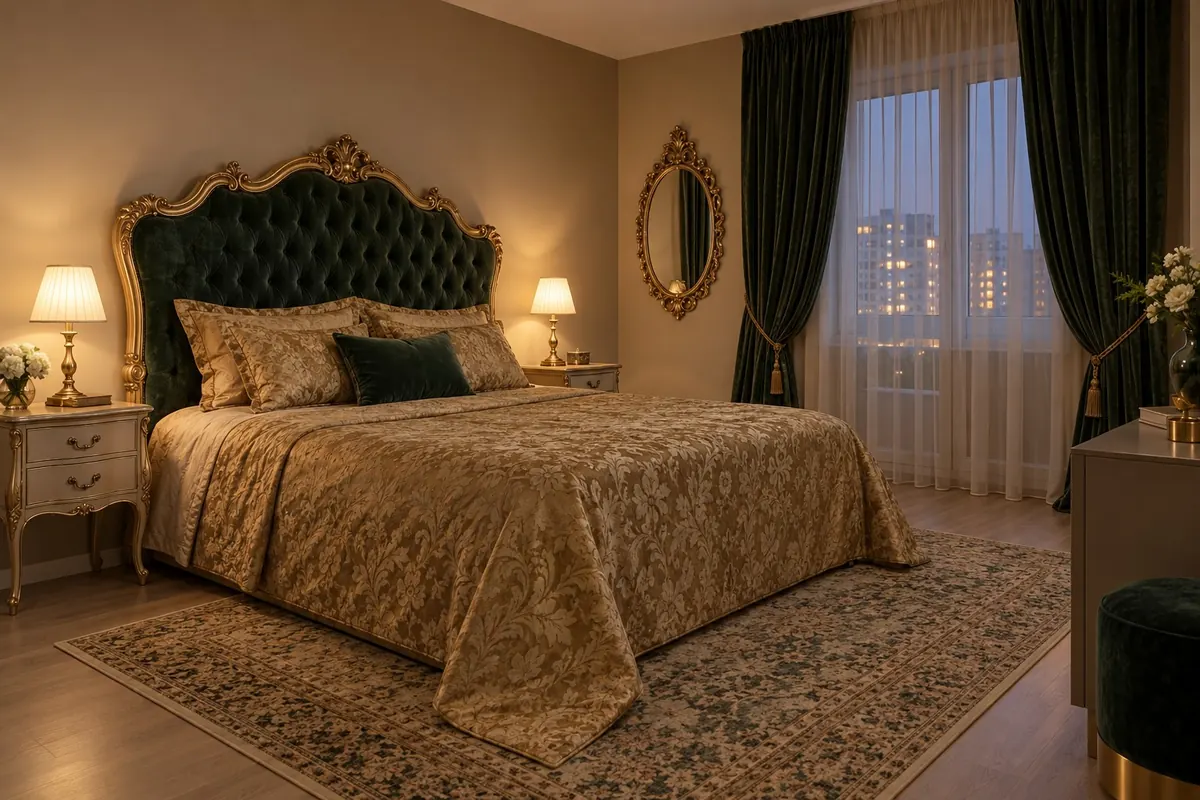
The bedroom suits Baroque best, because it has one obvious accent: the headboard. A tall upholstered headboard in a carved frame, a jacquard bedspread, matching nightstands with lamps, and an oval mirror in a gilded frame on the side wall. A built-in wardrobe painted the color of the walls will not compete with the bed.
Kitchen
The kitchen is the hardest room: carving collects grease, and gilding does not handle steam well. Keep Baroque to details here: raised-panel fronts, bronze-look handles, a candle-style chandelier over the table, chairs with velvet seats.
Mistakes that give away "budget Baroque"
- Cheap foam moldings painted gold. Up close you see the seams, and Baroque is meant to be looked at up close.
- A glossy stretch ceiling next to carving and velvet.
- Everything from one "Baroque" collection: wallpaper, curtains, furniture and chandelier.
- Gold next to chrome. Keep the metals in one warm range: brass, bronze, gold.
- Dark walls without enough light. A deep background needs several light sources, otherwise the room sinks.
How to try Baroque on a photo of your room?
Desow Redesign has no separate "Baroque" style. The closest option is Classic. They share symmetry, plasterwork, a crystal chandelier, gilded frames, dark wood and patterned fabrics. The difference is visible too: Classic is stricter, with straight lines and a calm palette, while Baroque relies on curves and on deep color set against gold.
Here is the order:
- Upload a photo of your room to Redesign and choose Classic. A version is usually ready in under a minute and costs 10 credits.
- If your ceiling is 2.6-2.7 m, run the same room in Neoclassic: it shows the background without heavy plaster. More on it in our article on neoclassical interior design.
- If you want velvet, dark walls and paintings in heavy frames, try Manor from our guide to rare interior styles.
- Add the Baroque detail with Smart Edit: select the mirror or the armchair and describe the replacement, for example "a mirror in a carved gilded frame". An edit costs 7 credits and works in a desktop browser.
The Free plan gives you free credits once at sign-up, enough for several versions. The image shows the mood and the combinations, and the actual sizes of frames and furniture are chosen later from measurements.
Frequently asked questions
How is Baroque different from Rococo?
Rococo grew out of late Baroque and became lighter. Baroque is ceremonial and massive, with dark colors set against gold. Rococo is intimate: pastel colors, small asymmetric shell-like scrolls, delicate furniture on thin legs.
What is Elizabethan Baroque?
It is the Russian branch of the style from the reign of Empress Elizabeth, 1741-1761. Its leading architect was Bartolomeo Francesco Rastrelli, who designed the Winter Palace and the Great Palace at Tsarskoye Selo. Its interiors have enfilades, gilding, and mirrors used as "false windows" (Russian Wikipedia).
What colors and wallpaper suit Baroque?
The background is ivory, warm beige or one deep color: burgundy, emerald, dark blue. Gold goes in as an accent. Damask wallpaper goes on one wall, and a large pattern looks better on a matte background without shine.
Does Desow have a Baroque style?
There is no separate style. The closest is Classic: symmetry, plasterwork, crystal and gilding. You can add Baroque details such as a carved mirror or a velvet armchair afterwards with Smart Edit.
In short
- Baroque is a 17th and 18th century style: curves, carving, gilding, mirrors, velvet and deep color against gold.
- The full style needs high ceilings and large rooms. In an apartment with 2.7 m ceilings, take the details: a carved mirror, one curved piece, velvet, damask on one wall.
- Baroque differs from Rococo in its mass and contrast, from classic style in its curves instead of straight lines, and from Empire in its fluid shapes: Empire has strict straight lines and military symbols.
- Other styles are collected in our guide to interior styles.
- Before you buy furniture, try Classic, the closest style to Baroque, on a photo of your room in Desow Redesign.