French style interior: a Parisian apartment in an ordinary building
French style interior for apartments: Parisian moldings, herringbone floors and a fireplace with 8.5 ft ceilings, how it differs from Provence and neoclassical.
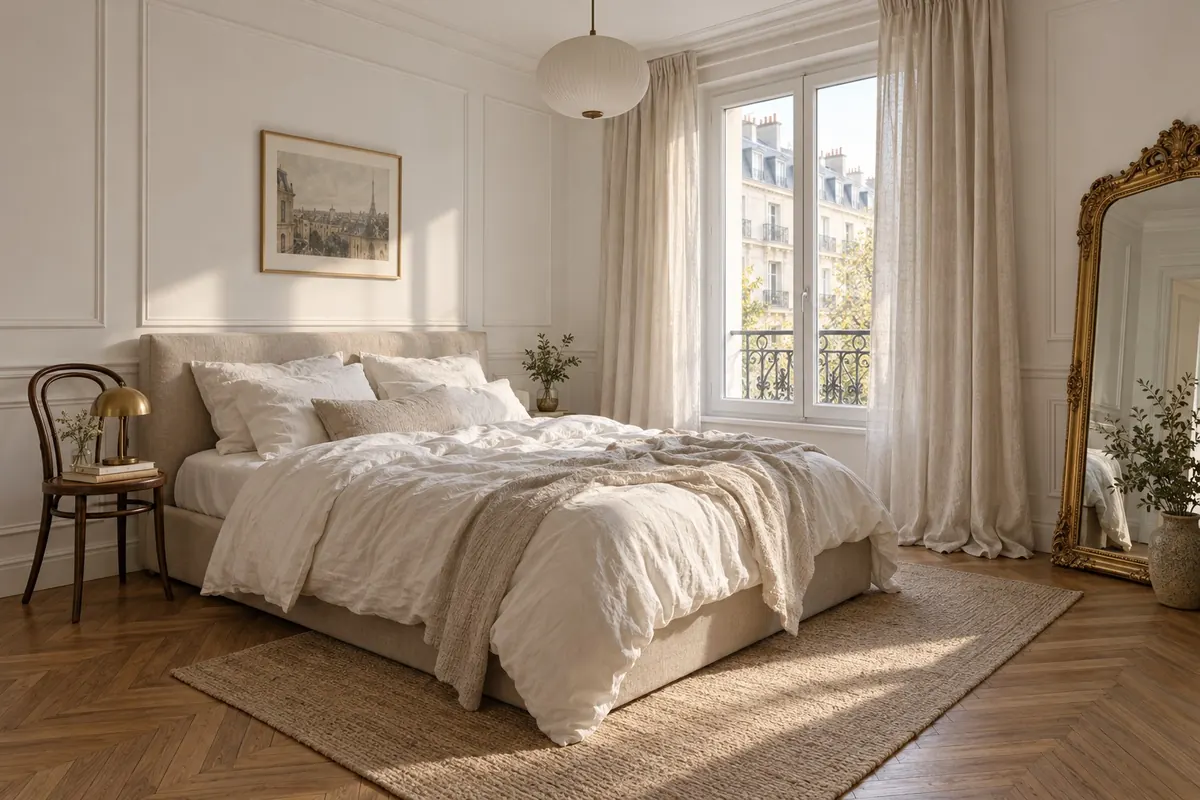
French style in interiors usually means Parisian style, also called Parisienne. It is white walls with thin molding, herringbone parquet, a marble fireplace with a mirror above it, and old pieces next to modern ones. Rural French style is Provence, and it has its own article. In an apartment with 2.6-2.7 m (about 8.5-8.9 ft) ceilings, a Parisian interior comes together from three or four details. It doesn't need molding on every wall.
Search results for this query are almost all 19th-century apartments: ceilings over three meters, floor-to-ceiling windows, wrought-iron balconies. Below is what carries over from a Parisian apartment to an ordinary one and what is better left in photos. The rest is about the Parisian version; the rural one has its own article. At the end: which style to try instead of French in Desow, since Desow has no French style.
Where did Parisian style come from?
Postcard Paris largely took shape under Georges-Eugène Haussmann. From 1853 to 1870 he was prefect of the Seine department and rebuilt the city under Napoleon III. According to Russian Wikipedia, about 60% of the medieval buildings were torn down and 150 km of streets were laid out under him. Apartment buildings of pale stone went up along the new boulevards, which is why these buildings and apartments are called Haussmannian.
The apartments in these buildings have molding, fireplaces, parquet and tall windows. The style itself grew out of how people live in them today: an ordinary sofa goes into the old room, a modern painting hangs next to a gilded frame, the floor lamp cord runs across the floor. Old finishes and new things together give the slight carelessness that people love Parisian interiors for.
How to recognize French style and recreate it in an ordinary apartment
A Parisian apartment is recognized by a set of details. Each one shows up in other styles too; the combination is what makes it recognizable.
| Feature | In a Parisian apartment | With 2.6-2.7 m (8.5-8.9 ft) ceilings |
|---|---|---|
| Walls | white, with molded panels | thin moldings painted the wall color, on one or two walls |
| Floor | oak herringbone parquet | engineered wood or LVP in a herringbone pattern |
| Fireplace | marble mantel with a large mirror above | a decorative mantel or a dresser with a framed mirror |
| Windows | tall, floor-length, with a railing | curtain rod right under the ceiling, floor-length curtains wider than the opening |
| Furniture | antiques next to modern pieces | one or two old pieces per room |
| Lighting | chandelier, floor lamps, table lamps | a flush chandelier and two or three lamps in the corners |
The palette is calm: warm white, milky white, gray, black in metal and frames, brass. Color comes with objects: an olive velvet pillow, an old rug, book spines.
How is French style different from Provence, neoclassical and classic?
All four styles are light, and all of them like wood and molding, so people mix them up. They differ in where they came from and how they treat old things.
| Feature | Parisian | Provence | Neoclassical | Classic |
|---|---|---|---|---|
| Origin | a 19th-century city apartment | a country house in southern France | classic style simplified for today | palaces and mansions |
| Old things | mixed with new, signs of real life | painted furniture with patina | new furniture in calm shapes | a matching set in one style |
| Symmetry | broken freely | doesn't matter | kept | strict |
| Floor | herringbone | light planks, terracotta | herringbone or planks | parquet, marble |
| How it feels | effortless and expensive | sunny and homey | neat and quiet | formal |
Rural France with linen, lavender and worn dressers is covered in the article on Provence style. The closest style to Paris is neoclassical: they share moldings and herringbone. The difference is that neoclassical looks like a newly renovated apartment, while a Parisian one looks like a home where the third generation now lives. Classic style is heavier than both: carved furniture, crystal, strict symmetry.
How do you create a Parisian apartment in an ordinary building?
Start with the shell: walls, floor, windows. Furniture and decor are easier to pick after that.
Walls and moldings
Choose moldings with a thin profile and paint them the wall color, so the relief shows through shadow. Panels are enough on the wall behind the sofa and on the "fireplace" wall. Tall vertical panels make the ceiling look higher; wide horizontal ones make it look lower. The other rules for a low room are covered in the article on neoclassical style. A Parisian look tolerates imperfection: if you like, panels in different rooms can be slightly different sizes, so the apartment looks less like a standard project.
Herringbone floor
Herringbone comes in English and French versions. English herringbone has square-cut plank ends, and the pattern steps. French herringbone (chevron) has ends cut at 45° or 60°, and the joints form continuous lines across the room. French is harder and more expensive. According to the Anticwood parquet workshop, it needs a 15-20% material allowance versus 10-12% for English, and at the workshop's rates installation costs 3,000-4,500 rubles per m² versus 2,500-3,500, materials not included. For a small room, English herringbone is the simpler and cheaper option with the same Parisian mood.
A fireplace without a fireplace
In a Parisian living room, everything gathers around the fireplace. In an apartment, a decorative mantel against the wall plays that role, with candles or an electric fireplace inside. Above the mantel goes a large mirror in an old frame, and on the shelf a couple of candlesticks and books. If there is no room for a mantel, a low dresser with a mirror above it gives the same effect.
Old and new
One old piece per room is enough: a bentwood chair, a flea-market dresser, a mirror frame, your grandmother's floor lamp. The rest of the furniture can be simple and modern: a plain linen sofa, a round table, a bookshelf. The plainer the background, the more the old piece stands out. The kitchen works the same way: plain white cabinet fronts, a marble-look countertop or backsplash, and an old hutch or a pair of bentwood chairs.
The budget depends on how much of the old stays. According to T-Zh, a basic finishing renovation in this style with molding, painting and new flooring starts at 10,000 rubles per square meter. The price depends heavily on the city and materials.
Which mistakes turn Paris into a "palace"?
- Gold everywhere. A gilded mirror frame looks good when it is the only one. Gilding on the chandelier, handles and table legs makes the room look like a banquet hall.
- Molding on every wall and the ceiling. With a 2.6 m (8.5 ft) ceiling, a ceiling medallion, a wide cornice and panels on all walls feel heavy. One or two walls are enough.
- A matching set from one store. A sofa, armchairs and table from one collection kill the mix of eras the style depends on.
- Heavy curtains with valances. A Parisian window has floor-length linen or thin cotton, without tassels or tiebacks.
- Gloss. A glossy stretch ceiling and lacquered plastic clash with old wood and stone. A matte white ceiling works better.
Check the room with a simple question: can you tell someone lives here? If everything is new and arranged in strict pairs, you have neoclassical. To look Parisian, it needs a couple of old pieces and a bit of mess.
How do you try French style on a photo of your room?
Desow Redesign has no French style. The closest is Neoclassical: light walls with moldings, a calm palette, often a herringbone floor. In other words, it gives you the Parisian shell. What it won't have: old pieces, carelessness and a mix of eras; everything looks new and tidy. So treat the Neoclassical version as a base you will later add your own finds to.
- Photograph the room in daylight from chest height, so the window, the floor and two walls are in the frame.
- Make a Neoclassical version in Desow Redesign. One version costs 10 credits and is usually ready in under a minute.
- For comparison, run Classic and Eclectic. Classic shows where Paris ends and the "palace" begins. Eclectic is closer to the Parisian mix of old and new, but it has more color.
- Pick a base and write down its wall color, floor pattern and panel size. Add the old piece in real life.
The Free plan gives you free credits once at sign-up, enough for several versions.
Frequently asked questions
What is French interior style called?
The urban French style is called Parisienne, Parisian or Haussmannian, after the prefect who rebuilt Paris in 1853-1870. Rural French style is Provence. When people say "French chic," they usually mean the Parisian version.
Does French style work in a small apartment?
Yes, if you don't take everything at once. White walls, a herringbone floor, a framed mirror and one old piece work in a one-bedroom apartment too. In a small room, a fireplace mantel takes space better used for storage, so a dresser with a mirror is a better substitute there.
Can you create a French interior without renovating?
Partly. Without renovating you can change curtains, lighting, the mirror, textiles and one or two pieces with history. Moldings are glued onto a finished wall and painted with it, which is a small job. A herringbone floor can't be done without renovating.
What colors suit French style?
The base is warm white or milky white, with gray, black and brass on top. Accents are muted: olive, navy, terracotta, dusty rose. Bright saturated walls are not typical of a Parisian interior.
Summary
- French style in interiors usually means Parisian: white walls with moldings, herringbone, a fireplace with a mirror, old pieces next to new ones.
- Rural French is Provence, with a different palette and furniture.
- A mix of eras and signs of real life set Parisian style apart from neoclassical; the absence of formality sets it apart from classic.
- With 2.6-2.7 m (8.5-8.9 ft) ceilings, moldings on one or two walls, one old piece and floor-length curtains are enough.
- Desow has no French style: try it on a photo of your room with Neoclassical as the base and compare it with Classic and Eclectic. Other directions are in the interior style guide.