Modern living room: the sofa, the TV wall, storage, lighting and curtains in a 170-215 sq ft room
A modern living room in a typical apartment: which sofa, what replaces the wall unit, hiding TV cables in a panel building, lighting, curtains, a photo try-on.
A modern living room comes down to five decisions: a low sofa with a simple shape in a warm neutral fabric, a floor-to-ceiling storage wall instead of a wall unit, a wall-mounted TV with no visible cables, a flat matte ceiling with light from several sources, and a clear floor. In a typical 16-20 m² (170-215 sq ft) living room you can do this without moving walls, and most of the work goes into the TV wall.
What modern style is, how it differs from minimalism and neoclassical, and which palettes it uses, we covered in our article on modern interior style. The general order of decisions for any living room, from the focal point to three layers of light, is in our article on living room design. This one is only about this room in this style: the sofa, the wall unit and the TV wall, lighting, curtains and mistakes.
What do people mean by a "modern living room," and how is it different from Scandi?
In November 2026, the top Yandex results for this search were almost all photo galleries, and they kept showing the same room: a low sofa in boucle or basket-weave fabric, floor-to-ceiling cabinets painted the wall color, walnut or oak veneer, a travertine-look coffee table, thin black lines of light fixtures. This is soft modern style, somewhere between minimalism and Scandi.
A Scandinavian living room has light wood, a paper shade, posters and plants. In a modern one the wood is darker and there's less of it, a track replaces the shade, and there's hardly any decor. Warmth sets it apart from minimalism: textured fabrics and a couple of things on display don't break the style.
In the kitchen, the same style rests on the cabinet fronts and the countertop (modern kitchen); in the bedroom, on the headboard and the wardrobe (modern bedroom). In the living room the main thing is the TV wall: it's the largest surface and the first thing you see from the door.
| Living room element | The modern way | What to avoid |
|---|---|---|
| Sofa | Low, straight or modular, greige basket weave, boucle, chenille | Carved arms, glossy faux leather, busy upholstery |
| Coffee table | Round or oval, stone, veneer, matte metal | Glass with chrome, a convertible table with drawers |
| Storage | Floor-to-ceiling cabinets in the wall color, handleless or with slim pulls | A wall unit with glass display cases and top cabinets |
| TV wall | TV on the wall, a floating veneer console, a lit niche | Cables down the wall, a screen on a tall stand |
| Ceiling and general light | A flat matte ceiling, surface-mounted track or spotlights | Multi-level drywall, a glossy stretch ceiling |
| Task light | A floor lamp by the sofa, a line of light in the niche | One ceiling fixture for the whole room |
| Curtains | Straight, solid-color, ceiling to floor | Valances, tiebacks, sheen |
| Rug | Solid or with a barely visible pattern, under the sofa's front legs | A small rug in the middle of the room |
| Decor | Two or three large pieces: a painting, ceramics, a plant | Small things on every shelf |
What kind of wall unit suits a modern living room?
Instead of a wall unit with a china cabinet and top cabinets, you get a storage wall: floor-to-ceiling cabinets with flat fronts and a niche for the TV. Fronts painted the wall color make the cabinets nearly disappear. Fronts in a single veneer do the opposite and turn the wall into the room's main warm accent.
Modular or built-in?
A modular wall unit from a store goes up in a day and moves with you, but it leaves a strip up to the ceiling, and the wall looks chopped up. A built-in is made to measure and covers the whole wall. If the budget only covers modules, buy the tallest ones and close the gap at the top with a filler strip in the wall color.
How many open shelves
It's better to have more closed storage than open. A handy guideline is two-thirds fronts and one-third shelves. Books don't need deep shelves. Russia's standard for storage furniture, GOST 13025.1-85, gives 180-390 mm (7-15 in) between book shelves and a compartment depth of 140-440 mm (5.5-17 in) (GOST 13025.1-85, Table 2, in Russian). In practice, ordinary books fit on a shelf 25-30 cm (10-12 in) deep, and on a deeper one a second row of stuff soon appears in front of them.
What to do with an old wall unit and how deep clothes cabinets need to be is covered in the table of options in our article on living room design.
How do you make a TV wall in a modern living room?
Mount the TV on the wall and hide the cables. A screen on a tall stand with cords running to the outlet in plain view makes the wall look like a living room from the 2000s.
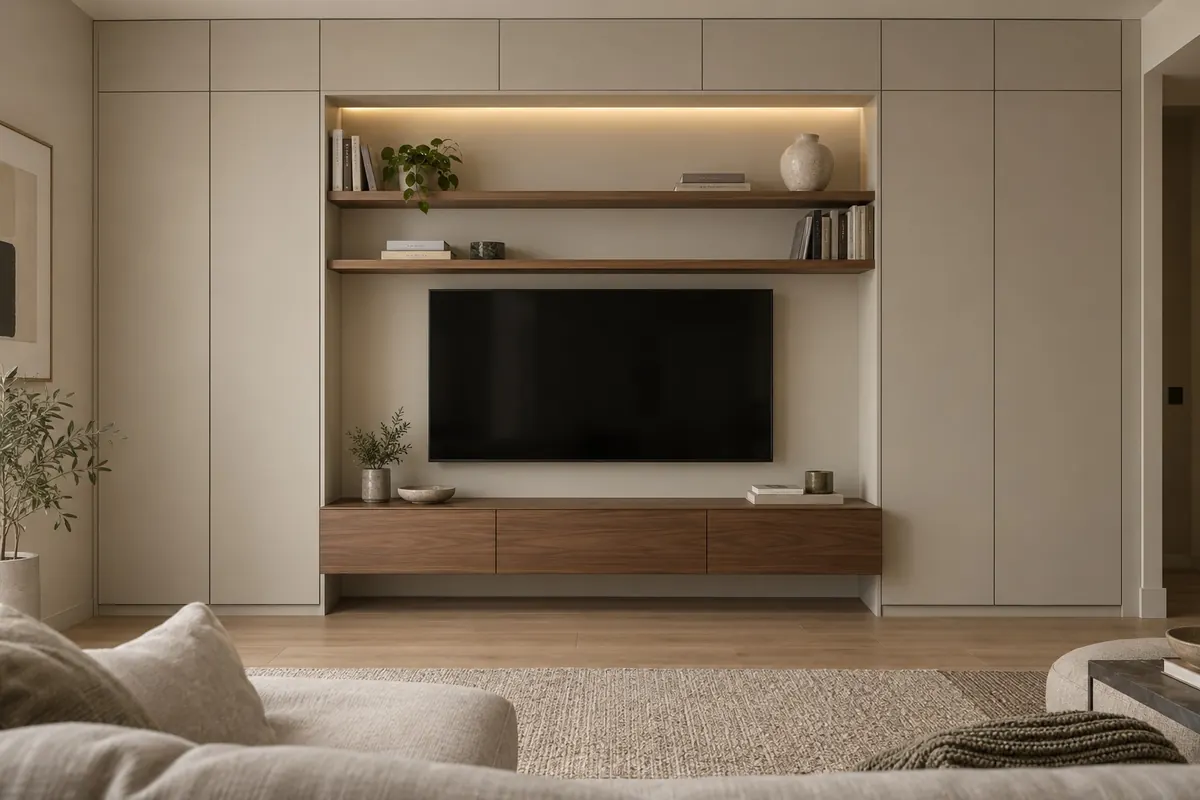
Cables in a panel building
In a precast panel building you usually can't just bury a cable in the wall. In Moscow, the rules for apartment alterations prohibit cutting channels "in horizontal joints and under interior wall panels, as well as in wall panels and floor slabs for electrical wiring" in standard-series buildings (Resolution 508-PP, Appendix 1, clause 9.11, in Russian). Other cities have their own rules, but cutting into a load-bearing panel without an engineering design is risky anywhere.
So the cables go elsewhere:
- Behind a floating console. The screen hangs low, the cables drop behind the console, and the outlet and router hide inside it.
- Inside a cabinet niche. A cable raceway runs along the back of the cabinet where no one sees it.
- In a raceway painted the wall color. A flat channel painted along with the wall is less noticeable than you'd think.
- Behind a furred-out wall. Drywall on metal studs takes a few centimeters (an inch or two) off the room, but it hides both the cables and the lighting.
Where to hang the screen
The window works best to the side of the screen. Designers usually hang the center of the screen at the eye level of a seated person, typically 110-130 cm (43-51 in) off the floor. The distance from the sofa depends on the screen size; the numbers are in our article on arranging furniture. Put a warm LED strip in the niche: in the evening it lights the wall behind the screen, so the bright screen doesn't hang against a dark background.
Which sofa, lighting and curtains should you choose?
Sofa
The sofa is low, with a straight back or made of modules. The fabric matters more than the color: basket weave, chenille or boucle with a visible texture, in greige, warm gray or cream. If you have a cat or a dog, look at dense short-pile fabrics such as microvelvet, and at removable covers: boucle and loose basket weaves snag on claws and collect pet hair.
In a 16-18 m² (170-195 sq ft) room, a straight three-seater or a modular sofa that can be split between two walls is easier to live with. A sectional works when it and the path to the window both fit along the wall. Nine layouts for square, long and walk-through living rooms are in our article on an 18-20 m² living room.
Lighting
The ceiling stays flat and matte. With ceilings of 2.6-2.7 m (8.5-8.9 ft), the track is usually surface-mounted: a recessed one goes into a stretch ceiling or drywall, and that lowers the ceiling. The track lights the storage wall and the painting, a floor lamp stands by the sofa, and an LED strip glows in the niche. In the evening, the floor lamp and the strip are enough.
Curtains
Curtains are straight and solid-color: linen, cotton-poly, heavy voile. Mount the rod on the ceiling and hem the panels to the floor, and the room looks taller. If the sun glares on the screen during the day, add roller shades in the wall color to the window sashes.
A light modern living room: how to avoid the office look
White walls, white cabinets and a gray sofa together look like an office. Choose a warm white: cream, ivory, light greige. How white changes under different light is covered in our article on white in interiors. Add one mid-tone wood, such as walnut veneer on the console, and texture in the fabrics: a wool rug, linen, boucle. Keep the accent color in pillows and a throw. Olive, terracotta or muted blue look calm against a warm neutral.
Common mistakes
- A glossy white wall unit. Gloss reflects the window and the screen, and lit display cases send the room back to the 2000s.
- Furniture around the edges. The middle of the room ends up empty. Gather the sofa, armchair and coffee table on one rug.
- Three different "wood looks." Laminate, console and coffee table in different shades clash.
- A multi-level ceiling at 2.6 m (8.5 ft). Each level costs height, and perimeter lighting gives away an old renovation.
How do you try a modern style on a photo of your living room?
Desow's Redesign doesn't have a separate "Modern" style right now; the closest ones are Japandi and Minimalism. Japandi gives you the same warm neutrals, low furniture, boucle and wood, only with less black metal and more natural textures. Minimalism shares the flat storage wall but is stricter: almost nothing stays on display. More on each in our articles on Japandi and on minimalism.
- Take a photo of the living room in daylight from a corner, so the window, the floor and the future TV wall are in the frame. How to shoot without distortion is covered in our article on photographing a room.
- Upload the photo to Redesign, choose the "living room" room type and the "Japandi" style. One version costs 10 credits and is usually ready in under a minute.
- Make a "Minimalism" version of the same photo. If you like the warmth of Japandi and the order of minimalism, your modern style lies somewhere between them.
- Swap one item. You can change the sofa or the console in the image with Smart Edit. It works in a desktop browser.
The Free plan gives you free credits once at sign-up, enough for several Redesign versions. The images in this article are AI-generated examples, not photos of real apartments.
Frequently asked questions
Which sofa suits a modern living room: straight or a sectional?
In a 16-18 m² (170-195 sq ft) living room, a straight three-seater or a modular sofa is easier to live with. A sectional works if it doesn't block the path to the window. Choose textured upholstery: basket weave, chenille, boucle.
Can you keep an old wall unit in a modern living room?
Usually not the whole thing: display cases, top cabinets and dark lacquer clash with the style. A sturdy veneer section can stay on its own and be painted the wall color. Replacement options are in our article on living room design.
What wallpaper works in a modern living room?
Solid colors with a subtle texture, or paintable non-woven wallpaper. Large patterns and sheen don't go with the style. If you want a feature wall, make it the TV wall, with texture or color.
How do you design a modern kitchen-living room?
Tie the zones together with one floor, one palette and one wood: kitchen cabinets in the wall color, the TV console and the dining table in the same veneer. Layouts and range hoods for a shared room are covered in our article on kitchen-living rooms.
In short
- A modern living room means a low sofa with textured upholstery, a floor-to-ceiling storage wall, a wall-mounted TV, a flat ceiling and light from several sources.
- Cabinets in the wall color with a TV niche replace the wall unit, with about two-thirds closed storage.
- In a panel building, TV cables run behind the console, inside a cabinet, in a raceway or behind a furred-out wall: in Moscow, cutting channels in panels is prohibited.
- A light living room stays warm with warm white, one mid-tone wood and textured fabrics.
- Desow has no "Modern" style. The closest are Japandi and Minimalism: try both on a photo of your living room.