Japandi interior design: how to bring the style into a standard apartment with a low ceiling
Japandi in a standard apartment: how it differs from minimalism and wabi-sabi, which materials and colors to use, and tips for a low ceiling and small window.
Japandi is an interior style that combines Japanese restraint with Scandinavian coziness: low wooden furniture, warm light walls, linen, ceramics, and almost empty surfaces. It works well in a standard apartment because it doesn't need high ceilings or big windows. Low furniture brings the eye line down, so a ceiling of 2.5-2.7 m (8.2-8.9 ft) feels taller. The trouble is in the details: dark beams, heavy drapes, and one more beige object quickly turn Japandi into a dull room.
Photo roundups usually show Japandi in houses with ceilings close to three meters and floor-to-ceiling windows. A regular apartment raises different questions: where Japandi ends and minimalism or wabi-sabi begins, which materials and colors to choose, and what to do with an 8-foot ceiling and a single window.
What is Japandi interior design?
Japandi (Japan + Scandi) takes Japan's love of empty space, natural texture, and handmade objects, and Scandinavia's light wood, soft textiles, and comfort.
You can spot the style by a few signs:
- Low furniture. A platform bed or a bed on short legs, a deep-seated sofa, a coffee table lower than usual.
- Two wood tones. Light oak or ash as the base, dark walnut or stained oak as accents.
- A warm light base. Milky white, oatmeal, sand, warm gray. Very little pure white or cool gray.
- Natural fabrics. Linen, cotton, wool, chunky weaves.
- Few objects, each with character. A handmade vase, a branch in a jug, one print on the wall.
- Closed storage. Smooth cabinet fronts, floor-to-ceiling wardrobes, nothing extra on display.
Where does Japandi end and minimalism, wabi-sabi, and Scandinavian style begin?
Japandi has three close neighbors, and it's easy to push the style too far toward any of them. The table shows which way you're drifting.
| Feature | Japandi | Minimalism | Wabi-sabi | Scandinavian |
|---|---|---|---|---|
| Palette | milky white, oatmeal, clay, dark accents | white, gray, graphite | earthy, muted, uneven | white, light gray, pastels |
| Wood | light oak plus dark walnut | little, or one light tone | old, roughly finished | light pine, birch |
| Furniture | low, simple shapes, solid wood | geometric, smooth surfaces | rough, vintage, imperfect | light, on slim legs |
| Decor | 2-3 handmade pieces | almost none | chipped ceramics, dried flowers, patina | lots of textiles, candles, plants |
| Imperfection | texture is fine | avoided | the style is built on it | no special role |
| Risk in a standard apartment | the room looks dull | the room looks like an office | it looks like an unfinished renovation | the room fills up with clutter |
Take the dark wood and ceramics out of Japandi and you get minimalism. Add uneven plaster, old things, and dried flowers and you move into wabi-sabi. Light pine, a bright throw, and a dozen candles give you Scandinavian style.
Wabi-sabi originally describes a Japanese view of beauty: "wabi" means simplicity and modesty, "sabi" means the mark that time leaves on things. Japandi borrows its tolerance for texture, but the objects stay neat and new.
What materials and colors does Japandi need?
Wood, linen, and stone are the base of Japandi, and the color is almost always warm and muted.
Wood. A light oak floor or matte laminate that looks like it. Keep dark walnut for one or two pieces: a nightstand, a table, a mirror frame. When all the wood is one tone, the room looks flat.
Walls. Matte paint in milky white or sand, limewash, microcement. Gloss works against the style.
Textiles. Linen curtains and bedding, a wool rug with a chunky texture, a coarse-knit throw.
Lighting. A rice paper or rattan shade, a floor lamp, wall sconces. Bulbs at 2700-3000 K give warm light that keeps the wood from looking gray.
Accent colors. Sage, olive, clay, terracotta, graphite. One or two per room, in textiles or ceramics. We covered how to pair warm neutrals with wood in the article about color combinations in interior design.
How do you do Japandi in a standard apartment?
Most apartments in Russia have ceilings of 2.5-2.7 m (8.2-8.9 ft) and one normal-size window. The Russian building code SP 54.13330.2022 requires a floor-to-ceiling height of at least 2.5 m in living rooms and kitchens, and at least 2.7 m in several climate subzones (clause 5.12 of SP 54.13330.2022, in Russian). In Khrushchyovkas, the Soviet five-story buildings of the 1960s, ceilings can be even lower: 2.25 to 2.67 m, according to the real estate magazine Metr Kvadratny (in Russian).
What should you do with a low ceiling?
A low ceiling doesn't get in Japandi's way, as long as you don't bring in tricks from country houses.
- Keep the ceiling light. The same shade as the walls or one tone lighter. Wooden beams and slats on a 2.5 m ceiling make it feel even lower.
- Put slats on the wall, up to the ceiling. Vertical lines pull the eye upward. A slat panel behind the headboard or the TV works better than one on the ceiling.
- Hang curtains from the ceiling itself. A hidden ceiling track and floor-length linen add height.
- Keep furniture low. The lower the sofa and bed, the more open wall above them.
- Use a pendant light only over the table. In a walkway it ends up at head height. Elsewhere, a flush ceiling shade, sconces, or a floor lamp work better.
- Build wardrobes up to the ceiling. Smooth fronts in the wall color almost disappear.
The easiest way to see how the style works with your ceiling height is on a photo. Redesign keeps the geometry of your room and changes the finishes, furniture, and lighting: upload a photo and choose the Japandi style. The result is usually ready in less than a minute.
What should you do with a small window?
A small window mostly needs you not to block it: keep both the window and the path of its light clear.
- Leave the windowsill empty. One branch in a vase at most.
- Choose light linen or sheer curtains. You only need heavy ones in the bedroom if you want blackout, and during the day they slide past the edge of the window.
- Hang a mirror on the wall next to the window. From there it spreads light around the room.
- Light the room on three levels. The ceiling, a floor lamp or sconce at eye level, and a lamp on a nightstand or shelf.
Japandi in an apartment, room by room
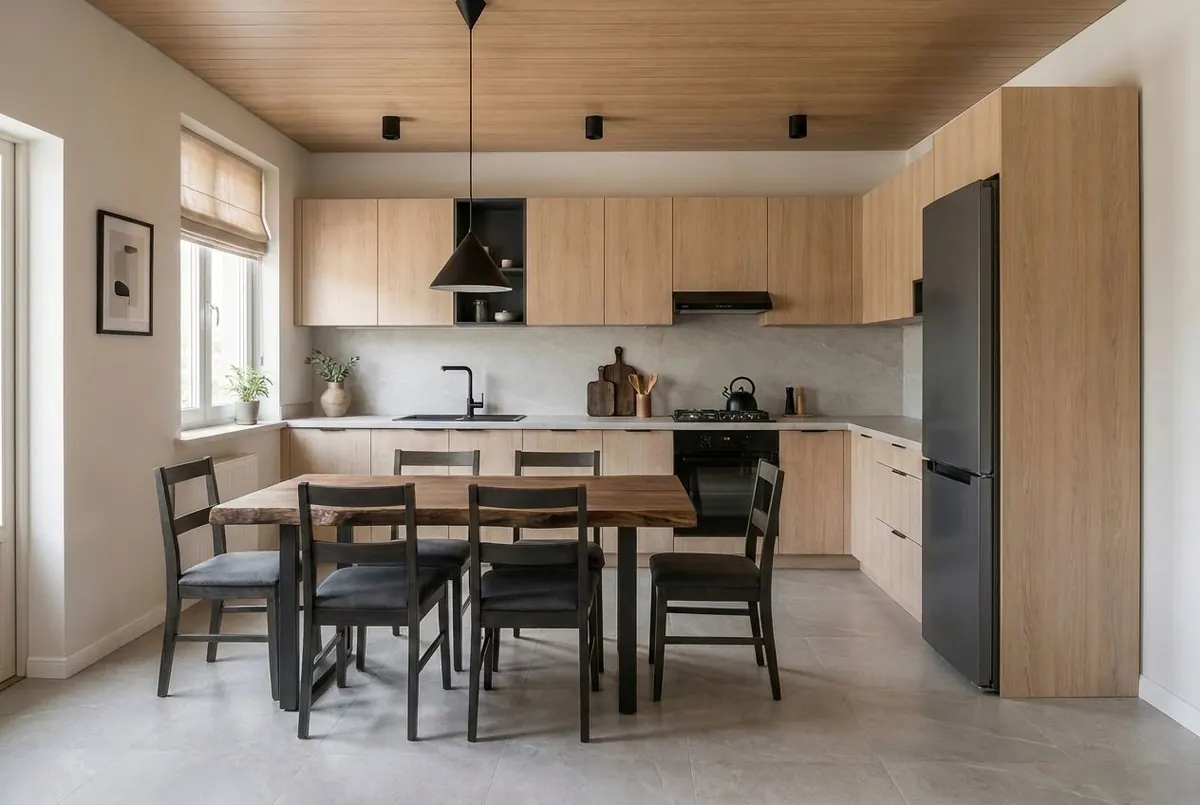
Japandi kitchen
In the kitchen, Japandi depends on the cabinet fronts. Smooth light-oak fronts, a stone- or concrete-look countertop, a black faucet, and one open shelf for ceramics. Built-in appliances help, and small items go off the counter into drawers. In a 6-7 m² (65-75 sq ft) kitchen, where a solid wood table won't fit, one dark wooden piece is enough: chairs or a shelf. We covered storage in a small space in the article about small kitchen design.
Japandi bedroom
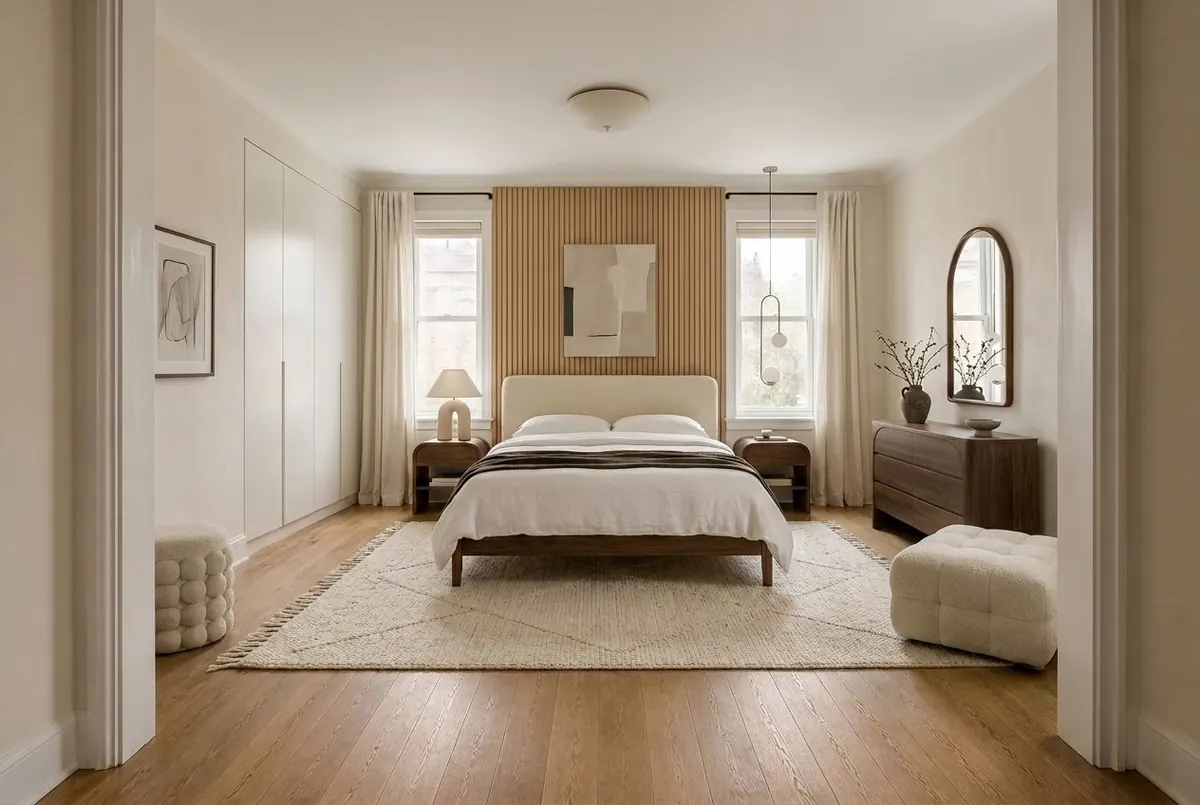
A bedroom needs a low bed, linen bedding, and warm light. Put a panel of vertical slats up to the ceiling behind the headboard and dark wood nightstands on each side. Build a wall-to-wall wardrobe with smooth fronts in the wall color. A lamp and one object stay on the nightstand, and everything else goes into drawers.
Japandi living room
A Japandi living room is built around a low sofa and a wool rug. The TV goes on a long, low wooden console with the cables hidden inside. One plant, but a large one: an olive tree, a fiddle-leaf fig, or a branch in a floor vase.
What mistakes turn Japandi into a plain beige room?
Japandi loses its character when only the palette is left and the contrast and texture are gone.
- Everything in one tone. Beige walls, a beige sofa, a beige rug. You need a dark accent: wood, ceramics, graphite in the textiles.
- Japanese souvenirs instead of the style. A fan, calligraphy, and bamboo in a pot give you a themed interior, and Japandi never shows up.
- Open shelves full of small things. The style relies on empty surfaces, so Japandi storage is almost always closed.
- Cool light. Bulbs at 4000 K and above often make wood look gray and linen look clinical.
- Too much wabi-sabi. Chips, rough boards, and dried flowers all over the apartment look like an unfinished renovation.
How can you try Japandi on your own room?
Japandi is easier to judge on your own room than on a roundup of other people's interiors. Here's the order:
- Take a photo of the room in daylight. From chest height, so the floor, ceiling, and window are in the frame.
- Upload the photo to Redesign and choose the Japandi style. One generation costs about 10 credits.
- Compare it with the neighbors. On the same photo, try Wabi-sabi, Minimalism, and Scandinavian. The line between the styles shows up on your own walls.
- Write down what repeats. The wood tone, wall color, lights, and curtains make a shopping list and a brief for a designer.
You get free credits once when you sign up, enough for several redesigns. If warm neutrals feel too quiet for you, take a look at boho style: it has more color, weaving, and pattern.
Frequently asked questions
Is Japandi a good fit for a small apartment?
Yes. Low furniture, closed storage, and a light base make a small room feel more spacious. Just don't bring dark ceiling beams and heavy drapes into it.
How is Japandi different from minimalism?
Japandi is warmer. It has two wood tones, linen, handmade ceramics, and it allows texture. Minimalism is stricter: fewer objects, smooth surfaces, a cool or neutral palette.
What colors are used in Japandi?
The base is milky white, oatmeal, sand, and warm gray. The accents are dark wood, graphite, sage, olive, and clay. There's very little pure white or cool gray.
Can you do Japandi without expensive solid wood furniture?
Yes. Solid wood matters for one or two pieces people notice right away, such as a table or nightstands. Cabinet fronts, shelves, and wardrobes can be laminated particleboard with a good wood texture.
Summary
- Japandi combines Japanese restraint with Scandinavian coziness: low furniture, two wood tones, linen, ceramics.
- Warmth and texture set it apart from minimalism, neatness from wabi-sabi, and less clutter from Scandinavian style.
- For a 2.5-2.7 m ceiling: a light ceiling without beams, slats on the wall, curtains hung from the ceiling, low furniture.
- A small window benefits from an empty sill, light linen, and lighting on three levels.
- Before renovating, try Japandi and its neighboring styles on a photo of your own room.
More styles and how they compare are collected in the interior styles guide.