Brutalist interior design: concrete and bold forms in an apartment that doesn't feel cold
Brutalist interior design for an apartment: concrete and heavy forms without the warehouse feel, how it differs from loft and minimalism, and how to soften it.
Brutalist interior design is concrete or a concrete look, large simple forms and almost no decor. In a regular apartment the style doesn't feel cold if you keep the concrete limited: one wall or the ceiling, one or two massive pieces, and warm wood, wool, linen and warm light around them. You don't need to pour new walls to get there.
Top-ranking articles about Brutalism usually start with architectural history and end with photo galleries of double-height living rooms. The tile maker Estima warns plainly that in small apartments the style can make a room gloomy (Estima). Below is how to avoid that with an 8.5-9 ft (2.6-2.7 m) ceiling, where the line runs between Brutalism, loft and minimalism, and what to honestly expect from microcement and concrete-effect paint.
What is Brutalism in interior design?
Brutalism came into interiors from 1950s architecture. The name comes from the French béton brut, "raw concrete." The English architects Alison and Peter Smithson were the first to use the term. One of the style's models is Le Corbusier's 1952 Unité d'habitation in Marseille: its facade was left in raw concrete, which made construction cheaper (Contented).
The style took three things from architecture:
- Honest materials. Concrete, stone, wood and metal are shown as they are, with no paint pretending to be something pricier.
- Mass. Furniture and objects look heavy and solid: a block table, a cube nightstand, a wide bench.
- Few details. No carving, no moldings, no small decor. Texture and proportion do the work.
Brutalism in today's apartments is softer than the architectural kind: usually a calm gray interior with one strong texture.
How is Brutalism different from loft, minimalism and wabi-sabi?
All four styles like gray, natural materials and few things, so people mix them up. They differ in where they came from and what they find beautiful.
| Feature | Brutalism | Loft | Minimalism | Wabi-sabi |
|---|---|---|---|---|
| Origin of the idea | architecture in cast concrete | former factory or warehouse | order and emptiness | Japanese aesthetic of imperfection |
| Main texture | smooth or board-formed concrete | brick, rusty metal, pipes | smooth light surfaces | clay, lime plaster, uneven wood |
| Furniture shapes | massive blocks, cubes, slabs | industrial, vintage | thin, light, hidden | low, handmade |
| Decor | one or two large pieces | signs, posters, Edison bulbs | almost none | ceramics, branches, old things |
| Palette | gray, graphite, dark wood, ochre | brick red, black, brown | white, beige, light gray | sand, clay, gray-beige |
| Mood | monumental and calm | the story of the place | quiet and air | warmth and traces of time |
In short, a loft tells the story of a factory and loves wear and tear, while Brutalism looks new and solid, like a sculpture. How to do a loft with a low ceiling is covered in our article on loft style. If you prefer emptiness without heavy forms, see minimalism. If you want the same gray range but warmer and with irregular textures, look at wabi-sabi.
How do you do Brutalism in a regular apartment?
The main rule is to ration the concrete. In a 160-215 sq ft (15-20 m²) room with one window, gray walls on every side take away the light, and the room feels lower.
Walls and ceiling
- Concrete on one surface. Usually that's the wall behind the sofa or bed. Keep the other walls light: warm white, cream, pale gray.
- A light ceiling. A concrete ceiling works in tall rooms. At 8.5-9 ft it "presses down," so keep it smooth and light.
- Bare concrete in a new building. If the walls are already concrete, you can leave them exposed. But after the formwork comes off, there are usually pits, marks and drips, so the wall gets cleaned, the defects filled and a protective coating applied.
Furniture and forms
Brutalism needs one large piece that anchors the room. For example, a low block coffee table, a solid wood media console or a wide bench. Keep the rest of the furniture simpler and lighter. If everything in the room is massive, it will feel cramped.
Palette
The base is concrete gray, graphite and warm white. Add dark wood and one natural accent: ochre, olive, rust orange or terracotta. Black metal goes in two or three spots: a light fixture, handles, legs.
How much concrete your room can take is best checked before you buy materials. Upload a photo of the room to Desow Redesign and choose the Brutalism style.
How do you soften Brutalism with textiles and light?
What makes Brutalism feel cold is the combination of smooth concrete, cool light and a bare floor. So you soften it with fabric, wood and light.
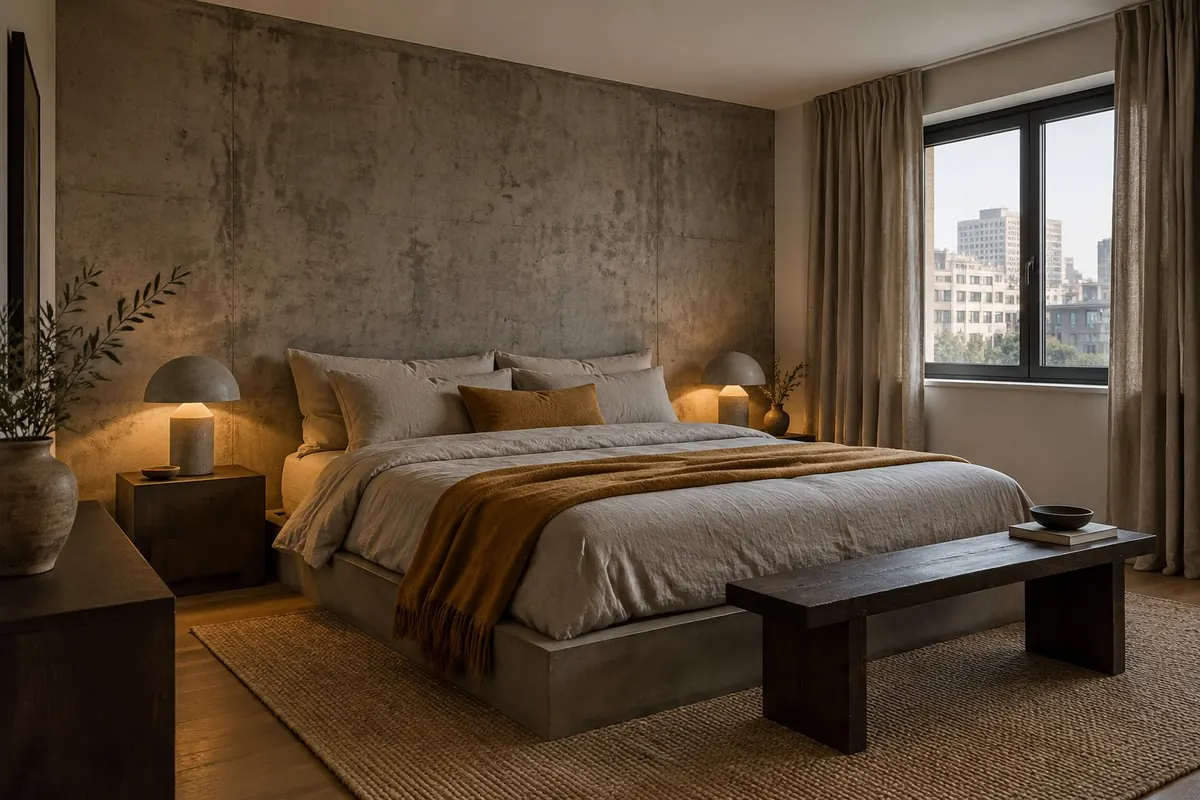
Textiles. You need a large wool or jute rug that covers most of the floor. On the sofa, choose boucle or linen upholstery rather than smooth leather. Curtains in heavy floor-length linen, bedding and throws in linen and wool. The rougher the wall, the softer the fabric next to it.
Light. Concrete looks clinical under cool light and velvety under warm light. Choose warm bulbs and several sources at different heights: a floor lamp by the sofa, sconces, a table lamp, a light that grazes the wall. Light along a textured wall shows its relief, while a single ceiling fixture in the center barely shows it.
Wood and living things. Dark oak or walnut in the table, bench and shelves. One or two large plants. Handmade ceramics on a shelf or table.
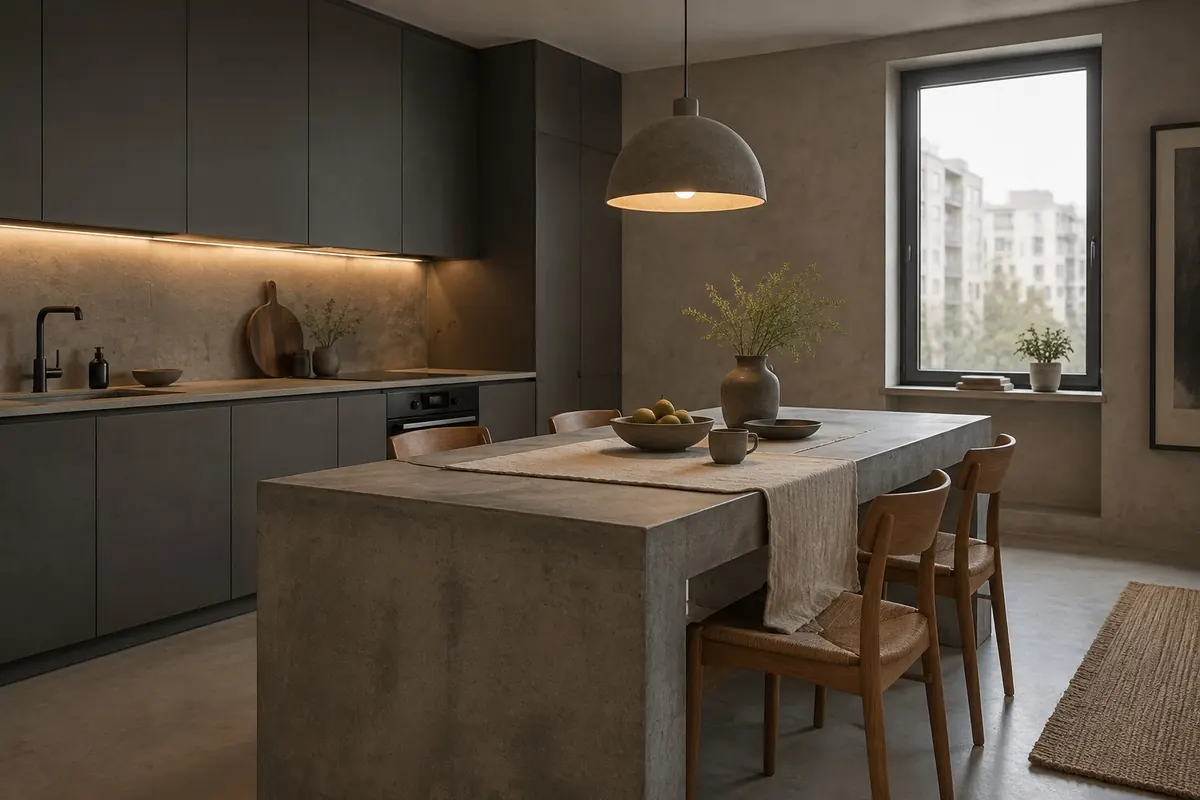
The same rules apply in the kitchen. Concrete goes on the table or backsplash, cabinet fronts are matte and handleless, and the warmth comes from wooden chairs, a linen runner and a pendant light with a warm bulb.
Microcement, concrete or concrete-effect paint: which to choose?
There are five ways to get a concrete texture in an apartment. Each has its limits, and prices vary a lot by city, contractor and area, so get a quote from your contractor.
| Option | Pros | Cons | Where it fits |
|---|---|---|---|
| Exposed cast concrete | the real material, no extra layer | uneven surface and formwork marks, dusty without sealing | a new building with a clean pour |
| Microcement | seamless, thin layer, works on walls, floors and wet areas | needs a level base and a skilled installer, sealer is a must | bathroom, kitchen, accent wall |
| Concrete-effect decorative plaster | relief and depth, hides small defects well | results depend on the installer's hand | dry rooms, the wall behind the sofa |
| Concrete-effect paint | fast, easy to redo | almost no relief, up close you can tell it's paint | rental apartment, small room |
| Concrete-look porcelain tile | durable, washable, waterproof | grout lines, needs a flat wall | floor, backsplash, bathroom |
Three things are worth knowing about microcement. The finished coating is 2-5 mm (about 1/16-3/16 in) thick. Without a protective sealer it lasts 3-5 years, with sealer and care 15-20 years. It reaches full strength in 21 days (T-J). The same source notes that installers charge more for microcement than for tile or plaster.
Exposed concrete also needs treatment. A penetrating sealer densifies it and reduces dust, and a lacquer adds a protective film and a slight sheen (Estima). Untreated bare concrete gives off dust.
For a single wall in a bedroom or living room, plaster or paint is often enough. Microcement makes sense where you need a seamless, water-resistant surface: in the bathroom and kitchen.
How do you try Brutalism on your own room?
Brutalism is especially hard to picture from other people's photos: magazine shots usually have high ceilings and huge windows. The same concrete can look very different in your room.
- Photograph the room in daylight, hold the phone level, and get the floor, the window and part of the ceiling in the frame.
- Upload the photo to Desow Redesign and choose Brutalism. For comparison, run the same room in Loft, Minimalism and Wabi-sabi. That shows where you want mass and where you want lightness.
- If the style fits but there's too much concrete, remove the excess with Smart Edit: for example, replace a concrete ceiling with a light one. It works in a desktop browser.
A version is usually ready in less than a minute. One Redesign version costs 10 credits. The Free plan gives you free credits once at sign-up, enough for several versions. The image shows style and mood; materials and furniture sizes are chosen later from measurements.
Frequently asked questions
Does Brutalism work in a small apartment?
It does if there's little concrete: one wall, one massive piece, a light ceiling and warm light. A completely gray 160 sq ft room with one window looks dark and cramped.
How is Brutalism different from loft?
Loft came from former factories and loves brick, pipes, wear and vintage. Brutalism grew out of cast concrete architecture: forms are solid and massive, surfaces are clean, and nothing reminds you of a factory.
Can you do Brutalism without real concrete?
Yes. Microcement, decorative plaster, concrete-effect paint or concrete-look porcelain tile give the texture. Real concrete can stay in small things: a planter, a lamp base, a candle holder.
What colors suit Brutalism?
The base is concrete gray, graphite and warm white. Add dark wood and one natural accent: ochre, olive or terracotta. Usually there's no more than one bright color.
Is Brutalism the same as a "brutal" or masculine style?
Almost. People often call any stern interior with dark colors and leather "brutal." Brutalism is narrower: concrete, massive simple forms and minimal decor.
Key takeaways
- Brutalism is concrete or a concrete look, massive simple forms and minimal decor.
- In an apartment with an 8.5-9 ft ceiling, keep concrete on one wall, the ceiling light and just one massive piece.
- Wool, linen, dark wood and warm light at different heights take away the chill.
- Microcement gives a seamless 2-5 mm finish but needs a level base and sealer. For a dry room, plaster or paint is often enough.
- More styles are in our interior styles guide, and you can try Brutalism on your own room in Desow Redesign.