Wabi-sabi interior design: imperfection without mess in a regular apartment
Wabi-sabi for a regular apartment: how it differs from Japandi and minimalism, how to tell patina from mess, and what to do over one weekend with no renovation.
Wabi-sabi interior design is a style that values the marks of time and handwork: uneven plaster, worn wood, rumpled linen, ceramics with crooked rims and earthy colors. In a regular apartment it works when the imperfection stays in the texture of things while the room itself is clean and nearly empty. An old piece has to work properly, and two or three objects are enough for a shelf. You can start without renovating, in a single weekend.
Wabi-sabi photo roundups are usually shot in houses with concrete walls and windows onto a garden. In an apartment with an 8.5-foot (2.6 m) ceiling and one window the style carries a different risk: rough texture and old furniture can easily pass for an unfinished renovation. Below we look at where that line runs, how wabi-sabi differs from Japandi and minimalism, and where to start.
What is wabi-sabi in interior design?
In Japanese aesthetics these are two concepts. In an article for Arzamas, Elena Dyakonova describes wabi with a word that translates as "simplification": no pretension, deliberate primitivism. Sabi is sometimes called "the beauty of antiquity", and in the tea ceremony it is partly expressed by the concept of nare, "patina" or "traces of time" (Arzamas, in Russian). Interior design took from both ideas the simplicity of objects and respect for wear.
In an apartment you can recognize the style by a few features:
- Textured walls. Lime or clay plaster, microcement, deep matte paint. No gloss anywhere.
- Wood with a history. An old stool, a worn dresser, solid wood left unlacquered or oiled, a cracked board.
- Handmade ceramics. Cups and vases of different shapes, with uneven glaze and wobbly rims.
- Rumpled linen and cotton in curtains, bedspreads and tablecloths, all in undyed shades.
- An earthy palette. Clay, ochre, ash, warm gray, the colors of stone and old wood.
- Empty space. There are few objects, and each one stands out because nothing sits next to it.
How is wabi-sabi different from Japandi and minimalism?
In color and shape the three styles are close: a calm palette, few things, clear surfaces. They usually part ways in how they treat old things, in wall finishes and in where the money goes. The table shows typical traits, not strict rules.
| Parameter | Wabi-sabi | Japandi | Minimalism |
|---|---|---|---|
| Wall finish | uneven plaster, microcement, textured paint | smooth walls, warm matte | flat planes, even matte |
| Old pieces | valued, wear is left as is | one or two, if they look neat | usually replaced with new ones |
| Chips and cracks | part of the character, ceramics are mended with a visible seam | mostly not | a defect |
| What you buy new | textiles, lighting, a mattress | furniture from one collection | floor-to-ceiling cabinets, built-in appliances |
| Where you save | on furniture: the country house, your parents, classifieds | on decor | on decor and textiles |
| Where the budget goes | plaster and a skilled plasterer | good wood | storage and smooth finishes |
| Main risk | the room looks like an unfinished renovation | everything is beige and dull | the room looks like an office |
Japandi borrows texture from wabi-sabi, but its pieces are more often new and lined up in one look. Minimalism usually removes both the texture and the history of things. Wabi-sabi can be put together cheaply from old furniture. What can be expensive is the finish: good uneven plaster needs a skilled plasterer and is hard to get right by eye on the first try.
How do you tell wabi-sabi from mess?
In wabi-sabi the imperfection lives in the material and never in the upkeep. A crack in an old board is texture; a grease stain on the countertop is dirt. Uneven plaster is style; a chipped corner and a dangling wire are unfinished work.
Five checks for a room
- Is the room clean? Dust and streaks are not part of the style. Dust collects faster in textured plaster and rough wood, so they need wiping more often.
- Does each piece work? An old chair has to hold your weight and a dresser drawer has to slide. Worn varnish can stay; wobbly legs need fixing.
- Are the edges neat? An uneven wall with clean lines at the ceiling, baseboard and window reveals reads as intentional. Ragged edges look rushed.
- Is there empty space? Two or three objects on a shelf, one on a table. Ten "pieces with a story" side by side look like a storage room.
- Do the colors tie things together? Old pieces from different years are held together by the palette: wood, clay, linen. One bright plastic basket breaks the whole picture.
What to keep and what to replace
Keep the wear on solid wood, chips on ceramics, rumpled linen and faded wood. Replace a sagging mattress, particleboard furniture with peeling edge banding, yellowed plastic and textiles that are past fresh: rumpled linen should smell of laundry.
Old pieces for the style are easier to find than it seems, and more people buy them every year. According to Avito, Russia's largest classifieds site, sales of vintage furniture and home decor on the site in the first quarter of 2025 grew 27% over the same period of 2024 and more than 2.5 times over three years. Vintage textiles and rugs grew 37%, tableware about a third (Avito on vc.ru, in Russian).
Wabi-sabi room by room
Wabi-sabi living room
One wall behind the sofa in textured plaster or matte clay-colored paint. A sofa with a linen slipcover, a low table of old wood, a stool by the window, one large vase with a dry branch. Warm 2700 K light from a floor lamp and a table lamp with a linen shade. In the evening you hardly need the ceiling light.
Wabi-sabi kitchen
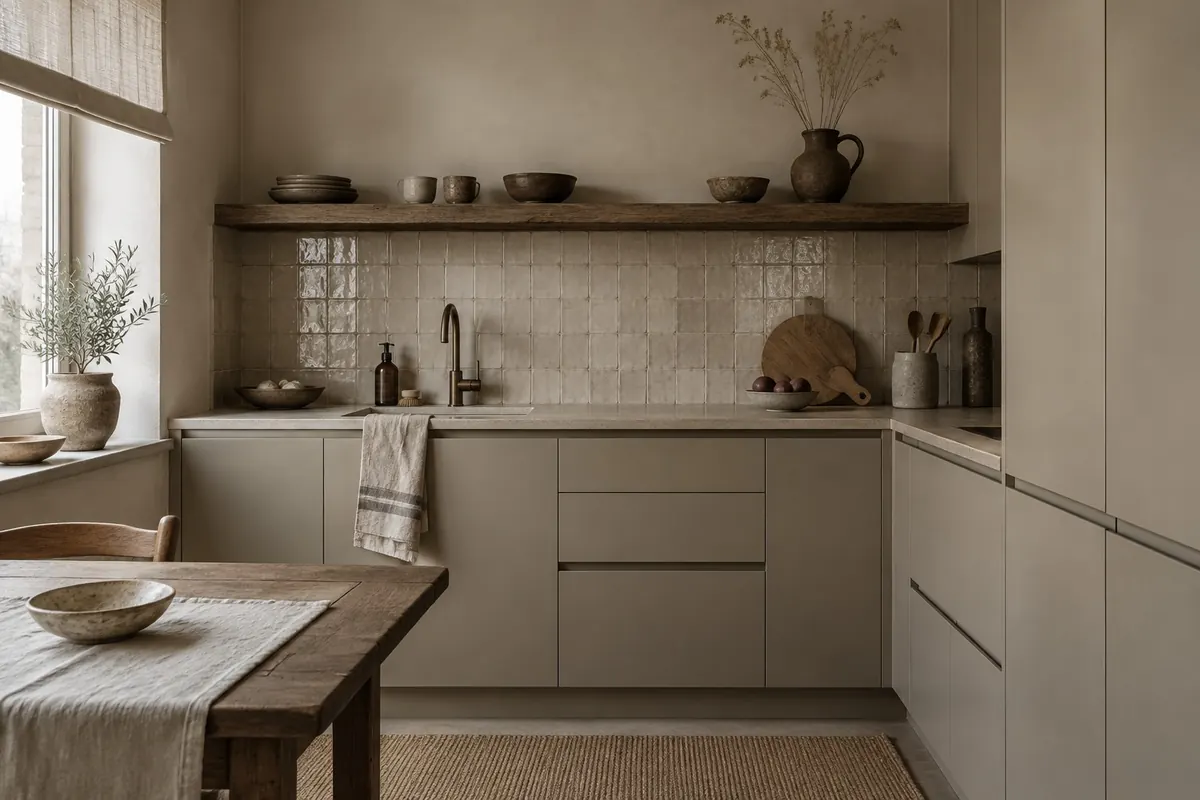
A wabi-sabi kitchen relies on materials. Matte fronts in warm gray or wood look, a stone-look countertop, a backsplash of handmade tile or microcement. One open shelf made from an old board, with ceramics of different shapes. Appliances are hard to match to this style, so it is better to build them in. If your kitchen is small, the tips in our article on small kitchen design will help.
Wabi-sabi bedroom
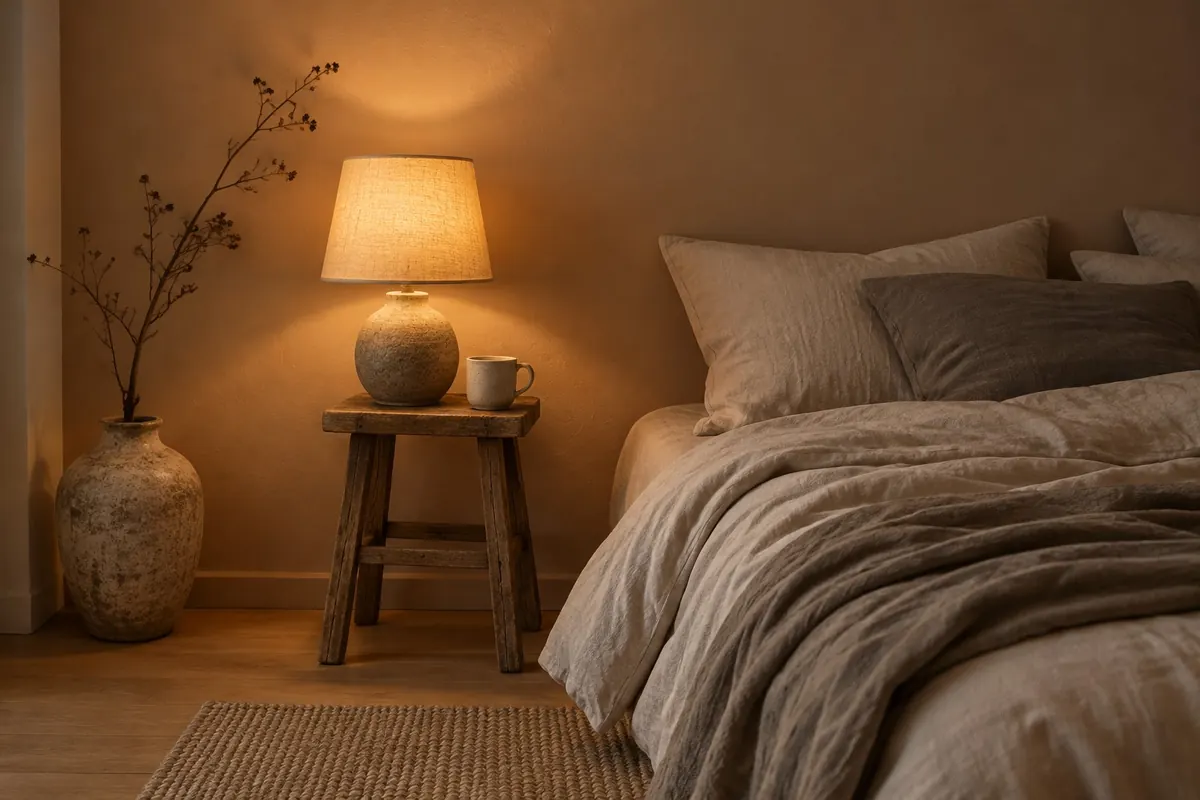
This is the easiest place to start: there are few things and less everyday wear. A low bed, rumpled linen bedding in oat and ash tones, an old stool instead of a nightstand, a ceramic lamp. If you want to add live plants, look at biophilic design: it also relies on natural materials, but its focus is greenery.
What can you do over a weekend?
In two days you can bring one room noticeably closer to wabi-sabi without renovating.
Saturday: clear things out
- Clear the surfaces. Leave one to three items each on the table, dresser and windowsill. Sort the rest into three piles: put back, put away, give away.
- Remove synthetics: shiny bedspreads, bright throws, glossy cushions. Replace them with linen or cotton in undyed shades.
- Find one old wooden piece: a stool, a chair, a crate, a cutting board. Check the country house, your parents' place or classifieds.
Sunday: light, ceramics and color
- Change the lighting: 2700 K bulbs, and in the evening a floor or table lamp instead of the ceiling fixture.
- Gather ceramics: two or three cups or vases of different shapes, with a dry branch or dried wheat in one of them.
- If you can, paint one wall in a matte clay or ochre color. Over a weekend this is the most visible change.
Leave plaster, microcement and new flooring for the renovation. First check whether you like the style in your own room.
How do you try wabi-sabi on your own room?
A clay wall and an old table are hard to picture from someone else's photos: your windows, light and square footage are different. Check the style on a photo of your own room.
- Take a photo of the room in daylight. Hold the phone level, and get the floor, the window and part of the ceiling in the frame.
- See the room without clutter. Declutter costs 7 credits and removes furniture and small items from the photo. An empty room makes it easier to decide what should come back.
- Try the style. Upload the photo to Redesign and choose Wabi-sabi. For comparison, run the same room in Japandi and Minimalism: on your own walls the difference shows better than in a table. One version costs 10 credits and is usually ready in less than a minute.
The Free plan gives you free credits once at sign-up, enough for several generations, such as a declutter and a few Redesign versions. The image shows style and mood; furniture sizes are chosen later from measurements.
Frequently asked questions
What does wabi-sabi mean?
It is two Japanese concepts. Wabi is simplicity and modesty. Sabi is the beauty that time and wear give to things. In interior design it is a style with natural materials, marks of time and few objects.
Does wabi-sabi work in a small apartment?
It does, as long as you do not put rough plaster on every wall. In a 160 sq ft (15 m²) room one textured wall, a light floor and two or three old pieces are enough. Clear surfaces and a calm palette usually do not make the room feel smaller.
Can you do wabi-sabi in a new build?
Yes. Smooth walls give a clean background, and old furniture, ceramics and linen add the history. Textured plaster can go on one wall after the main renovation.
What colors work for wabi-sabi?
The base is clay, ochre, ash, warm gray, milky white and the color of undyed linen. Accents are dark wood, graphite and rust. Pure white and bright colors hardly appear in the style.
Key takeaways
- Wabi-sabi values simplicity and the marks of time: plaster, old wood, handmade ceramics, rumpled linen.
- Old pieces and uneven finishes set it apart from Japandi; texture and the history of objects set it apart from minimalism.
- The imperfection lives in the material. Dirt, broken things and clutter are not part of the style.
- You can find furniture for the style at the country house, from your parents or in classifieds, while most of the money goes into finishes.
- Over a weekend, with no renovation, you can clear things out, change the textiles and lighting and find one old piece.
- More styles are in our interior styles guide, and you can try wabi-sabi on your own room in Redesign.