Biophilic interior design: light, materials and plants that will survive in your apartment
Biophilic interior design: why it starts with light and materials, which plants live by a north-facing window and how to try the style on a photo of your room.
Biophilic interior design brings nature back into an apartment in five ways: daylight, a view outside, natural materials, natural shapes and living plants. Plants are only one of the five. In an ordinary apartment you start with light and materials, then choose plants for the amount of sun your window actually gets.
The name comes from "biophilia," the human pull toward living things. The best-known practical framework for the style is the report "14 Patterns of Biophilic Design," published in 2014 by the American firm Terrapin Bright Green. The patterns fall into three groups: nature in the space, natural analogues and the nature of the space itself (Terrapin Bright Green). Greenery belongs to the first group, next to daylight, water and airflow. The other patterns cover materials, shapes, views and sheltered spots, so a dozen pots on the windowsill does not make a room biophilic on its own. For an ordinary apartment, we have boiled the framework down to the five pillars in the first paragraph.
What is biophilic interior design?
In a biophilic interior, light, materials and room for plants are planned from the start, together with the layout. You can recognize it by these features:
- Daylight: windows are not covered with heavy drapes, and sheer curtains diffuse the sun.
- A view outside: an armchair or desk is placed so you can see trees or sky from it.
- Natural materials: wood, stone, linen, wool, clay, rattan, jute.
- Natural shapes: rounded corners, soft lines, patterns of leaves, stone and wood grain.
- Plants matched to the light: different heights, grouped together, chosen for a specific window.
- Palette: green, beige, sand, terracotta and wood tones. How to balance green against the background is covered in our article on color combinations.
In Desow Redesign this style is called Biophilic. The example below has only a few plants. The wood and the green stone do most of the work.
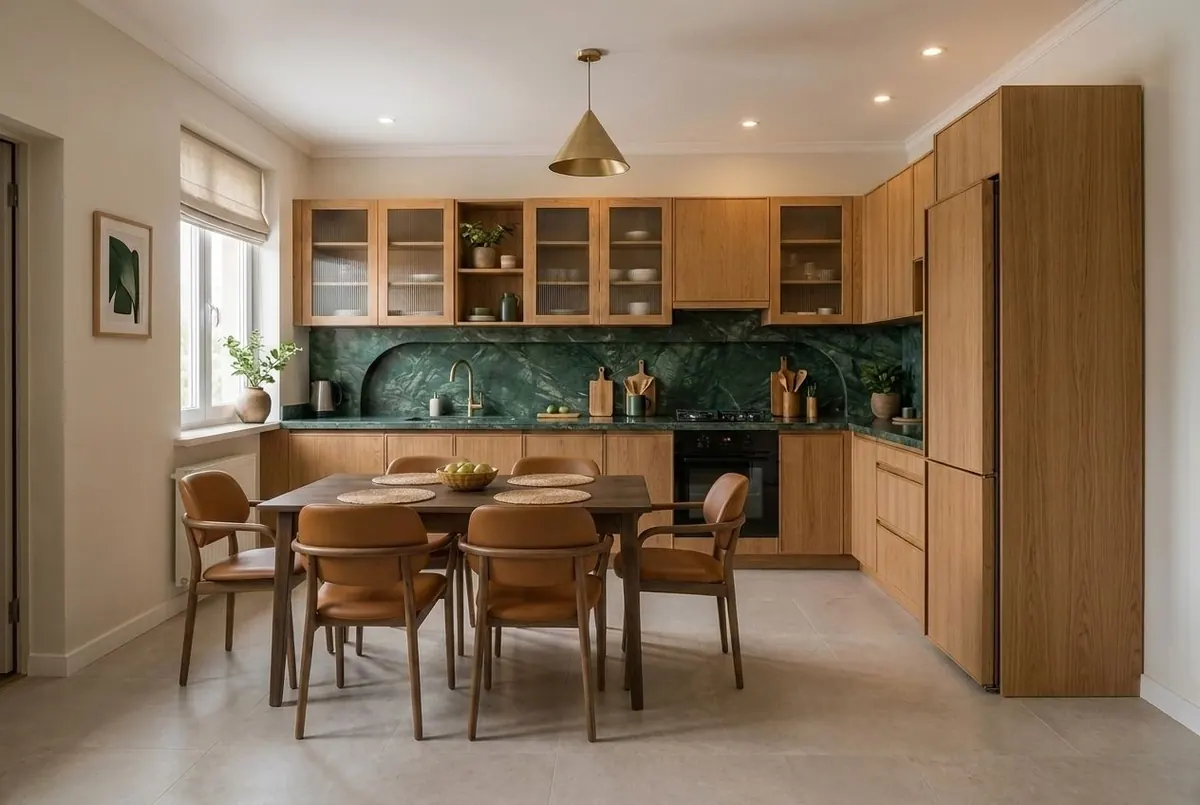
How this style will look in your own room is easier to see on a photo of it in Redesign than to guess from other people's pictures.
How is biophilic design different from eco style and Scandi?
All of biophilic style's neighbors use wood and a light background. They differ in what they put first.
| Biophilic | Eco style | Scandinavian | Wabi-sabi | |
|---|---|---|---|---|
| Main idea | the feeling of nature nearby | eco-friendly materials and less harm | a light, practical home | the beauty of imperfection |
| Plants | important, but matched to the light | optional | a few, as decor | one branch or dried flowers |
| Materials | wood, stone, linen, clay | natural, recycled, local | light wood, wool | aged wood, clay, plaster |
| Shapes | soft, organic | simple | straight, light | uneven, handmade |
| Palette | green, beige, terracotta | natural tones | white, gray, light wood | earthy, muted |
| Main risk | a jungle nobody looks after | dull sameness | emptiness | a room that looks unfinished |
Biophilic style pairs easily with Scandinavian style: they share a light background and wood, and biophilic adds more greenery and softer shapes. With wabi-sabi it shares clay and rough textures, but wabi-sabi gets by almost without plants. What is actually eco-friendly about eco style is covered in our roundup of retro, eco and other styles.
Where to start: light and the view outside
Start with the window. A plant without light will die, and wood and linen look dull in a dark room.
Light
Take down heavy drapes or pull them to the sides and hang sheer linen curtains: they diffuse the sun and keep the room bright. A mirror on the wall beside the window carries light deeper into the room. In the evening you need warm light from several sources at 2700-3000 K: a floor lamp, a table lamp, a shelf light.
The view outside
If your window looks out on a yard with trees, put an armchair or a desk by it and do not block the view with a row of pots. If it faces the wall of the next building, bring nature inside: one large plant in your line of sight, a painting or photo of a forest, a shelf of greenery at eye level.
Natural materials and shapes
Without renovating, you build biophilic style from furniture and textiles. Start with one large wooden piece: a table, a bookcase or a headboard. Add linen curtains, a wool throw, a jute rug, baskets, clay planters and vases.
If a renovation is coming, think about surfaces:
- a floor in a warm wood tone;
- stone or stone-look porcelain tile on the countertop, backsplash or windowsill;
- walls in matte paint or plaster in a natural shade, no gloss;
- an arch, rounded niche corners, a round table instead of a rectangular one.
Keep leaf patterns to one zone, such as a single wall or the curtains. Leaves on the wallpaper, the pillows and the rug all at once turn the room into a theme. Where it is too dark for plants, such as a windowless entryway, people hang a panel of preserved moss: it needs no light and no watering.
Which plants will survive in your apartment?
Choose the plant by the window. Before buying, check which way the window faces and how far from it the pot will stand.
| Where it stands | Light | What works |
|---|---|---|
| Deep in a room with a north-facing window | low, diffuse | cast iron plant, ZZ plant, Chinese evergreen |
| Next to a north- or east-facing window | bright, no direct sun | calathea, ctenanthe, blue star fern |
| East- or west-facing window | soft sun in the morning or evening | rubber plant, begonia |
| South-facing window | direct sun most of the day | cacti and succulents; everything else needs a sheer curtain |
In the darkest corner, where daylight barely reaches, even shade-tolerant plants will need a grow light.
Plants for north-facing windows
The British Royal Horticultural Society (RHS) has a list of houseplants for shade. It says the cast iron plant (aspidistra) can tolerate deep shade. Chinese evergreen (aglaonema) does well in low light, and the ZZ plant handles anything from low to bright indirect light. For blue star fern, calathea and ctenanthe, the RHS recommends a spot near a north-facing window. The peace lily prefers bright indirect light but tolerates lower light too (RHS). The same page adds a caveat: these plants survive in shade, as long as it is not too dark.
In winter a north-facing window gives too little light even by British standards. The RHS suggests moving plants to a south- or west-facing windowsill for that season. If shoots turn weak, pale and spindly, or variegated leaves turn plain green, the plant is short of light (RHS). A grow light over a shelf helps.
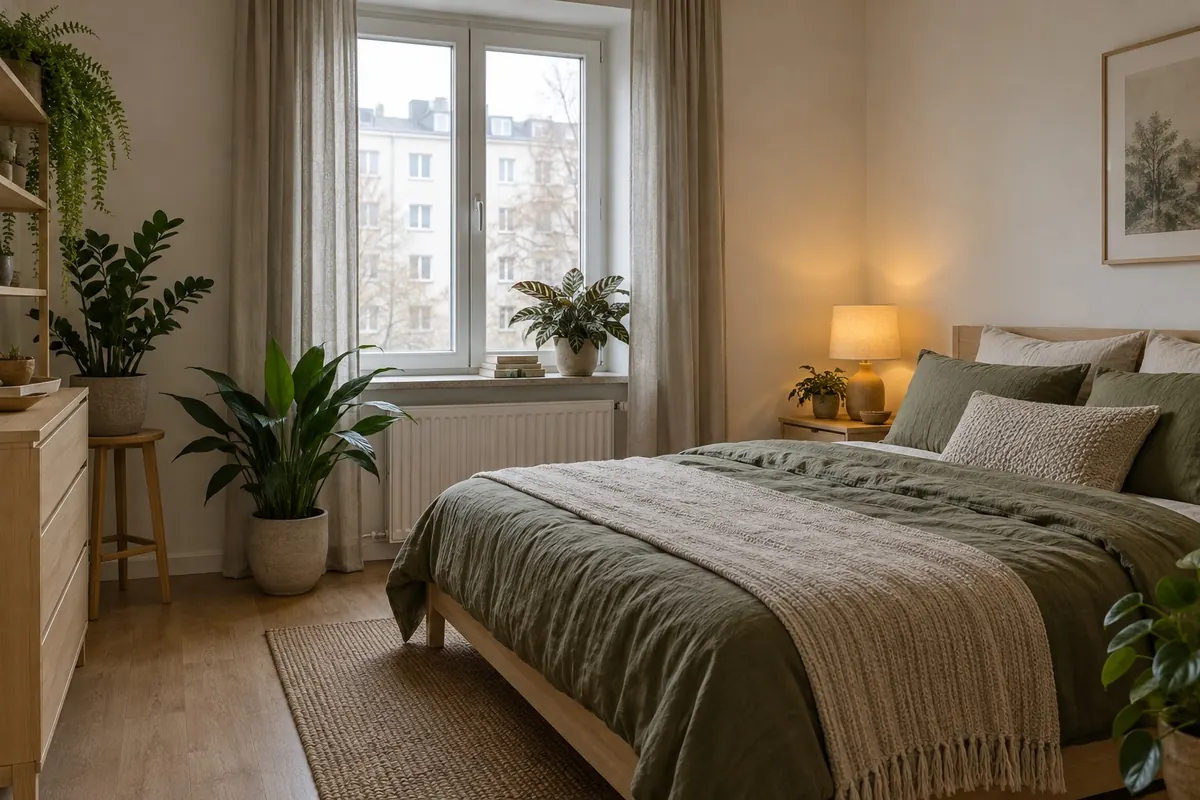
For the look of the room, the number of plants matters less than how they are placed. One large plant in a corner and a group of two or three of different heights look stronger than a row of identical pots. Planters in one material, such as clay or wicker, tie a group together.
Do plants clean the air?
Not noticeably. In 2020, researchers at Drexel University reviewed published experiments on plants and volatile organic compounds. By their calculation, matching a building's normal air exchange would take 10 to 1,000 plants per square meter of floor space (Cummings, Waring, 2020). Airing out the room and ventilation are what freshen the air. Plants are there for the view and the mood.
How to try biophilic style on a photo of your room
How much wood, greenery and light your room can take is fastest to see on a photo of it.
- Photograph the room in daylight with the window in the frame. How to shoot a room for an AI tool is covered in our article on photographing a room.
- Clear the clutter. If the photo has a lot of stuff in it, run it through Declutter first.
- Try the style. Upload the photo to Desow Redesign and pick Biophilic. A result is usually ready in under a minute.
- Compare with neighbors. On the same photo, try Scandinavian, Japandi and Wabi-sabi.
- Fix the details. If you like everything except an empty corner, select it in Smart Edit and describe it: "a large plant in a clay planter." Smart Edit works in a desktop browser.
One Redesign generation costs 10 credits. The Free plan gives you free credits once at sign-up, enough for several variations at up to 1K resolution with a watermark. The AI does not know how much light your room gets and may put a sun-loving plant in a dark corner. Use the image to judge the look, and pick the plant from the table above.
Frequently asked questions
What is biophilic design in simple terms?
It is an interior where nature is built into the layout: plenty of daylight, a view of greenery, wood, stone and linen, soft shapes and living plants chosen for the light.
Which plants work in a room with north-facing windows?
Deep in the room, cast iron plant, ZZ plant and Chinese evergreen work well. Right by the window, calathea, ctenanthe and blue star fern will do fine. In winter they may not get enough light: move them to a south-facing windowsill or hang a grow light.
Can you create a biophilic interior without live plants?
Partly. Light, wood, stone, linen and soft shapes already give a sense of nature. Living greenery gives the style the most, so if you have even a little light, start with one easy plant, such as a ZZ plant.
How is biophilic design different from eco style?
Eco style is about sustainability: natural and recycled materials, less harm to nature. Biophilic design is about feeling close to nature: light, views, shapes and plants. They often share materials, but their goals differ.
How many plants does a biophilic interior need?
There is no rule. One large plant and a group of two or three smaller ones are enough for a room, as long as they stand where they get enough light. More plants mean more care, and dried-out pots work against the style.
In short
- Biophilic interior design rests on five things: light, a view outside, natural materials, natural shapes and plants.
- Start with light: sheer curtains instead of heavy drapes, a mirror beside the window, warm lamps in the evening.
- Choose plants by the window. Cast iron plant, ZZ plant and Chinese evergreen suit north-facing rooms; calathea and blue star fern do well right by the window.
- Plants do not noticeably clean the air; they are there for the view and the mood.
- Before shopping, try the style on a photo of your room and compare it with neighboring styles.
More styles are collected in our guide to interior design styles. Similar natural materials appear in wabi-sabi and Scandinavian style, and what else is in fashion this year is covered in our article on interior trends for 2026.