Retro, eco, American, Italian, shabby chic, Eastern and Moroccan interior styles: key features and how to do them in an apartment
Retro, eco, American, Italian, shabby chic, Eastern and Moroccan interior styles: key features, how to do them at home and which Desow style to try instead.
American, retro, Italian, shabby chic, eco, Eastern and Moroccan are popular interior styles that are not among the 23 styles in Desow Redesign. American style is a lighter take on classic decor, with an open kitchen and living room and a lot of symmetry. Retro means furniture on slim legs and the colors of the 1950s-1970s. Italian means marble, walnut and furniture with a strong shape. Shabby chic is white furniture with worn edges and faded roses. Eco is natural materials and furniture with safety documents. Eastern and Moroccan styles mean rugs, low sofas, brass and patterned tile. For each one below you will find its key features, a plan for an ordinary apartment and the closest Desow style you can try on a photo of your own room.
All 23 Redesign styles are collected in our guide to interior styles, and Romantic, Manor and Dark Academia are covered in our roundup of rare styles.
How are the seven styles alike and how do they differ?
They split by what holds the style together: an era, a country or materials. Retro and shabby chic rely on old things, American and Italian on the furniture and finishes of their country, eco on materials, Eastern and Moroccan on pattern and textiles.
| Style | Key features | Closest in Desow | What the closest style will not give you |
|---|---|---|---|
| American | open kitchen and living room, symmetry, wall paneling, a big soft sofa | Neoclassic | a kitchen island, open plan, relaxed family feel |
| Retro | tapered legs, teak and walnut, mustard and orange, geometric rugs | Mid-century | 1970s kitsch and Soviet-era pieces |
| Italian | marble, walnut, lacquer, furniture with a strong shape, designer lighting | Classic, Neoclassic | contemporary Milan-style design |
| Shabby chic | white furniture with worn edges, faded roses, lace | Romantic | patina and distressed paint |
| Eco | wood, linen, stone, plants, natural colors | Biophilic | a safety check of the materials |
| Eastern | low furniture, rugs, brass, carved screens, deep colors | Boho | dense ornament and a formal feel |
| Moroccan | zellige tile, terracotta plaster, lanterns, leather poufs | Boho | patterned tile and arches |
The closest style gives you the colors, materials and character of the furniture. A lantern, an arch or a distressed dresser you add by hand later.
What is American interior style?
In Russia the term usually means American classic: the interior of a suburban house in the US, only lighter and easier to live in. Symmetry and moldings stay, but the furniture is simpler than in strict classic decor and is made for a family, not for guests. The rural branch, the American farmhouse, is covered in our article on country style.
Signs of American style:
- kitchen, dining and living areas in one space, with a kitchen island or peninsula;
- symmetry around a fireplace, TV or console table: paired lamps, paired armchairs;
- light walls, white moldings, wood paneling on the lower part of the wall;
- a big sofa with rolled arms and an ottoman instead of a coffee table;
- built-in storage and Shaker-style framed doors in the kitchen and closets.
How to do it in an apartment
The main difficulty is the open kitchen. In Moscow you cannot merge a kitchen that has a gas stove with a living room: clause 9.16 of resolution 508-PP prohibits "combining a gasified room with a living room" (mos.ru). Other cities have their own rules. If the kitchen stays separate, build the American look in the living room: a sofa with an ottoman, a symmetrical wall with a console and two lamps, paneling halfway up the wall. If you can open up the kitchen, our article on kitchen-living room design explains how.
Closest in Desow: Neoclassic
Neoclassic has the same moldings, light colors and symmetry, and it also suits 2.6-2.7 m (8.5-9 ft) ceilings. The mood is different: Neoclassic is stricter and dressier, with more brass and fewer throws. After a Neoclassic Redesign, add an ottoman, a plaid throw and family photos on the console, and the room gets closer to an American home.
Retro interior style: which decades, and how to avoid a museum
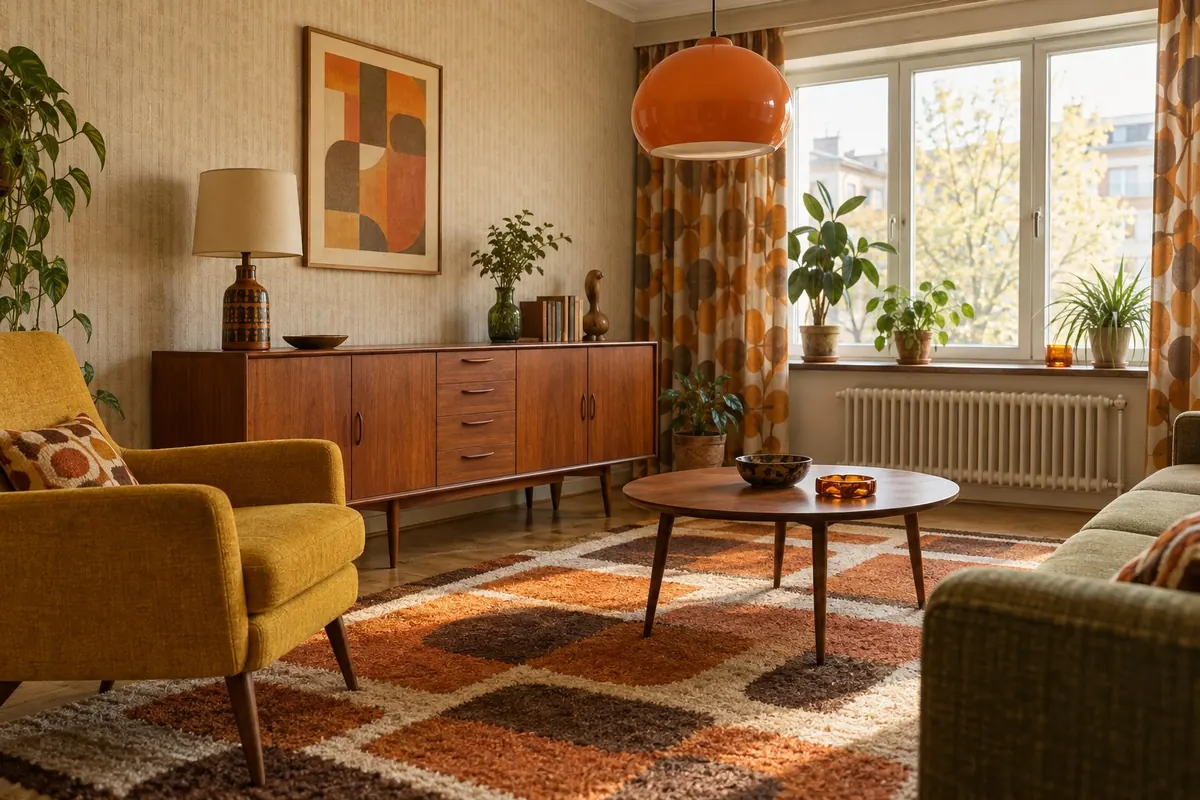
Retro is a stylized take on the recent past. According to Skillbox Media, retro style draws on 20th-century design, "most often the period of the 1950s-1970s" (Skillbox Media). Retro means new things made in an old spirit; vintage means the old things themselves.
Signs of retro:
- furniture on slim tapered legs, low sideboards and armchairs with sloped backs;
- warm wood: teak, walnut or veneer that looks like them;
- mustard, orange, olive and brown;
- geometric shapes or big circles on rugs, curtains and wallpaper;
- round pendant lamps in glass or plastic and retro appliances: a fridge, a record player, a rotary phone.
How to do it in an apartment
Pick one decade. The sixties mean light wood and light shapes, the seventies mean brown with orange and a shag rug, and the eighties are closer to Memphis. A mix of all three looks like an antique dealer's storeroom. Two or three old pieces are enough, for example a sideboard and a floor lamp, and the rest can be new and quiet in shape.
Retro has one detail that is useful in a panel building: exposed wiring, with twisted cable on ceramic insulators and surface-mounted switches and outlets. In Moscow, cutting channels for wiring in wall panels is prohibited (clause 9.11 of the same 508-PP, text of the resolution), and exposed retro wiring lets you add an outlet or a sconce without touching the panel. Have an electrician install it.
Closest in Desow: Mid-century
Mid-century is the strictest branch of retro: modernism of the 1940s-1960s with furniture on legs, teak and mustard. It gets the furniture and colors right, but it will not add kitsch: a 1970s shag rug, crystal, a Soviet rug on the wall. Add those yourself, one piece at a time.
Italian interior style: classic or Milan?
People search for three different interiors under this name. Italian classic means carved furniture, gilding, marble, heavy curtains and crystal. Contemporary Italian design means low modular sofas, leather, lacquer, a marble table and designer lamps. The rustic Tuscan house with ochre walls and beams is covered in our article on Mediterranean style.
Signs shared by the first two:
- marble or stone: a countertop, a coffee table, a windowsill;
- furniture with a strong shape, with one or two pieces as the focus of the room;
- warm colors (cream, cognac, terracotta) or black-and-white contrast;
- walnut and other dark woods;
- lighting as part of the design: a striking chandelier or an unusual floor lamp.
How to do it in an apartment
With a 2.6-2.7 m ceiling, take one carved piece or one chandelier from gilded classic decor and keep the rest calm. In a standard apartment the contemporary version needs a good sofa and one marble piece. In the kitchen marble is fussy: it is calcite with a hardness of 3 on the Mohs scale (Russian Wikipedia), it scratches and does not tolerate acid. For work surfaces people more often choose marble-look porcelain stoneware.
Closest in Desow: Classic and Neoclassic
Italian classic is closest to Classic: the classical orders, symmetry, plaster molding, marble. Neoclassic is lighter and works if you want an Italian interior without gilding. For contemporary Italian design both are too traditional; Minimalism is closer there, and you pick the furniture yourself.
Shabby chic interior style: how to distress furniture without clutter
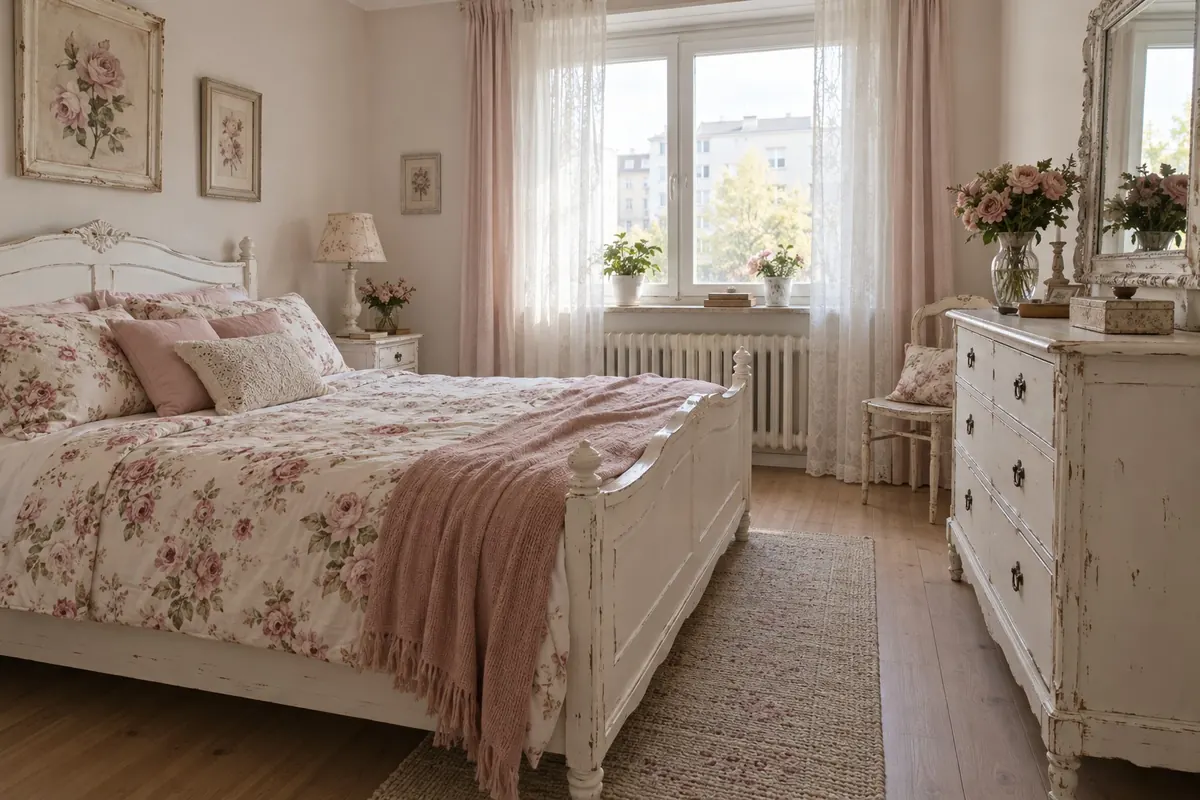
Shabby chic is a light interior with old or deliberately aged furniture. According to T-Zh, the style appeared in England in the 1980s thanks to designer Rachel Ashwell (T-Zh).
Signs of shabby chic:
- white or cream painted furniture with worn edges;
- faded roses and small flowers on bedding, curtains and upholstery;
- powder pink, mint, cream;
- old mirrors and frames, porcelain, lace and ruffles;
- furniture with soft lines, carved headboards, turned legs.
How to do it in an apartment
You can make distressed furniture from old pieces. Paint a dresser or chair in two coats, dark and light, then sand the top coat on the corners and edges where furniture would wear on its own. T-Zh names things that do not fit the style: sliding-door wardrobes, geometric patterns and sharp corners. In the bedroom, replace a mirrored sliding wardrobe with one that has painted framed doors, or hide it behind a curtain on a ceiling track.
Closest in Desow: Romantic
Romantic gives you the same colors, soft furniture lines, sheer curtains and flowers. The furniture in it is new and smooth, without patina or wear. We compared the two in our roundup of rare styles, and shabby chic versus Provence is covered in our article on Provence style.
Eco interior style: what is actually eco about it?
Yandex Realty describes eco style as "harmony between the modern and the original, closeness of people and nature" and calls it a relative of Scandinavian style (Yandex Realty). Most people think of eco as wood, linen and plants, but the style also covers what you breathe at home.
Signs of eco:
- natural materials: solid wood and veneer, linen, cotton, wool, stone, jute, rattan;
- natural colors: beige, sand, olive, gray-green, the color of wood;
- live plants;
- simple shapes without extra decor;
- as little plastic and gloss as possible.
How to do it in an apartment
Start with what you cannot see in a photo. Furniture made of particleboard and similar panels releases formaldehyde, and there is a limit for it: technical regulation TR TS 025/2012 allows formaldehyde migration into the air of no more than 0.01 mg/m³ (TR TS 025/2012). Compliance is confirmed by a certificate or a declaration, depending on the type of product, and you can ask for these documents when you buy a wardrobe or a bed. For floors, choose solid or engineered wood, and wood-look porcelain stoneware in the kitchen and bathroom. Curtains should be linen or cotton, rugs wool or jute.
Closest in Desow: Biophilic
Biophilic style takes the same things from nature: wood, linen, stone, plants. Its focus is the feeling of nature nearby, so it has more plants and soft shapes than eco. Redesign cannot check materials for safety: the image shows only how the room looks, and you still check the furniture documents in the store.
Eastern interior style: which East do you mean?
"Eastern style" covers several very different interiors: Arabic, Turkish, Indian, Chinese, Japanese. In Russia the term most often means the Arabic and Turkish version: low furniture, rugs, brass, deep colors. A Japanese interior works differently, with emptiness and wood, and it has its own article on Japanese style.
Signs of Eastern style:
- low furniture: a daybed or sofa piled with cushions, poufs, a low table;
- several overlapping rugs, on the floor and on the sofa;
- carved wooden screens, lattices, arched openings;
- brass and copper: trays, lamps, jugs;
- ruby, emerald, saffron, indigo.
How to do it in an apartment
A whole apartment in Eastern style feels heavy, so the style is usually built in one area: a corner sofa with cushions, a low table, a rug, a brass lamp. An arched mirror or a carved screen can stand in for a real arch in the wall. Rugs collect dust, so choose a top rug that can go to the cleaner.
Closest in Desow: Boho
Boho takes the rugs, poufs, cushions and ethnic patterns from Eastern style. But Boho has a light background and mixes things from different countries. An Eastern interior is denser and dressier, with more ornament and deeper color. For the Chinese and Japanese versions, Japandi and Wabi-sabi are closer.
Moroccan interior style: tile, lanterns and arches
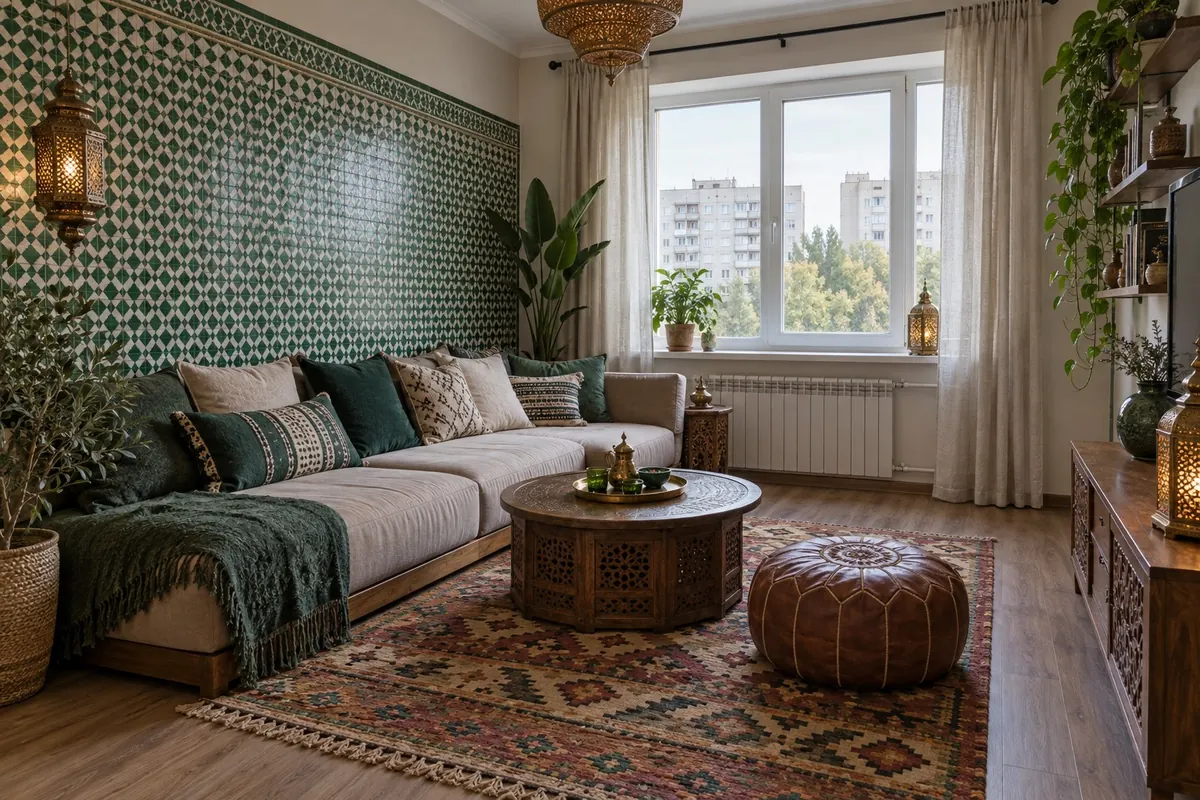
Moroccan is the best-known branch of Eastern style. Its signature is zellige, which Russian Wikipedia describes as "terracotta tiles traditional for Moorish architecture" that were "as a rule, assembled into geometric figures" (Russian Wikipedia).
Signs of Moroccan style:
- zellige or cement tile with a geometric pattern;
- walls in textured plaster in terracotta, sand or ochre;
- pierced brass lanterns that cast patterned shadows on the walls;
- leather poufs, kilims and rugs with diamond patterns;
- arches in doorways, niches and mirrors.
How to do it in an apartment
In an apartment, tile most often goes on the kitchen backsplash or a bathroom wall. Handmade zellige is uneven and usually costs more than regular tile, so people often use ceramic tile with the same pattern instead. In the living room, one patterned area, a lantern, a pouf and a rug are enough. The whole apartment does not have to be terracotta: keep the walls sand-colored and move the color into the textiles.
Closest in Desow: Boho
Boho and Moroccan style share kilims, poufs, woven textures and warm colors. Boho usually has no patterned tile, lanterns or arches. You can add them by hand or with Smart Edit: select an area of the wall and describe in words what should be there. Smart Edit costs 7 credits and works in a desktop browser.
How to try these styles on a photo of your room?
These seven styles are not in Redesign, so you test the idea with the closest Desow style. It shows how your room handles the colors and furniture, and you add the recognizable details later.
- Take a photo of the room in daylight, holding the phone level, with the floor and window in the frame. More in our article on how to photograph a room.
- Upload the photo to Desow Redesign and pick the closest style from the table: Neoclassic for American, Mid-century for retro, Biophilic for eco, Boho for Eastern and Moroccan.
- Compare two neighboring styles on the same room, for example Classic and Neoclassic for Italian. A variant is usually ready in under a minute.
One Redesign variant costs 10 credits. The Free plan gives you free credits once at sign-up, enough for several variants, with results up to 1K and a watermark. Below is the same living room in a panel building before and after a Biophilic redesign; it is a generated example, not a client's renovation. The olive sofa, linen, wood, jute basket and plants are nearly the full eco set.
Frequently asked questions
Are these styles available in Desow Redesign?
No. Redesign has 23 styles, and American, retro, Italian, shabby chic, eco, Eastern and Moroccan are not among them. Instead, you can try the closest one: Neoclassic, Mid-century, Classic, Romantic, Biophilic or Boho.
What is the difference between retro and vintage?
Retro means new things made in the spirit of past decades. Vintage means the old things themselves, found or inherited. People often mix them in one room: a vintage sideboard and a new retro-style armchair.
Does retro style work in a small apartment?
Yes, if you pick one decade and a light background. Furniture on slim legs looks light, and you can see the floor under it. Clutter comes from the number of things, so two or three old pieces are enough.
Are Eastern and Moroccan style the same thing?
Moroccan is one branch of Eastern style. It has its own markers: zellige tile, terracotta plaster, brass lanterns, leather poufs. "Eastern style" also covers Turkish, Indian and Chinese interiors.
How is American style different from American country?
American style is a lighter classic look for a city or suburban home: moldings, symmetry, light colors. American country is a farmhouse: rough wood, plaid, painted furniture, everything simpler and more rustic.
In short
- American is a lighter classic look with symmetry and an open kitchen; the closest Desow style is Neoclassic.
- Retro is furniture on legs and the colors of the 1950s-1970s; the closest is Mid-century, and kitsch is added by hand.
- Italian is marble, walnut and one standout piece; the closest are Classic and Neoclassic.
- Shabby chic is white furniture with worn edges and faded roses; the closest is Romantic.
- Eco is natural materials and furniture with safety documents; the closest is Biophilic.
- Eastern and Moroccan are rugs, brass, low furniture and patterned tile; the closest is Boho.
- Try the closest style on a photo of your room in Desow Redesign and add the style's details later.