Mediterranean style interior: how to pull it off in an apartment that gets little sun
Mediterranean style interior for apartments: palette, materials, Greek and Italian versions, how it differs from nautical, and what to do with white walls.
Mediterranean style is the look of a house on the southern coast: matte white or warm plaster walls, terracotta tile, light wood, linen and blue or turquoise accents, sometimes an arch instead of a square doorway. It works in a northern apartment if you pick a warm white and use less blue than in island photos: on a cloudy day a cool white wall turns gray.
Almost every Mediterranean interior gallery is shot under a southern sun. Moscow gets far less of it: on average 14 hours of sunshine in December and 323 hours in July (Wikipedia, 2001-2011 data). So this article covers more than the signs of the style. It also looks at how the style behaves in a room with a window onto a courtyard in November.
What is Mediterranean style in interior design?
It's an umbrella name for seaside homes in Greece, Italy and Spain. What they share is the climate and the materials: thick walls, plaster, stone, clay tile and simple wooden furniture. There is usually little luxury in it. It looks like a house people live in all summer without worrying about sand on the floor.
The two most common versions:
- Greek, or Cycladic. White walls, blue and turquoise, smooth rounded shapes, very few things. This is the image of Santorini, where houses built of local tuff are, as a rule, carefully whitewashed outside, and the color accent comes from the bright turquoise domes of the churches (Wikipedia).
- Italian, or Tuscan. Warmer and earthier: ochre, terracotta, olive green, rough beams, wrought iron details, more wood.
People who search for "Italian style interior" often mean something else: classic Italian furniture with gilding and carving. That has nothing to do with Mediterranean style.
Signs of the style: palette, materials, shapes
One blue wall doesn't make a room Mediterranean: the style appears when several materials come together in one room. The table helps you check what supports the style and what pulls a room away from it.
| Element | What works | What breaks the style |
|---|---|---|
| Walls | matte plaster, limewash paint, warm white, sand | glossy paint, patterned wallpaper, cool gray |
| Floor | terracotta tile, light planks, patterned tile in the kitchen and bathroom | dark glossy laminate, marble-look porcelain |
| Shapes | an arch, a wall niche, rounded corners, low furniture | multi-level ceiling with LED strips, sharp glossy shapes |
| Furniture | light oak, whitewashed wood, rattan, rush seats | dark varnished solid wood, chrome, plastic |
| Textiles | linen, cotton, jute, stripes | velvet, shiny synthetics, tassels and fringe |
| Accents | blue, turquoise, terracotta, olive green | neon, lots of black, gilding |
| Decor | pottery, an olive tree in a pot, woven baskets | shells and anchors on every shelf, a fishing net on the wall |
Blue and terracotta fight each other if you use them in equal amounts. A handy rule: one light base, one main accent and one supporting color. We covered how to split colors by proportion in our article on color combinations in interior design.
Why does white plaster look gray in an apartment?
A white wall reflects whatever light comes through the window. In the south, direct sun makes the wall warm, almost golden. Up north the light is diffused and cool for most of the year, and a white with a cool undertone looks gray or bluish. This is especially true in a room with a north-facing window or a window onto a closed courtyard.
What to do about it:
- Choose a white with a warm undertone. Cream or a soft milky white instead of an "office" white. On a cloudy day it stays white instead of going gray.
- Test the sample on site. Paint a sheet of cardboard and look at it on two walls: in the morning, during the day and in the evening under a lamp. A sample in the store is lit differently.
- Use less blue than you want. Saturated blue in a north-facing room looks dark and heavy. Keep it for cushions, tile and pottery, and leave the walls alone.
- Warm the room with materials. A terracotta floor, jute, light wood and ochre tones keep the room warm even when it's gray outside. In a dark room the Tuscan version often feels cozier than the Cycladic one.
- Warm light in the evening. Bulbs at 2700-3000 K, several sources at different heights: a floor lamp, a table lamp, a pendant over the table. A single ceiling light in the center makes a white room look flat.
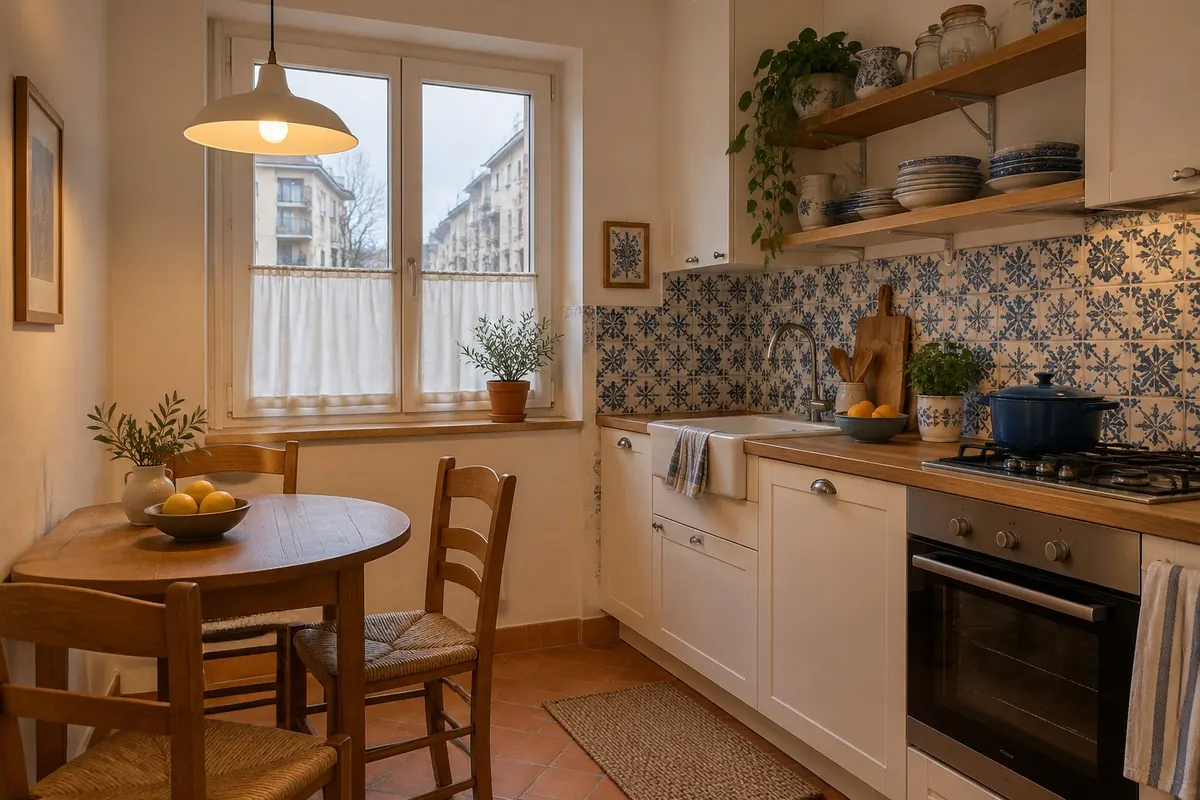
The photo above shows a kitchen on a cloudy day. Blue stays only on the backsplash and the dishes, the walls are warm white, the floor is terracotta and the pendant over the table is on.
How is Mediterranean style different from nautical, Provence and Scandinavian?
These are the styles it gets confused with most often. It shares white and blue with nautical style, the south and whitewashed wood with Provence, and a light base with Scandinavian.
| Mediterranean (Coastal in Desow) | Yacht | Provence | Scandinavian | |
|---|---|---|---|---|
| Mood | a house by the sea, vacation | a yacht cabin, order | a farmhouse in southern France | a bright northern apartment |
| Walls | warm white plaster, sand | white panels, varnished wood | whitewashed, cream | white, light gray |
| Floor | terracotta, light planks | dark varnished wood, teak | light wood, terracotta in the kitchen | light oak |
| Colors | white, blue, turquoise, terracotta | navy, white, brass | lavender, olive, pastels | white, gray, beige |
| Furniture | simple, low, woven | built-in, custom made | painted, with patina | clean-lined, practical |
| Details | arches, pottery, linen | brass, leather, rope | dried flowers, wrought iron, small florals | textiles, plants |
The easiest way to tell them apart is by material: Mediterranean style has plaster and clay, yacht style has varnish and brass. For more on the Coastal and Yacht styles in Desow, see our guide to interior design styles. If you want more flowers and vintage in the room, look at Provence style. If you only want a light base without the south, Scandinavian style is closer.
How do you get Mediterranean style in an ordinary apartment?
With a 2.6-2.7 m ceiling, the style rests on finishes and materials. You don't need a dome or thick walls.
Arches and niches
One arch per apartment is enough, usually the opening from the hallway to the living room or kitchen. If you can't rebuild the opening, you can paint an arch on the wall behind the bed or sofa. A niche in the wall for books or pottery gives the same thick-wall effect.
Walls
Decorative mineral plaster or matte paint with a light texture both work. Texture shows up in side light, so it works best on the wall next to the window. Smooth white paint is fine too, as long as the rest of the room supports the style.
Kitchen and bathroom
These rooms are the easiest place to start: terracotta tile on the floor, a backsplash of blue and white patterned tile, an open shelf in light wood. In the bathroom, tile and a linen towel are enough. Keep patterned tile to one zone, or the room gets busy.
Living room and bedroom
A simple sofa in light linen, a light wood coffee table, a jute rug, an olive tree in a clay pot. In the bedroom: linen bedding, a striped throw, a woven basket. None of this needs a renovation.
How can you test Mediterranean style on a photo of your room?
The main question in a northern climate is how the style looks in your light. A photo of your own room answers it, and island photos won't help.
- Take a photo of the room on a cloudy day, from chest height, with the window, the floor and two walls in the frame. That way you see the style in the hardest light.
- Pick the Coastal style in Desow Redesign. It's a light beach version: white walls, linen, jute, light wood, a white and blue palette. The service keeps your room and shows the finishes and furniture in a new look, usually in under a minute. One generation costs about 10 credits, and you get free credits once when you sign up, enough for several generations.
- Compare with the neighbors. Make a version in Yacht and in Scandinavian. A room with a north-facing window often suits a Scandinavian base with a couple of Mediterranean details better.
- Add the south in spots. Smart Edit changes the material of a single object or surface: for example, the floor to terracotta tile or the sofa fabric to linen. Everything else in the frame stays the same.
- Write down the colors and materials from the best version and take that list to the store.
Frequently asked questions
Does Mediterranean style work in a small apartment?
Yes. Light walls, light furniture and little decor help a small room feel more spacious. Skip heavy beams, bulky wrought iron decor and patterned tile on every wall.
Which white should you choose for a Mediterranean interior in a northern climate?
A warm white: cream, soft milky white, light sand. A cool pure white looks gray on a cloudy day. Before painting, test the sample on your own wall in the morning and in the evening.
How is Mediterranean style different from nautical style?
Nautical, or yacht, style is stricter: navy, varnished wood, brass, rope and built-in furniture. Mediterranean style is softer and simpler: plaster, terracotta, linen and light wood.
Can you get Mediterranean style without a renovation?
Partly. Linen curtains, a jute rug, pottery, woven furniture and an olive tree already set the mood. Without warm plaster or paint on the walls the style will be incomplete, but still recognizable.
In short
- Mediterranean style means warm white plaster, terracotta, light wood, linen and blue or turquoise accents.
- The Greek version is whiter and bluer, the Italian one is warmer and earthier, with ochre and olive green.
- In a northern climate, pick a white with a warm undertone, keep blue for details and use warm 2700-3000 K light in the evening.
- What sets it apart from yacht style is plaster and clay instead of varnish, brass and navy.
- Before you buy paint, try the Coastal style on a photo of your room taken on a cloudy day.