Mid-century modern interior design in a standard apartment
Mid-century modern in a standard apartment: furniture on legs, walnut, mustard and olive, which 1960s Soviet pieces to keep, and how it differs from Scandi.
Mid-century modern interior design is furniture from the middle of the 20th century: low, on slim legs, made of walnut or teak, with simple soft shapes and bright accents of mustard, olive and orange. In a standard apartment with a 2.6-2.7 m (8.5-9 ft) ceiling the style works with almost no renovation, because the light furniture does not crowd the room. Some pieces may already be at your parents' place: Soviet furniture of the 1960s grew out of the same modernism.
The name means "modernism of the middle of the century." It is usually shown in American houses with floor-to-ceiling windows. This article is about an ordinary Soviet-era walk-up or a panel-block two-bedroom: how to put mid-century together there, which 1960s pieces are worth keeping, and how to tell the style apart from Scandinavian and Art Deco.
What is mid-century modern and where did it come from?
Mid-century modern took shape in the US and Europe in the late 1940s and the 1950s. Postwar families needed affordable apartments and houses, and the furniture for them was made light, practical and fit for mass production. Designers tried new materials: bent plywood, plastic, metal.
The best-known pieces of the style appeared within little more than a decade. Eero Saarinen created the single-pedestal Tulip table in 1956, and the Castiglioni brothers designed the Arco arc floor lamp in 1962. In 2024 an original Arco cost about 300,000 rubles, and a copy was roughly eight times cheaper (T-Zh). You do not need designer originals for the style to read: recognizable shapes are enough.
Five signs of mid-century modern
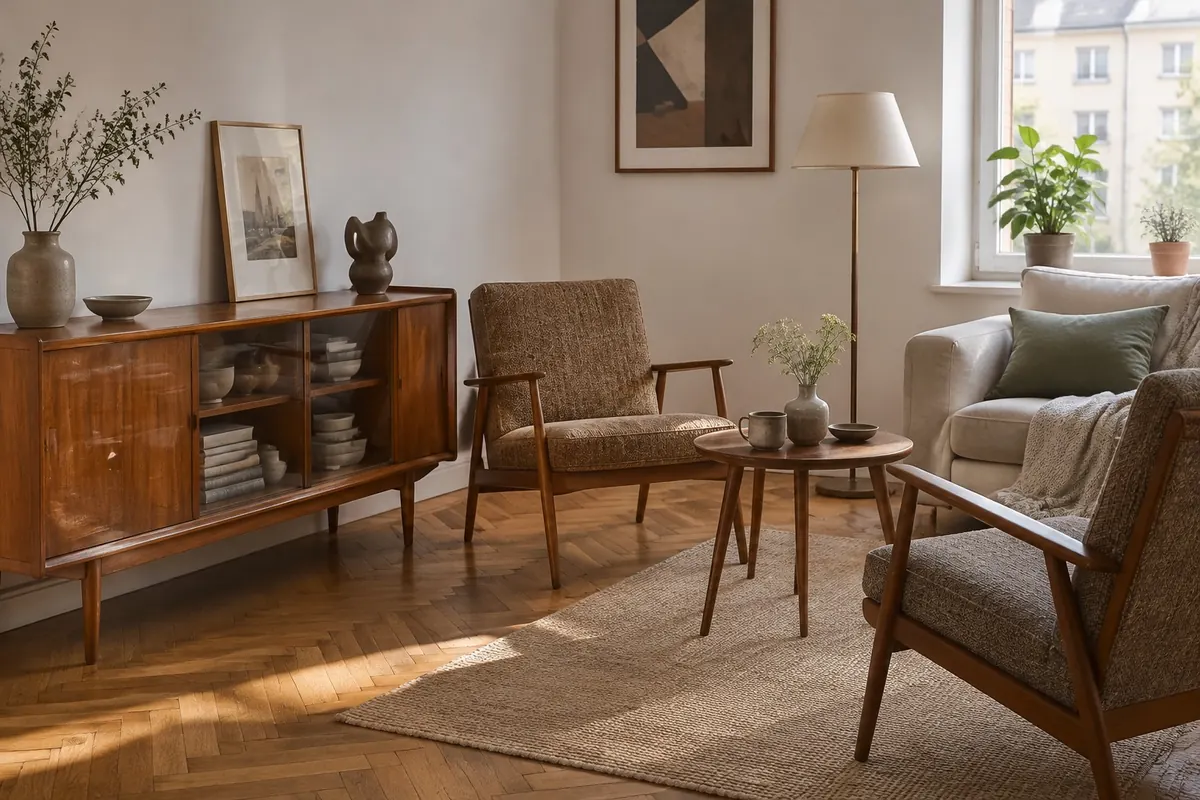
- Furniture on legs. The sofa, sideboard, dresser and armchair stand on slim legs, often tapered and slightly splayed. You can see the floor under the furniture.
- Warm wood. Walnut, teak, sometimes oak with a honey tone. Wood with a reddish cast instantly sets mid-century apart from Scandi with its pale birch.
- Color accents. Mustard, olive, terracotta, orange and teal on a light background. Usually it is an armchair, a sofa or pillows, not the walls.
- Simple soft shapes. Rounded corners, shell chairs, round and oval tables. No carving and no plasterwork.
- Light as part of the furniture. An arc floor lamp, dome pendants, table lamps with tapered shades.
Three signs out of five are usually enough. If you take all of them at once and add patterned walls, the room starts to look like a film set.
How are 1960s Soviet furniture and mid-century related?
Soviet furniture of the late 1950s and the 1960s is a close relative of mid-century modern. In 1956-1968 the USSR went through a furniture reform: designers dropped historical stylization and turned to the forms of international modernism. The goal was practical: to furnish the new small apartments. At the all-Union competitions of 1958 and 1961-1963, the juries selected 56 furniture sets for mass production, and by the mid-1960s furniture in the new style went into mass manufacturing (dissertation summary by A. Dezhurko, HSE University).
According to the same work, Soviet furniture makers had the closest ties with colleagues from the socialist countries of Eastern Europe, and later with designers from the Baltic republics. They did not copy American models, and the resemblance is a general one: light furniture on legs without decoration.
An armchair with wooden armrests, a three-legged coffee table, a low cabinet or a sideboard on legs from the 1960s fits into mid-century without a stretch. Such furniture often turns up on classified ad sites and costs less than new reproductions.
What works and what does not:
- Works: armchairs and chairs on tapered legs, low sideboards and cabinets on legs, side tables, floor lamps, ceramics.
- Works after restoration: pieces with worn lacquer and sagging upholstery. Veneer can be refreshed, and an armchair can be reupholstered in mustard or olive fabric.
- Does not work: polished floor-to-ceiling wall units and heavy furniture sets from the 1970s and 1980s. That is a different era, and in a 190 sq ft (18 m²) room they take up a whole wall.
One or two old pieces next to a new sofa still read as mid-century. With more old furniture, the room shifts into eclectic style, which has its own rules for tying things together.
How do you do mid-century modern in a standard apartment?
Start with the furniture. The walls can stay light and the floor can be any wood or wood-look surface: the style rests on the furniture silhouette and two or three spots of color.
Rules for a 2.6-2.7 m (8.5-9 ft) ceiling and a 160-215 sq ft (15-20 m²) room:
- Low furniture. The sofa, sideboard and dresser are lower than usual, so the wall above them stays open and the ceiling feels higher.
- One wood. Walnut or teak in two or three pieces. Five different wood tones in one room compete with each other.
- Color in furniture and textiles. A mustard armchair, an olive sofa, terracotta pillows. Walls are best left white or cream.
- A floor lamp instead of a chandelier. An arc lamp over the sofa and a couple of table lamps give warm 2700-3000 K light without a fixture in the middle of the ceiling.
- A rug with a geometric pattern. It ties the furniture colors together and hides an imperfect floor.
A mid-century living room
A sofa on legs, an armchair with wooden armrests, a round coffee table and a long low TV console. Above the console, one abstract painting or a poster.
A mid-century kitchen
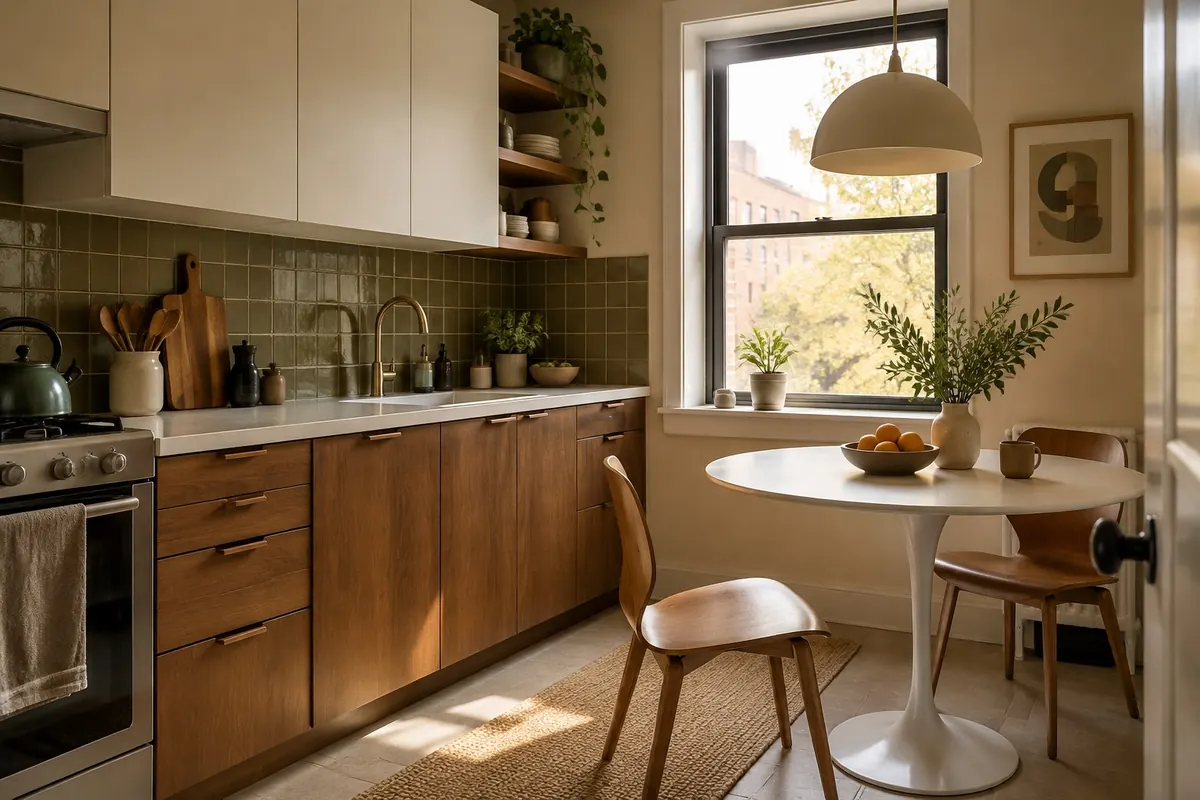
This kind of kitchen works even in 65-85 sq ft (6-8 m²). Walnut-look lower cabinets, light upper cabinets, a backsplash in olive or mustard tile. A round pedestal table is easy to approach from any side, and in a narrow kitchen it looks lighter than a rectangular one. How mustard differs from ochre and how much yellow a kitchen can take is covered in the article on yellow in interior design.
A mid-century bedroom
A bed on legs with a wooden headboard, two nightstands with drawers, table lamps with tapered shades. Color comes from the bedspread or from one muted olive wall behind the bed.
How is mid-century different from Scandinavian, Art Deco and Memphis?
All four styles come from the 20th century, which is why people confuse them. They differ in wood, color and how much impact the room has.
| Parameter | Mid-century | Scandinavian | Art Deco | Memphis |
|---|---|---|---|---|
| Period | 1940s-1960s | from the 1950s, today in a contemporary form | 1920s-1930s | 1980s |
| Wood | walnut, teak, warm tones | birch, light oak | dark, lacquered | almost none, plastic and laminate |
| Color | mustard, olive, orange on light | white, gray, pastels | emerald, black, brass | bright contrasting colors, patterns |
| Furniture | low, on slim legs | simple, light | rounded, velvet | geometric, toy-like |
| Feel | warm retro | light and calm | sheen and impact | play and provocation |
If you want something lighter and calmer, look at Scandinavian style. If you want sheen and a dark wall, there is Art Deco. The bright geometry of the 1980s is covered in our article on Memphis style. Retro from other decades, and how to keep an apartment from turning into a museum, is in our roundup of retro, eco and other styles.
How do you try mid-century on your own room?
A mustard armchair next to your floor and wallpaper may look different than in other people's photos. Before buying or restoring anything, look at the style on a photo of your own room.
- Photograph the room in daylight from chest height so the floor, the window and part of the ceiling are in the frame. More on shooting in our article on how to photograph a room.
- Upload the photo to Desow Redesign and choose the Mid-century style. For comparison, run the same room in Scandinavian and Eclectic.
- If you like everything except one item or the sofa color, fix that detail with Smart Edit.
A version is usually ready in less than a minute. One Redesign version costs 10 credits. The Free plan gives you free credits once at sign-up, enough for several versions. The image shows style and mood; furniture sizes are chosen later from measurements.
Frequently asked questions
Does mid-century modern work in a small apartment?
Yes, and it is one of the easiest styles for small rooms. The furniture is low and on legs, you can see the floor under it, and the walls stay light. Color lives in the furniture and textiles.
What colors do you need for mid-century modern?
The base is a white, cream or sand background and warm wood. The accents are mustard, olive, terracotta or orange. Two accent colors per room are usually enough.
Can you do mid-century with Soviet furniture?
Partly, yes. Armchairs, side tables, cabinets and sideboards from the 1960s on slim legs fit the style. Polished wall units and furniture sets from the 1970s and 1980s do not belong to mid-century. The best combination is one or two old pieces with a new sofa.
Are mid-century and mid-century modern the same thing?
Yes, it is one style. "Mid-century" is a short form of mid-century modern, "modernism of the middle of the century."
How is mid-century different from retro?
Retro is a pastiche of any past decade, often with kitsch. Mid-century modern is a specific style of the 1940s-1960s with its own rules: light furniture, warm wood, simple shapes.
Key takeaways
- Mid-century modern is mid-20th-century furniture on slim legs, walnut and teak, mustard, olive and orange on a light background.
- In a standard apartment with a 2.6-2.7 m (8.5-9 ft) ceiling the style is convenient: the furniture is low and the walls stay light.
- 1960s Soviet furniture is a relative of mid-century: in 1956-1968 Soviet furniture design moved to the forms of international modernism.
- Mid-century differs from Scandinavian style in its warm wood and color, and from Art Deco in its lack of sheen.
- More styles are collected in our interior styles guide, and you can try mid-century on your own room in Desow Redesign.