Contemporary interior style: what it is, how it differs from Art Nouveau and modernism, and how to do it in an ordinary apartment
Contemporary is the interior style of the current decade. How it differs from Art Nouveau, modernism and minimalism, and how to do it in a typical apartment.
Contemporary style is an interior put together from what feels comfortable and fitting right now: a calm light base, furniture with simple, soft shapes, natural textures and one or two pieces with character. It has no fixed canon. Its rules shift with time, which is why a "contemporary" interior from 2006 looks like an old renovation today.
In Russian articles about contemporary style, the confusion starts with history: some trace the style to the Bauhaus, others to the 1960s, still others to the 1980s. Below: where these disagreements come from, what contemporary looks like in the 2020s, and how to put it together so you don't have to redo the whole apartment five years from now.
How is contemporary different from Art Nouveau and modernism?
In Russian, five similar-sounding words collide here, and each means something different. That is where the mixed messages in articles and in briefs to designers come from.
| Term | Russian name | Period | How to recognize it |
|---|---|---|---|
| Art Nouveau | "modern" | late 1880s - 1914 | curving lines, floral ornament, stained glass |
| Modernism, Bauhaus | "modernism" | 1919-1933 (Bauhaus) and later | geometry, function, steel tubing, no decoration |
| Mid-century modern | "midsenchuri" | 1940s-1960s | wood, tapered legs, streamlined shapes |
| Contemporary | "kontemporari" | the current decade | whatever counts as current right now |
| Modern style | "sovremenny stil" | now | in Russian roundups, an umbrella name for today's styles |
Art Nouveau is a historical movement from the turn of the 20th century; in Russia it is called "modern" (Wikipedia, in Russian). In English-language design, "modern" usually means modernism: the functionalism of the Bauhaus school, which worked in Weimar, Dessau and Berlin from 1919 to 1933 (Wikipedia, in Russian). There, in 1925, Marcel Breuer designed a chair made of steel tubing, later known as the "Wassily."
Contemporary does not fit into this sequence as a separate era. It takes function and simple shapes from modernism, but it is tied to "now." English Wikipedia puts it briefly for architecture: contemporary architecture is the architecture of the 21st century, and no single style dominates it (Wikipedia). The same is true of interiors. That is why contemporary has no generally accepted birth date.
Why does contemporary age, and how can you tell?
If the style equals "now," yesterday's contemporary simply becomes an old interior: a mid-2000s renovation was also called modern, and a lot has flipped to the opposite since then. The table below is an observation of how mainstream taste has shifted, not a strict classification.
| Feature | Contemporary of the 2000s | Contemporary of the 2020s |
|---|---|---|
| Ceiling | multi-level, glossy, perimeter lighting | flat, matte |
| Cabinet fronts | gloss, chrome | matte, handleless or with a thin profile |
| Lighting | cold, lots of recessed spots | warm, floor lamps and sconces, several lighting scenes |
| Palette | white with gray, contrasting black | warm neutrals: milky white, beige, greige |
| Shapes | right angles, sharp edges | curves: sofas, side tables, headboards |
| Textures | glass, plastic, solid surface | wood, linen, wool, travertine, boucle |
| Decor | matching sets from a store | one painting, one old piece, ceramics |
So contemporary is never done once and for all. You put the apartment together so you can update it layer by layer later.
How to recognize contemporary today
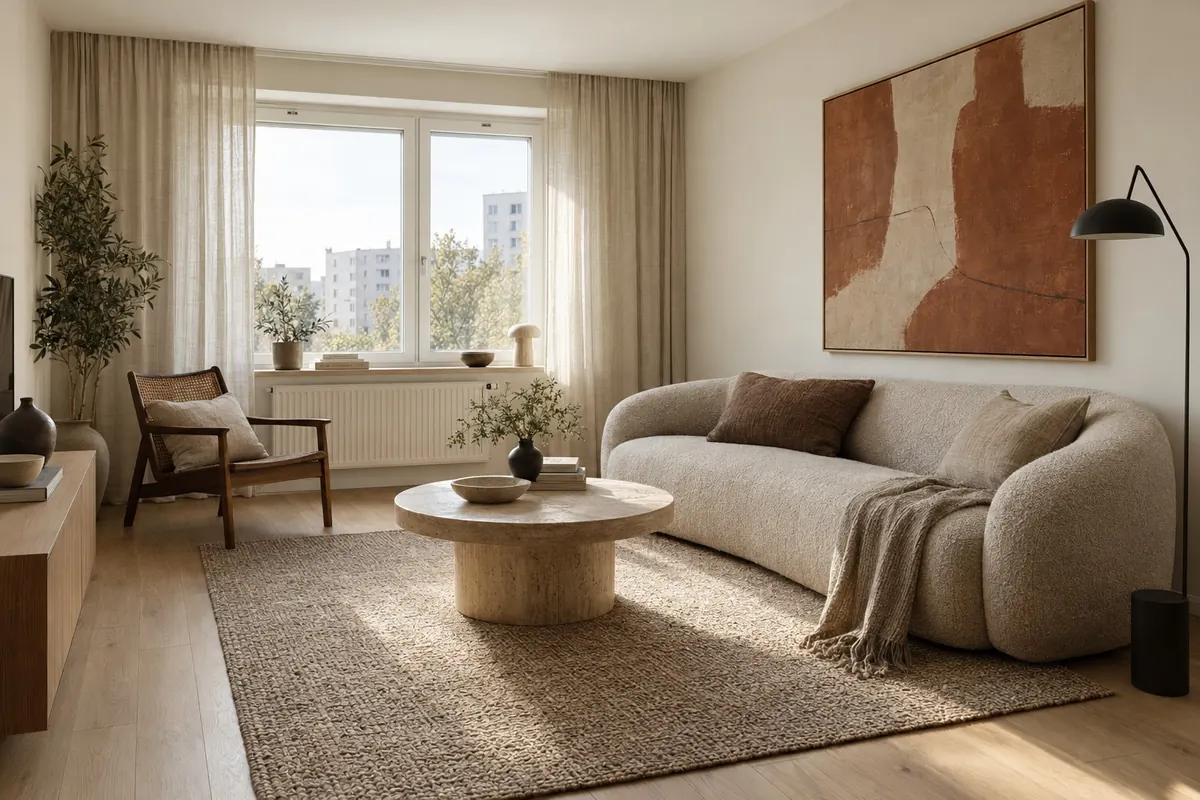
In the 2020s, contemporary is recognized by a combination of three things.
- Warm restraint. The backdrop is light and calm, but not sterile. White is often replaced with milky white or warm gray.
- Soft geometry. Furniture is simple, without carving or gilding, but with rounded corners. It often stands on legs, so you can see the floor.
- A personal piece. A painting by a living artist, a flea-market armchair, a grandmother's vase. Without such a piece, contemporary easily turns into a furniture store showroom.
The third point is what sets contemporary apart from minimalism. Minimalism hides almost everything, while contemporary leaves a few things in view that say something about the owner.
How do you do contemporary in an ordinary apartment?
Contemporary doesn't need high ceilings or a large floor area, so it works well in a typical apartment. The difficulty lies elsewhere: anything done as part of a renovation lasts 10-15 years, and "contemporary" will change in that time. So work in layers. The time frames in the table are rough guidelines, not rules: a lot depends on materials and on how you live in the apartment.
| Layer | How often it changes | What to choose for contemporary | What to avoid |
|---|---|---|---|
| Floors, doors, baseboards | every 15-20 years | one flooring throughout, wood or mid-tone laminate | trendy shades like "gray oak" over the whole area |
| Walls and ceiling | every 5-10 years | matte paint in a warm neutral, a flat ceiling | complex ceilings and photo wallpaper |
| Kitchen and closets | every 10-15 years | smooth matte fronts, floor-to-ceiling cabinets | gloss and trend-driven milled fronts |
| Sofa, bed, table | every 7-10 years | simple silhouettes, replaceable upholstery | overly trendy shapes for the main sofa |
| Lighting | every 5-7 years | warm bulbs, a floor lamp, sconces, surface or track lights | a single ceiling light in the center |
| Textiles, art, small things | every 2-3 years | this is where "now" lives: color of the year, an unusual vase | changing the floor for a new trend |
Keep trends in the bottom rows of the table, in what you can change over a weekend. Choose calm floors, walls and kitchen, and the apartment will outlast several changes in fashion.
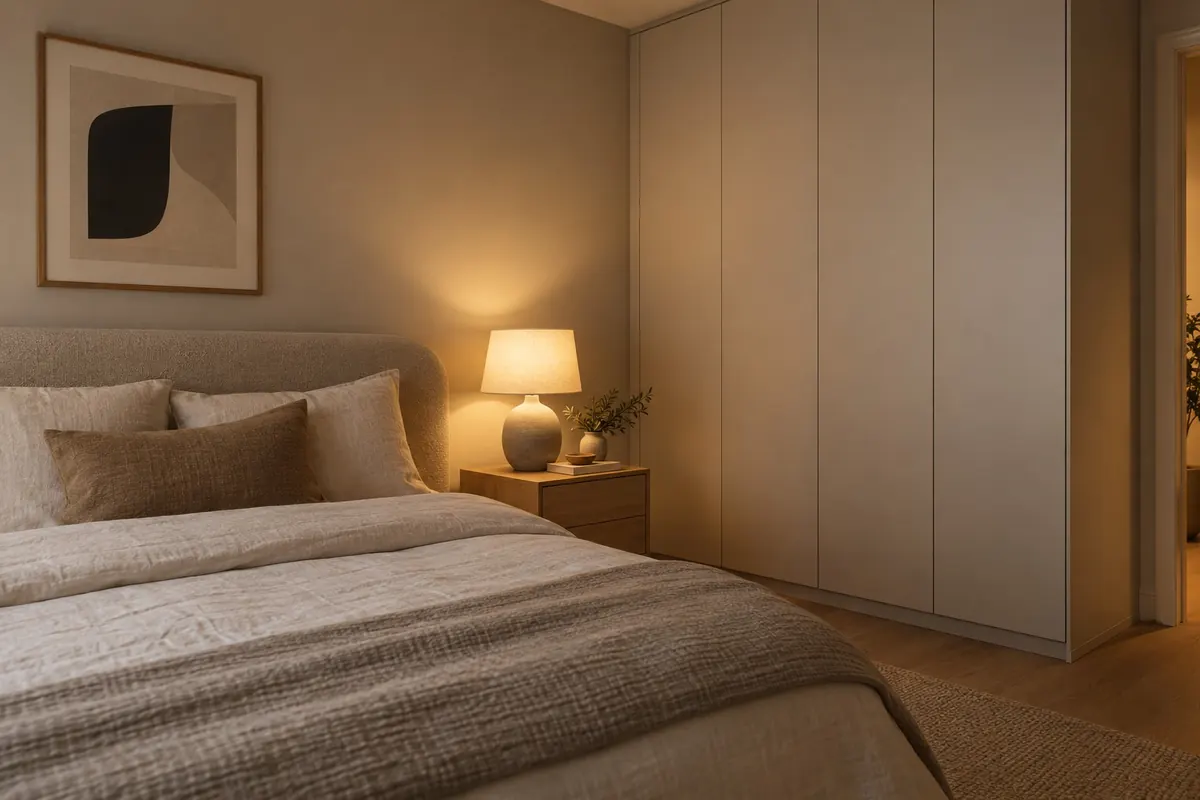
A panel apartment building adds one more condition: the rooms are small and the windows are ordinary. Here contemporary relies on unity. One palette for the whole apartment, the same flooring, without thresholds where possible, floor-to-ceiling closets so the wall doesn't break up. A contemporary living room usually comes together around a simple sofa, a floor lamp and one painting instead of a wall unit. A contemporary kitchen means matte floor-to-ceiling fronts, a calm countertop and warm light over the work area. Layout and colors for a 40-50 m² apartment are covered in detail in our article on modern interior style, which looks at the same set of decisions in a broader sense.
How is contemporary different from minimalism, high-tech and mid-century?
Contemporary borrows a little from each of its neighbors; the difference shows in how each style treats time and things.
| Style | Relation to time | Things in view | Main material | Risk |
|---|---|---|---|---|
| Contemporary | follows "now" | a few personal ones | wood, textiles, stone | dating fast if trends end up in the floors and walls |
| Minimalism | timeless | almost nothing | smooth surfaces | a cold, empty room |
| High-tech | an image of the future | technology | glass, metal, gloss | dating along with the technology |
| Mid-century | 1940s-1960s | furniture as exhibits | walnut, teak | turning the apartment into a museum |
The Art Nouveau style, which Russian speakers most often confuse with contemporary because of the translation, has its own article: Art Nouveau in interiors.
Common mistakes
- Buying a "ready-made contemporary" look from one store. The room looks like a shop window, with no personal piece.
- A trend in the finishes. Trendy tile across the whole backsplash or a colored floor gives away the year of the renovation faster than anything.
- Cold white light. Even the right furniture looks like an office under cold bulbs.
- Too many curves. A rounded sofa, a round table, arches and an oval mirror together turn contemporary into a caricature. Two or three soft shapes are enough.
How do you try contemporary on your own room?
Desow Redesign has no separate "Contemporary" style. The closest one is Minimalism. They share a base: a light, calm backdrop, smooth fronts, simple furniture and clear surfaces. Minimalism is stricter: the image will have less textiles and almost no personal things. But it will show you the base, and you can add the warm details yourself.
- Photograph the room in daylight, from chest height, so the floor, ceiling and two walls are in the frame.
- Upload the photo to Redesign and choose the Minimalism style.
- For comparison, make a second version in Mid-century or Scandinavian. They add wood and warmth. Contemporary usually lands somewhere in between.
- Note what doesn't match what you had in mind. You can change a wall color or the material of a single item in the photo with Smart Edit, which works in a desktop browser.
One Redesign version costs 10 credits and usually takes less than a minute. The Free plan gives you free credits once at sign-up, enough for several versions. How to compare several styles and pick one is covered in our article on choosing a style before renovating.
Frequently asked questions
Are contemporary and modern style the same thing?
Almost. In Russian, "contemporary" translates as "modern," and both mean an interior that feels fitting right now. The difference is in usage. Russian roundups often use "modern style" for all of today's directions at once, from loft to Scandinavian. Contemporary is usually understood more narrowly: the calm base of the current decade without the marks of another style.
How is contemporary different from Art Nouveau?
Art Nouveau (called "modern" in Russian) is a historical style from the late 19th and early 20th centuries with curving lines and floral ornament. Contemporary is today's interior, with simple shapes and almost no ornament. The confusion comes from the English word "modern," which usually refers to 20th-century modernism.
Does contemporary work in a Khrushchev-era building or a small apartment?
Yes, it suits a small floor area well. A light backdrop, floor-to-ceiling closets and furniture on legs make a room feel more open. Just don't pile up large rounded pieces: a small room doesn't have space for them.
Can I design a contemporary interior online from a photo?
You can try a close style. Desow has no separate "Contemporary" style; the closest is Minimalism. The free credits you get at sign-up cover several versions; subscription terms are on the pricing page.
In short
- Contemporary is the interior of the current decade. It has no canon and no birth date, so stories about the Bauhaus or the 1980s explain its roots, not the style itself.
- Russian "modern" means Art Nouveau from the turn of the 20th century, while English "modern" means modernism. Both get confused with contemporary because of translation.
- Today contemporary is recognized by a warm, calm backdrop, soft shapes, natural textures and one or two personal pieces.
- To keep the style from dating, keep trends in textiles, lighting and decor, and make the floors, walls and kitchen calm.
- In Desow, the closest style to contemporary is Minimalism: try it in Redesign on a photo of your room and compare it with Mid-century.