Art Nouveau interior design: how to bring the Russian modern style into a regular apartment
Art Nouveau interior design, known in Russia as modern style: key features, how it differs from contemporary and Art Deco, and what fits an 8.5 ft ceiling.
Art Nouveau interior design, called "modern" in Russia, is the style of the turn of the 20th century: flowing curved lines, stems and flowers in the ornament, stained glass, bentwood, wrought metal and a muted, nature-based palette. In a regular apartment you build it from details: one curved line in the furniture, patterned glass in a door or lamp, a botanical print on one wall. Full-on Art Nouveau in a 190 sq ft (18 m²) room with an 8.5 ft (2.6 m) ceiling turns it into a museum hall.
The name causes confusion. In Russian, "modern" is the historical style, while in English the word means something else: mid-century modernism or simply today's look. If what you want is how apartments are furnished now, that is the contemporary style, covered in a separate article. This one is about historical Art Nouveau and how to bring it into an ordinary panel-building apartment.
What is Art Nouveau and where did it come from?
Art Nouveau was most popular between 1890 and 1910 and had largely run its course by 1914. Each country had its own name for it: Jugendstil in Germany, Secession style in Austria, stile Liberty in Italy, Modernisme in Catalonia and simply "Modern" in the former Russian Empire (Wikipedia). One of its first buildings was Hôtel Tassel in Brussels by Victor Horta, completed in 1893.
The best-known Russian example is the Ryabushinsky Mansion on Malaya Nikitskaya Street in Moscow. Fyodor Schechtel built it in 1900-1903, and since 1965 it has housed the Gorky apartment museum (Wikipedia, in Russian). The main staircase is shaped like a wave, the parquet looks like sea waves, the door handles are shaped like seahorses, and a jellyfish lamp sits on the crest of the staircase.
An Art Nouveau architect designed everything, from the facade to the door handle, and every object in the house repeated the same motifs. In an apartment, three or four such motifs are enough, for example a stem, a wave and colored glass, repeated across different pieces. Twenty random curlicues from different stores don't add up to Art Nouveau.
How to recognize Art Nouveau: six features
Two or three of these are enough for a room to read as Art Nouveau.
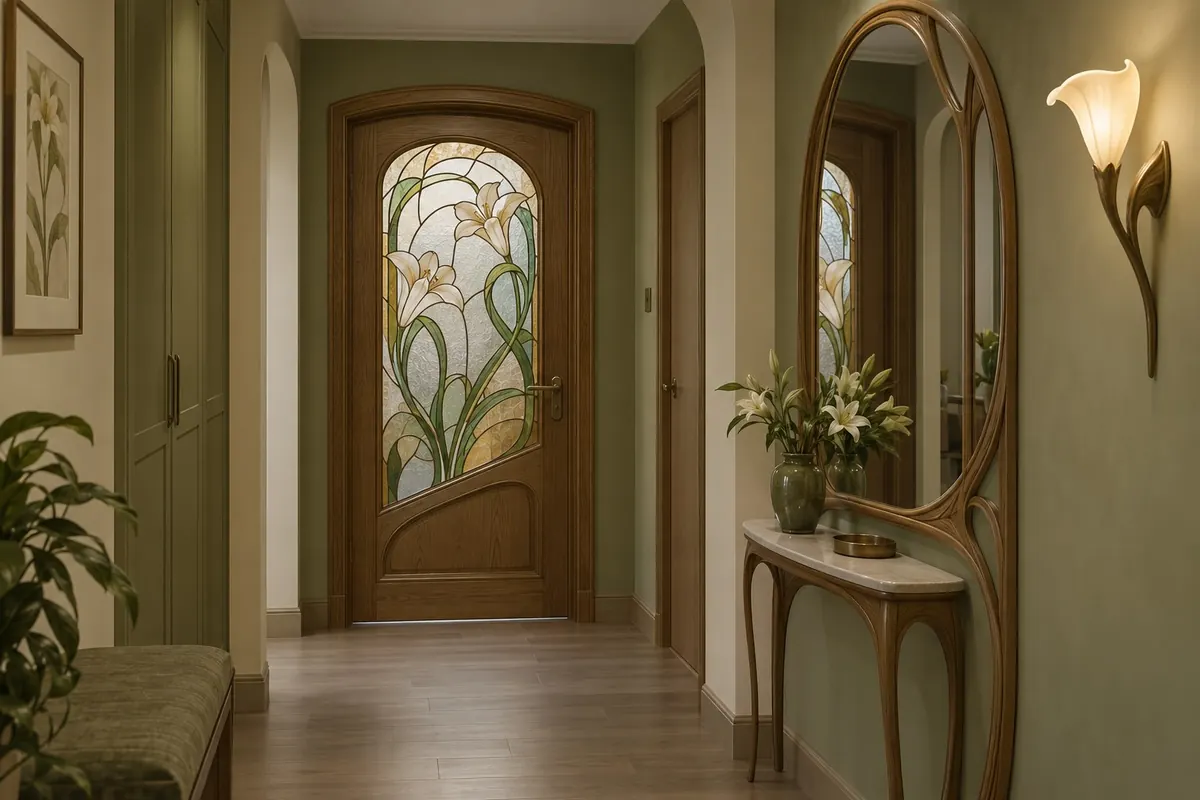
- The curved line. It's called the "whiplash": a long, smooth curve with a sharp flick at the end. You see it in a chair back, a table leg, a mirror frame, a railing.
- Botanical motifs. Irises, lilies, poppies, climbing stems, and less often dragonflies and peacock feathers. The ornament is stylized: a flower is reduced to a few flowing lines.
- Colored glass. Stained glass in a door or window, a lamp with a glass mosaic shade.
- Wood with a soft profile. Rounded cabinet corners, arched door tops, carving shaped like stems.
- Metal as drawing. Wrought iron or brass details that bend like plants.
- A nature-based palette. Olive, sage, mustard, dusty rose, cream, warm wood and bronze. Pure bright colors are rare.
One more trait is asymmetry. Classic style sets everything in pairs along an axis, while Art Nouveau happily leaves an arch off-center and an armchair on its own.
How is Art Nouveau different from contemporary, Art Deco and neoclassic?
These four styles get mixed up most often, and they differ mainly in the line and the source of the pattern.
| Feature | Art Nouveau | Art Deco | Neoclassic | Contemporary |
|---|---|---|---|---|
| Line | flowing curve, stem, wave | straight, stepped, fan | straight, frame, cornice | simple, no decor |
| Pattern source | plants, water, insects | geometry, machines, the sun | antiquity | almost no pattern, texture does the work |
| Symmetry | often broken | strict | strict | whatever is practical |
| Glass | stained glass, colored mosaic | fluted, mirrored, crystal | clear | clear, frosted |
| Metal | wrought, bronze, dark brass | shiny brass, chrome | brass in small doses | black, matte |
| First impression | everything seems to grow | everything shines and sparkles | calm and light | nothing extra |
Art Deco came after Art Nouveau and straightened its lines: stems turned into fans and chevrons. Neoclassic takes order and symmetry from classic style. If your room has straight moldings and matching sconces on both sides of the sofa, it's neoclassic, even if the wallpaper has flowers on it.
How to do Art Nouveau in a regular apartment?
Start with what changes without renovation, and leave expensive finishes for last. A typical apartment with a 2.6-2.7 m (8.5-9 ft) ceiling and precast panel walls usually sets three limits: little height, little light and right angles everywhere.
Walls and ceiling
Put the botanical pattern on one wall: behind the sofa or the bed. Keep the other walls plain, in the background color of the wallpaper. Skip ornate plaster on an 8.5 ft ceiling: it usually makes the ceiling look lower. A thin cornice or nothing at all is enough.
Arches are easier to add through furniture and frames than through walls: a mirror with an arched top, a cabinet with arched doors, a headboard with a soft outline. A drywall portal with a wave in the doorway eats height and looks like a 2000s office.
Doors and glass
This is a visible and relatively inexpensive move. An interior door with a glass insert showing stems sets the style for the entryway and hallway right away. If you don't want to replace the door, use stained glass film on the glass of a door or a kitchen cabinet: a budget option, though up close it looks simpler than real stained glass. A table lamp with a colored glass shade in the Tiffany spirit works in any room.
Furniture
One curved piece per room is enough: an armchair with bent arms, a side table on a curving leg, a bed with a wavy headboard. Keep the rest of the furniture simple, in warm wood, without gloss. When everything around is curved, the room loses its anchor and the eye has nowhere to rest.
Light and color
Art Nouveau usually suffers under cool light: wood turns gray and stained glass goes dull. Use warm bulbs and several light sources: a ceiling light, sconces, a table lamp. For the background, go with cream or light sage; for the accent, olive, mustard or dusty rose. How to build that kind of pair is covered in our article on color combinations in interior design.
Living room, bedroom and kitchen
In the living room, the style rests on an armchair, a lamp and one patterned wall. In the bedroom, on the headboard and bud-shaped bedside lamps. In the kitchen, wood cabinet fronts with a soft raised panel, a backsplash tile with a botanical pattern and brass pulls are enough.
Before you buy iris wallpaper, see how Art Nouveau would sit in your room: upload a photo to Desow Redesign and compare a few related styles.
What mistakes to avoid?
- Curlicues everywhere. Curved legs, frames, curtain rods and ceiling medallions together turn Art Nouveau into fake Baroque.
- Flowers on every surface. Wallpaper, curtains, rug and bedspread with botanical prints compete with each other. Keep the pattern on one large surface and the rest plain.
- Dark wood on a dark background. In a room with one window, especially a north-facing one, this eats the light.
- High gloss. White lacquer clashes with Art Nouveau, which suits matte wood, fabric and glass.
How to try Art Nouveau on a photo of your room?
Desow Redesign has no separate Art Nouveau style. The closest one is Art Deco. The two share an era of decorative art and the same materials: warm brass, patterned glass, velvet, light used as decoration. The difference is the line. Art Deco draws fans and steps, Art Nouveau draws stems and waves, so an Art Deco result needs softening.
The second option is Neoclassic. It gives a light, calm background, thin moldings and simple furniture. That's a good base to which you then add one or two Art Nouveau pieces. The difference is that neoclassic relies on symmetry and straight frames.
- Take a photo of the room in daylight, holding the phone level, with the floor, the window and part of the ceiling in the frame.
- Upload the photo to Redesign and run it twice: in Art Deco and in Neoclassic. Compare where you prefer impact and where you prefer a calm background.
- Finish the version you like with Smart Edit: select the ceiling light or armchair and describe it in words, for example "stained glass lamp with irises." An edit costs 7 credits and works in a desktop browser.
A version is usually ready in less than a minute. One Redesign costs 10 credits, and the Free plan gives you free credits once at sign-up, enough for several versions. The image shows the mood and how pieces go together; furniture sizes are chosen later from measurements.
Frequently asked questions
Are Russian "modern" and contemporary style the same thing?
No. "Modern" in Russian is the historical style from the late 1880s to 1914, with flowing lines, botanical ornament and stained glass. Contemporary style is how apartments are furnished today: simple shapes and a neutral background. The names get mixed up because of the English word modern.
What is "contemporary modern" in Russian design talk?
It usually means Art Nouveau simplified for today's apartment. The flowing lines, natural materials and palette stay, while ornament and carving shrink a lot. Sometimes the same phrase just means contemporary style, so look at the photos: do they have curved lines and botanical motifs?
Are Art Nouveau and "modern" different styles?
No, they're the same style. Art Nouveau is the French name and "modern" the Russian one; in Germany it was called Jugendstil and in Austria Secession style.
Does Art Nouveau work in a small apartment?
Yes, at the level of details: one wall with a botanical pattern, a door with glass, one curved armchair, a warm lamp. Avoid dark wood paneling, ornate plaster and wall-to-wall stained glass in a 130-190 sq ft (12-18 m²) room.
Can I try Art Nouveau in Desow?
Redesign has no separate Art Nouveau style. The closest are Art Deco and Neoclassic: the first gives brass, glass and velvet, the second a light background with moldings. You can then add Art Nouveau details with Smart Edit.
Key takeaways
- Art Nouveau, called "modern" in Russia, is the style of roughly 1890-1914: flowing lines, plants in the ornament, stained glass, bentwood and bronze.
- It gets confused with contemporary style because of the word modern, but they're different styles.
- With a 2.6-2.7 m (8.5-9 ft) ceiling, use details: a patterned wall, a door with glass, one curved armchair, warm light.
- Art Nouveau differs from Art Deco in its line: stems and waves instead of fans and steps.
- More styles are in our interior styles guide, and you can try Art Deco and Neoclassic on a photo of your room in Desow Redesign.