Slavic and Neo-Russian interior style: a Russian home in an apartment without the log cabin look
Russian and Slavic style interior design for apartments: how Neo-Russian differs from the log cabin look, how much folk pattern to use, Gzhel, linen and wood.
Slavic, or Russian, interior style is built on light wood, linen, embroidery, ceramics and folk patterns. Its modern version is called Neo-Russian style. It has no log walls, no masonry stove and no carved chest in every corner: the background is calm and light, and the tradition shows in two or three details. That can be an embroidered runner on the table, Gzhel china on an open shelf or a carved dresser. In a city apartment with 2.6-2.7 m (8.5-9 ft) ceilings, this is the version that works.
In a survey by Yandex Realty, designer Artem Boldyrev of AS Buro said: "Russian style is gaining momentum. We now see a Neo-Russian take on interiors almost everywhere" (Yandex Realty, in Russian). We covered this in our review of 2026 interior design trends.
How do Slavic, Russian and Neo-Russian style differ?
The names overlap, but each puts the stress somewhere else. "Slavic" is the broader term: it covers embroidery and folk patterns of different Slavic peoples, not only Russian ones. "Russian" relies on specific images: the peasant log house (izba), the country estate, the wooden tower house (terem), painted dishes. "Neo-Russian" is a modern take on the same motifs in a city interior.
The word has a history. In architecture, Neo-Russian is the name for the late 19th and early 20th century stage of the Russian Revival style, and some scholars see it as the national romantic branch of Art Nouveau (Wikipedia, "Russian style", in Russian). Designers today use it for a city apartment with references to tradition.
In Desow Redesign this direction is called "Slavic". In interiors it usually splits into three branches:
- Log house: logs or boards on the walls, a stove, benches, homespun rag rugs. For a country house or a sauna.
- Estate: a 19th-century gentry house with light walls, tiled stoves, mahogany furniture and lace.
- Neo-Russian: a light background, simple wood furniture, linen, with embroidery and folk crafts as accents. It suits a city apartment.
What makes up a Neo-Russian interior?
You recognize a Neo-Russian interior when three layers come together: natural wood, linen textiles with embroidery and one or two pieces of folk craft. Without the craft, the room is easy to mistake for Scandinavian, and five crafts on one shelf turn it into a souvenir shop.
Wood
Light oak, pine, birch, matte oil instead of varnish. Furniture has simple shapes, and carving stays on one piece: the headboard, a dresser front, a mirror frame. A carved window surround can also go indoors, around a doorway.
Linen and embroidery
Unbleached linen on curtains and tablecloths, embroidered towels, pillowcases with red geometric patterns. Red embroidery on white is the clearest sign of the style, and on textiles it is easy to dose: take it off and the room is neutral again.
Ceramics and folk crafts
Gzhel is blue-and-white porcelain and majolica from a cluster of villages about 60 km (37 miles) from Moscow. From the second half of the 1820s, many pieces were painted only with blue paint made from cobalt oxide (Wikipedia, "Gzhel ceramics", in Russian). Khokhloma is gold, red and black painted wood, and Pavlovsky Posad shawls carry large floral prints. Each of them is bright on its own. That is why a room keeps one main craft, and the rest of the dishes are plain clay and white ceramics.
Palette
Base: milky white, flax, the color of light wood. Accent: red, less often cobalt or deep green. One color should lead. When red, blue and gold compete as equals, the room turns into a folk-print cliche. How to keep the accent within a third of the room is covered in our article on color combinations in interiors.
How does Slavic style differ from English country and boho?
All three styles love wood, fabric and handmade things, so mood boards mix them up. The difference is in the pattern and in where the things come from.
| Feature | Slavic (Neo-Russian) | English country | Boho |
|---|---|---|---|
| Main idea | tradition and folk craft in a modern apartment | the coziness of an English village house | things gathered on travels, a free mix |
| Pattern | geometric embroidery, painting on wood and china | floral chintz, plaid, stripes | ethnic rugs, macrame, many countries |
| Wood | light, matte, carving on one piece | painted, sage and olive | rattan, wicker, dark wood |
| Textiles | linen, red embroidery on white | floral cotton, wool throws | jute, cotton, lots of cushions |
| Palette | milky white, light wood, red accent | cream, sage, muted red | terracotta, sand, olive |
| Risk | folk kitsch and a souvenir shop | a museum and visual noise | a storage room |
English country is the closest to Slavic style: both have village coziness and red as an accent. Country relies on floral wallpaper and painted furniture, Slavic on linen, geometric embroidery and natural wood. Read more about the branches of English style in our article on English style interiors, and about not drowning in things in our article on boho style.
How do you do Russian style in a city apartment?
Many Russian style mood boards are shot in wooden houses with high ceilings. In a typical apartment, logs, dark beams and a stove eat up the height, so people go with the light Neo-Russian version. Six rules:
- Keep the background neutral: light paint or plaster, no wood paneling and no faux logs.
- One main craft per room. A second one is fine as one or two pieces if it repeats the textile color: red Khokhloma next to red embroidery.
- Pattern on one or two surfaces: a runner and curtains, or a headboard and pillowcases.
- One carved piece. A dresser, sideboard or bed with carving gives character, the rest of the furniture stays simple.
- Skip glossy stretch ceilings, chrome and plastic cabinet fronts: they clash with wood and linen.
- Warm light in several spots: a pendant with a fabric shade, a lamp on the dresser, sconces by the bed.
It is easier to check how much pattern your room can take on a photo than in a store: upload a picture to Desow Redesign and pick "Slavic".
Kitchen
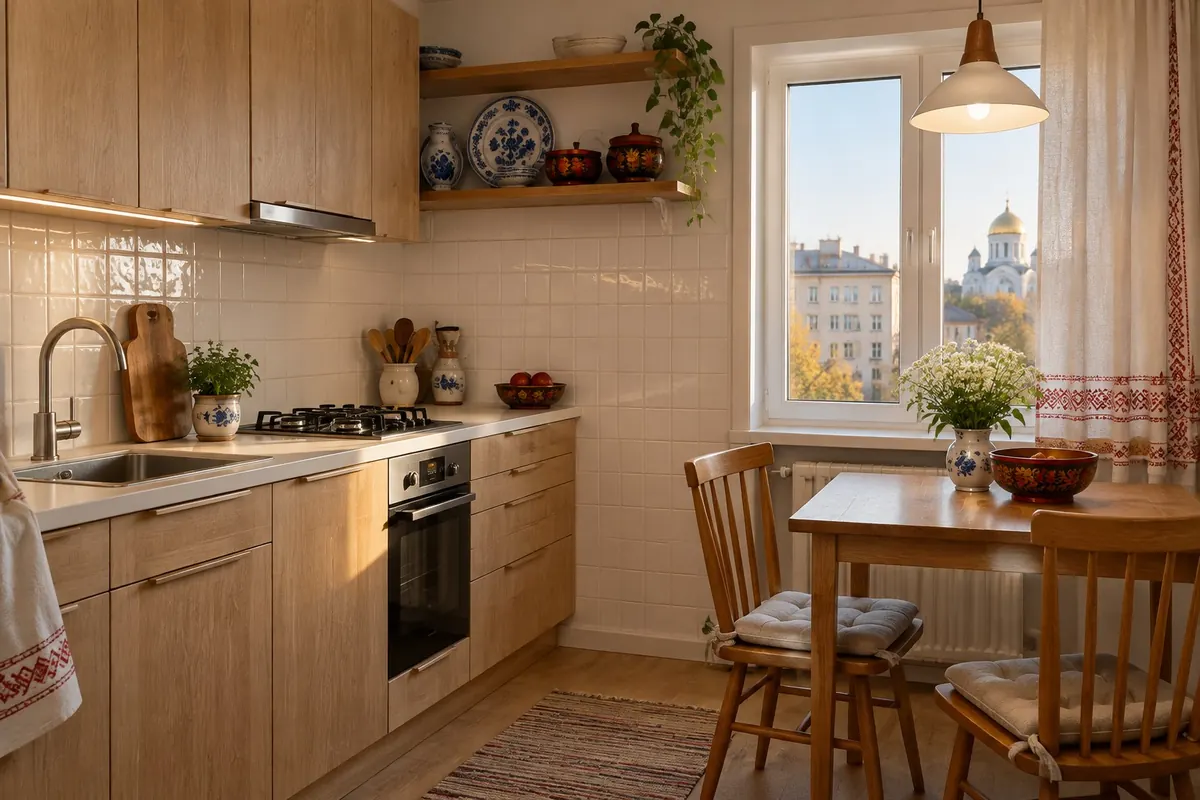
The kitchen is where the style settles in most easily. Plain wood cabinet fronts without carving, white backsplash tiles, one open shelf with Gzhel, a couple of Khokhloma bowls, a linen curtain with an embroidered border. In a kitchen under 9 m² (about 100 sq ft) we would leave one shelf open and put the rest away in cabinets. More ideas for small spaces are in our article on small kitchen design.
Bedroom
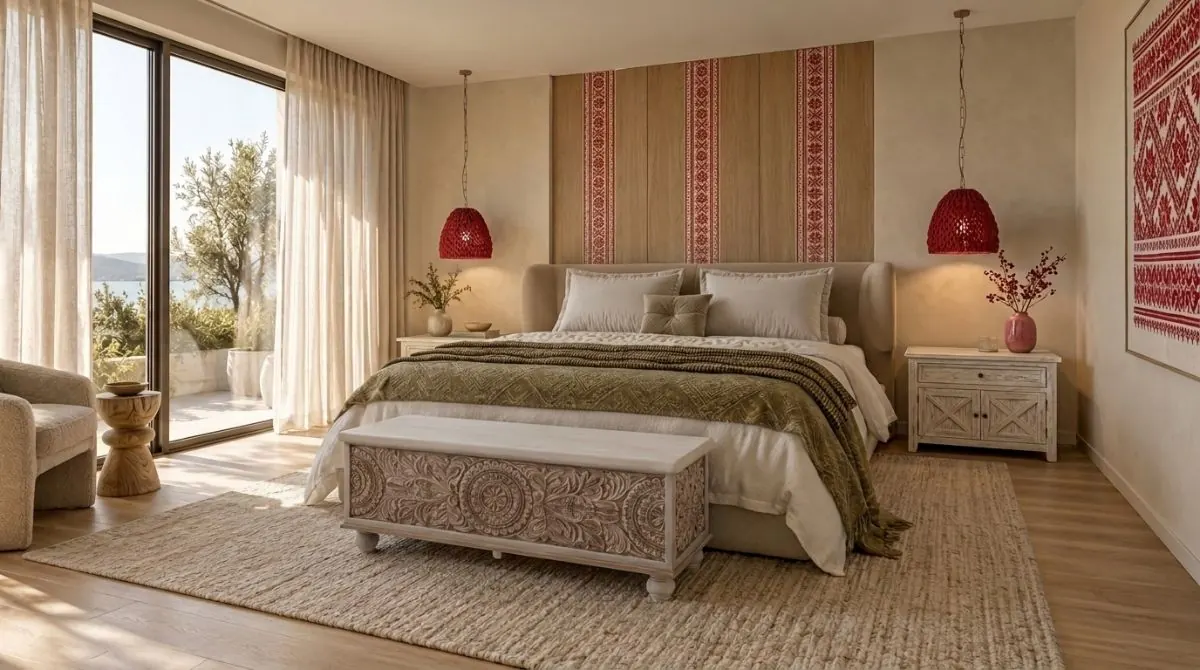
In the bedroom, the pattern gathers behind the headboard: vertical bands of embroidery on a wood panel, or a single framed piece. Linen bedding, a wool throw, a chest or bench at the foot of the bed instead of an ottoman. Red pendant lights on both sides of the bed repeat the color of the embroidery and tie the room together.
Living room
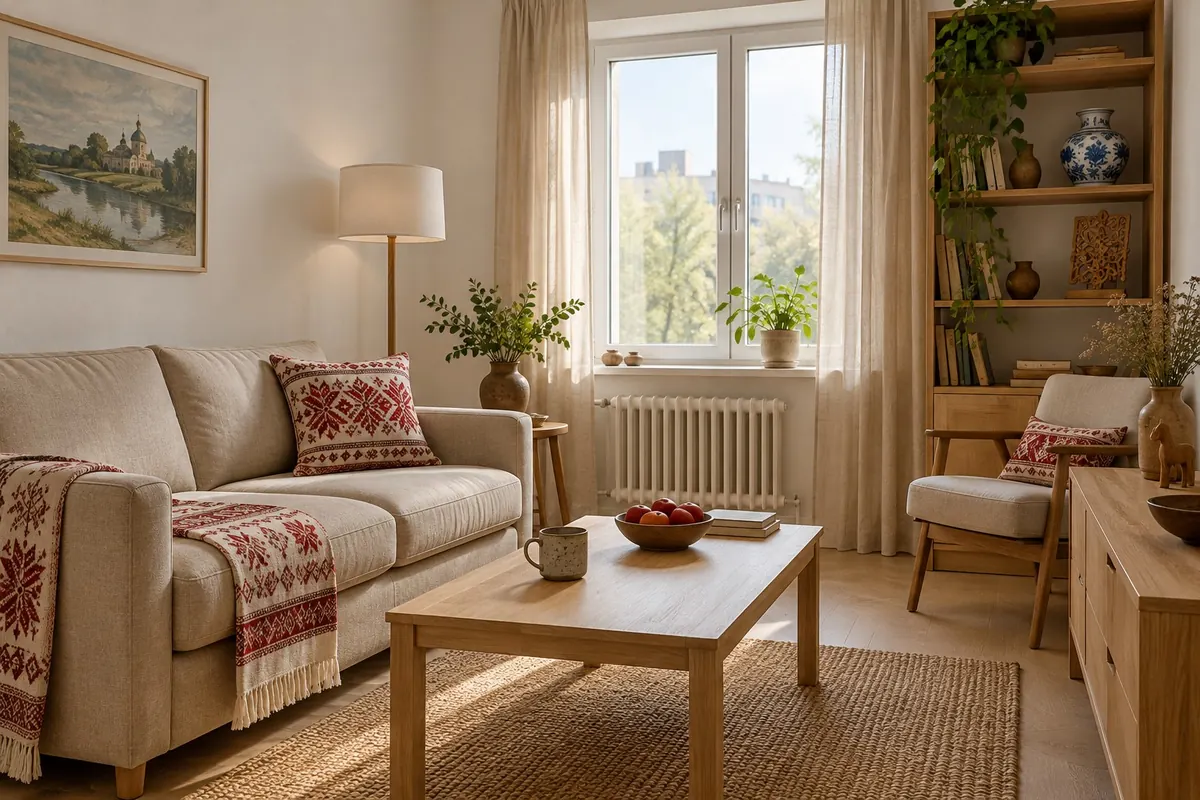
In the living room, the bookcase or a table with a bench takes the lead. The shelves hold ceramics, books and one Gzhel vase, and the sofa is modern, in a linen slipcover. Pattern stays on textiles: two cushions and a throw, as in the cover image of this article.
What mistakes turn an interior into folk kitsch?
In Russian, the word "lubok" means bright folk prints with simple stories, and in interior talk it means overdoing folk decor. Most often it happens like this:
- Every craft at once. Gzhel, Khokhloma, Zhostovo trays and nesting dolls on one shelf fight each other.
- Pattern everywhere: on the wallpaper, curtains, tablecloth, rug and dishes at the same time.
- Faux logs. "Log cabin" panels in an apartment with a 2.6 m (8.5 ft) ceiling look like a roadside cafe.
- Souvenirs instead of real things. One good piece from a workshop gives the style, a shelf of tourist nesting dolls and magnets does not.
- Dark varnished wood on everything. Light matte wood is closer to the modern take and does not eat the light.
How do you try Slavic style on a photo of your room?
Carved furniture and embroidered curtains are bought for years, so it is worth seeing the style on your own room first.
- Shoot the room in daylight, hold the phone level, and get the floor, the window and part of the ceiling in the frame.
- Upload the photo to Desow Redesign and pick "Slavic". A variant is usually ready in under a minute.
- Run the same room in "English country" and "Scandinavian". That shows where coziness ends and too much pattern begins.
One Redesign variant costs 10 credits. The Free plan gives you free credits once at sign-up for several variants up to 1K with a watermark: enough to pick a direction. The image shows the colors and mood, and the size of the embroidery and the height of the dresser are chosen later from measurements.
Frequently asked questions
Does Russian style work in a small apartment?
The Neo-Russian version does: a light background, simple furniture, pattern on one or two surfaces and one main craft. A log house look with wood on the walls and dark beams will feel heavy in a 12-15 m² (130-160 sq ft) room with a 2.6 m (8.5 ft) ceiling.
How is Neo-Russian style different from the Russian log house style?
The log house look recreates a village house: logs, a stove, benches, rag rugs. Neo-Russian style keeps its materials and motifs (linen, wood, embroidery, ceramics) and makes the walls, lighting and furniture modern.
Can you combine Slavic and Scandinavian style?
Yes, and it is a common pairing. Both styles have light wood and simple shapes. Scandinavian gives the background, and Slavic adds embroidery and ceramics. Read more about the Scandinavian base in our article on Scandinavian style.
Where do Gzhel and Khokhloma go without looking kitschy?
In the kitchen or dining area, on one open shelf or in one cabinet. Make one craft the main one and add the second as one or two pieces. Red Khokhloma will support red embroidery on the curtains, and Gzhel will pick up blue dishes. Let the rest of the dishes be white or plain clay.
Key takeaways
- Slavic, Russian and Neo-Russian style overlap. In an apartment, the Neo-Russian version works: a light background and tradition in the details.
- The base of the style is light matte wood, linen, red embroidery on white and ceramics.
- The dosing rule: one main craft per room, pattern on one or two surfaces, one carved piece.
- It differs from English country by geometric embroidery instead of floral chintz, and from boho by one tradition instead of a mix of countries.
- See related styles in our interior styles guide and in our articles on English style and boho.
- Before you buy furniture and textiles, try "Slavic" on a photo of your room in Desow Redesign.