Gray in interior design: warm and cool shades, color pairings and how to keep a gray room from feeling dull
Gray in interior design: warm vs. cool gray, a chart of shades, which colors go with gray, why a gray room looks dull and how to fix it with light and texture.
Gray comes in two families: warm, with a beige, brown or olive undertone, and cool, with a blue one. North-facing rooms usually get a warm gray, while south-facing rooms can take a cool one too. A gray room turns dull for three reasons: the undertone fights the light, the bulbs are cool, and every surface is smooth and the same value. So look at the shade under your own light, use two or three grays of different lightness, and bring in wood, linen and wool.
Gray is often called a universal backdrop that can't go wrong. Yet the same paint looks refined in a south-facing living room and turns the color of wet asphalt in a north-facing bedroom. General palette rules, the 60-30-10 rule and light reflectance value (LRV) are covered in our article on interior color combinations; this one is only about gray.
Warm and cool gray: the main shades
Pure gray is a mix of black and white, but you rarely find it in wall paint. Almost every gray has an undertone, a small amount of another color, and that undertone decides how the shade behaves in a room.
| Shade | Undertone | Works well in | Watch out |
|---|---|---|---|
| Light gray, pearl | nearly neutral | walls of small rooms, next to a white ceiling | next to bright white it can look dingy |
| Greige, gray-beige | warm, beige | north-facing rooms, bedroom, living room | under yellow bulbs it drifts to beige |
| Taupe, gray-brown | warm, brown or pinkish | living room, bedroom, upholstery | clashes with a cool gray floor |
| Gray-green, sage | green: warmer with yellow, cooler with blue | kitchen, bedroom, rooms with wood and plants | in a dark room it can turn murky |
| Gray-blue | cool, blue | south-facing rooms, home office | looks gloomy on the north side |
| Charcoal, anthracite | neutral or blue | accent wall, lower kitchen cabinets, furniture | on every wall of a small room it feels heavy |
If you lean toward the warmer gray-beiges, see our article on beige in interior design.
How to read a gray's undertone
On a single swatch the undertone is barely visible. Comparison gives it away:
- Put the swatch on a sheet of white printer paper. Against white, a warm gray leans beige or pink, and a cool one leans blue.
- Compare two or three grays side by side. On its own each looks like "just gray," but together you can see at once which is warmer.
- Look at the dark end of the fan deck strip. The darker shades of the same line usually show the undertone more clearly than the light ones.
- Check the sample by your own window. Look at it in daylight and in the evening under your lamps: the store light is different.
Why does a gray room look dull?
It usually comes down to several mistakes at once. The photo below has cool gray-blue walls, gray bedding and curtains, a north window and an overcast day.
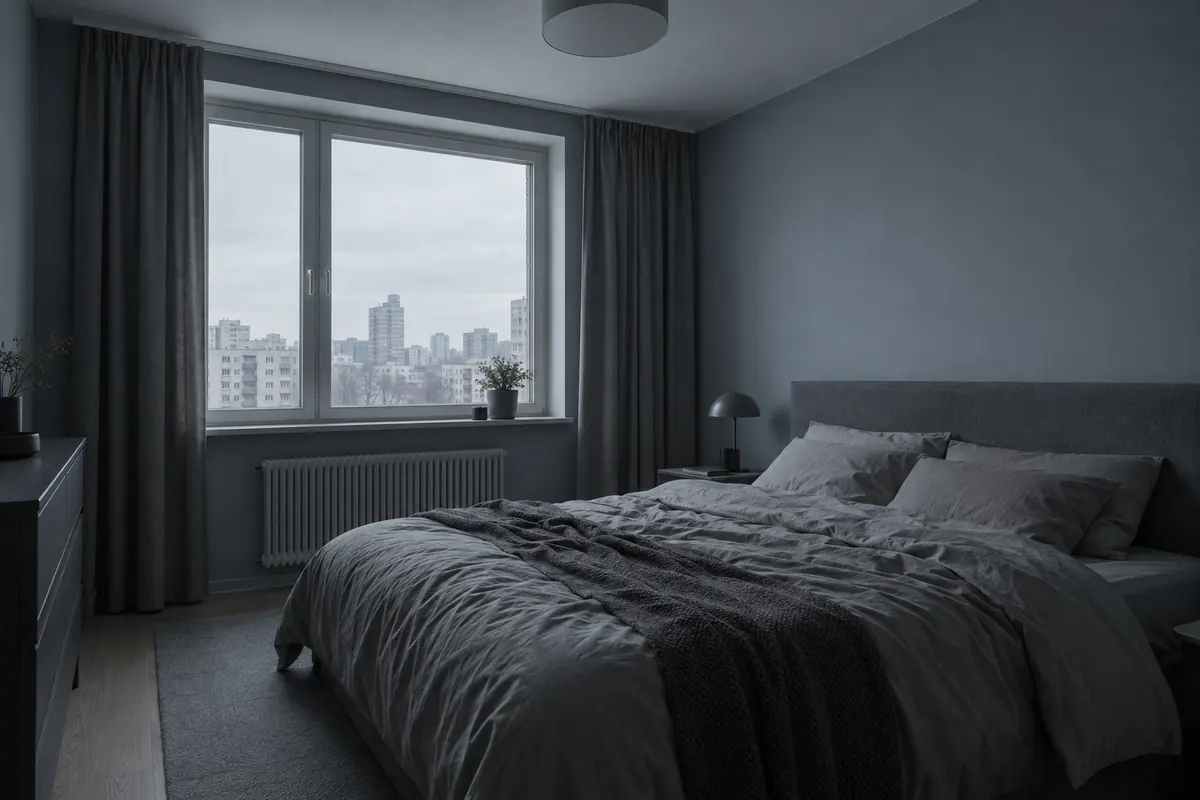
- The undertone fights the light. A cool gray under cool northern light loses its color, and the room looks gloomy.
- Everything is the same value. Walls, curtains, bedding and furniture are close in lightness, so the eye has nothing to hold on to. Gray needs range: a light background, mid gray in textiles, charcoal in one or two pieces, white bedding.
- One texture. Smooth paint, smooth fabric and smooth laminate make gray flat. Linen, wool, bouclé and wood add light and shadow to it.
- No warm material. Without wood, brass, plants or a color accent, a gray room feels like an office.
- Cool light bulbs. Under 4000 K and above, gray usually looks bluer, especially in the evening when there is no daylight.
- Too dark a gray in a small room. Dark paint reflects little light, and with one window the room feels smaller.
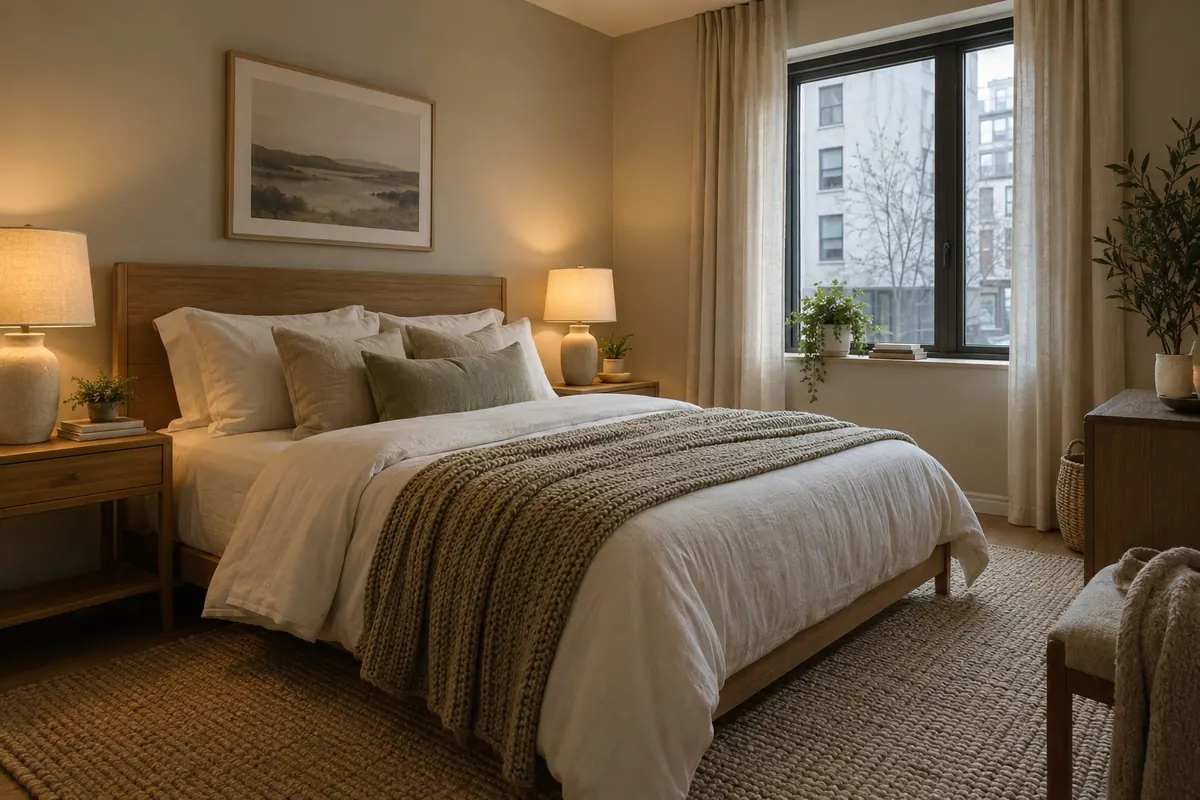
Below is a similar north-facing bedroom on an overcast day, but with warm gray walls, wood, white linen bedding, a knitted throw, greenery and two lamps with warm light.
Gray in north- and south-facing rooms
Window direction changes every color, but gray shows it most: it has no strong pigment to "outshout" the light from the window.
North-facing room
The light is even and cool, with almost no direct sun. Light warm grays work here: greige, warm pearl, gray with a drop of ochre. Gray-blue and cool charcoal on every wall are risky.
South-facing room
The sun is warm, so cool gray and gray-blue look fresh on the south side. A warm gray here can turn yellowish and drift into beige during the day.
East and west
The same wall looks different in the morning and in the evening. A neutral gray is the safer choice, and the sample should be checked at both times of day.
Light bulbs
In the evening the lamps set the wall color. In bedrooms and living rooms gray usually does best with warm 2700-3000 K light. The second number on the box is the color rendering index, Ra: it shows how accurately a bulb renders the colors of objects. The scale tops out at 100; values above 90 fall into the highest category, and 80-89 into the next one, also rated "very good" (Wikipedia, in Russian). The higher the Ra, the more accurately the bulb renders shades, so for a gray with a subtle undertone pick a bulb with Ra 90 or higher.
What colors go with gray in interior design?
Gray goes with almost any color, and the undertone tells you which pair will feel natural: warm gray with warm colors, cool gray with cool ones. Opposite pairs work too, as long as one color clearly leads.
- White. Warm gray pairs better with milky or cream white, cool gray with pure white. Bright white next to a warm gray often makes it look dingy.
- Beige and sand. The softest pair; together they make a greige palette. More in our article on beige.
- Wood and brown. Light oak warms even a cool gray, while walnut and chocolate make the palette deeper. Shades of brown are covered in our article on brown in interior design.
- Green, olive, sage. With warm and olive grays they make a calm, natural palette (on green).
- Blue. Navy with charcoal and light gray is a crisp palette for a home office or bedroom (on blue).
- Yellow and mustard. A classic accent for gray. In 2020 Pantone named two colors of the year for 2021: the cool gray Ultimate Gray and the yellow Illuminating (RBC Style). In a room, yellow works best as a throw, pillows or an armchair.
- Dusty pink and terracotta. Warm accents that take the "office" feel off gray. Pink goes better with a warm light gray, terracotta with greige and wood.
- Black. A gray room needs black only in thin lines: frames, light fixtures, handles.
Gray in the living room, bedroom and kitchen
Living room
In living rooms gray most often goes on the walls and the sofa. To keep them from blending, separate them by lightness: light walls and a sofa a shade or two darker, or the other way around. Then add a textured rug, a wooden coffee table and a couple of colored pillows, as in the cover photo. Layout and lighting for the living room are covered in our article on living room design.
Bedroom
A gray bedroom especially needs a warm undertone, white bedding and soft textiles. Charcoal works well behind the headboard if the other walls are light. More bedroom ideas are in our article on bedroom design.
Kitchen
In kitchens gray usually goes on the cabinet fronts. A common choice is charcoal lowers and light gray uppers, a warm wood-look countertop and under-cabinet lighting over the work area. More on gray kitchens and other cabinet colors in our article on kitchen design.
How to try gray on a photo of your room?
Before you buy paint, it helps to see gray in your own room. You can do it in Desow Smart Edit: upload a photo, select the wall and describe the color in words, for example "warm gray with a beige undertone" or "light gray-blue." The edit changes only the selected area, so two or three options are easy to compare. One edit costs 7 credits, and the free credits on the Free plan cover several options. Smart Edit works in a desktop browser.
To see the whole room in a gray palette, use Redesign, which also works on phones: gray is the base of the Minimalism, Loft, Brutalism and Scandinavian styles. Each has its own article: minimalism, loft, brutalism.
A screen can't show the exact shade; the picture shows the mood and the pairings. Check the finalist with a sample patch on the wall, in daylight and in the evening.
Frequently asked questions
Is gray a warm or a cool color?
Pure gray is neutral, but paint almost always has an undertone. Gray with a beige, brown or olive undertone is considered warm, and gray with a blue one is cool. You can see the undertone on a white sheet of paper or next to another gray.
Which gray should I choose for a north-facing room?
A light, warm one: greige, warm pearl, gray with a drop of ochre. Cool gray-blue on the north side often looks gloomy. Keep dark charcoal for one wall or for furniture.
What wall color goes with a gray floor?
Walls lighter than the floor and with the same undertone: milky white or greige with a warm gray laminate, white and light gray with a cool gray floor. If the floor is cool and you want warmth, add it with a rug and wooden furniture.
Is gray still in style?
As a base, yes, but cool gray is giving way to warm neutrals. Designer Irina Alexandrova, in a Yandex Real Estate survey, suggests replacing gray and white with milky, almond, pinkish-beige and "mushroom" shades. Pantone's color of the year and other trends are collected in our article on 2026 interior trends.
In short
- Gray can be warm (beige, brown, olive undertone) or cool (blue undertone). You only see the undertone by comparison.
- North-facing rooms take light warm grays, south-facing rooms can also take cool ones, east and west call for neutral grays.
- A gray room looks dull when the undertone fights the light, everything is the same value, and there is no texture or warm material.
- Bulbs for gray: warm 2700-3000 K with good color rendering, ideally Ra 90 or higher.
- First compare two or three grays on a photo of your room in Smart Edit, then check the finalist with a sample patch on the wall.