Wall colors in interior design: how to choose a shade by room, light and floor and test the color before you paint
Wall colors in interior design: a table by room and light, matching walls to your floor and furniture, one accent wall, low ceilings and paint samples.
Choose a wall color by three things: how much light the room gets, what you do in it and what stays after the renovation, such as the floor, doors and large furniture. A sunny living room suits muted cool shades, a north-facing one suits warm light shades, and a bedroom suits calm mid-tones. Compare the finalists on a photo of your room first, then with a sample patch on the wall.
Roundups of "50 wall colors" show other people's apartments, with their windows and their floors. Below is how to match a color to your own room and test it before you buy paint for the whole apartment. General palette rules, the 60-30-10 scheme and LRV are covered in our article on color combinations in interior design, and wall materials in the one on wall design.
What wall color should you choose for a room?
Start with the window: a paint fan in the store does not account for it. The same paint looks like two different colors in a sunny living room and in a bedroom whose window faces the next building.
| Room | Light | Wall color | What to avoid |
|---|---|---|---|
| Living room | south or west, sun for most of the day | muted cool and mid-tones: sage, gray-blue, greige | saturated yellows and oranges: in the sun they "burn" |
| Living room | north, or a window facing the next building | warm light shades: off-white, warm white, sand, light olive | cold gray and pale blue: in diffuse light they turn dull gray |
| Bedroom | any; it is usually empty during the day | muted mid and deep shades: gray-green, dusty blue, taupe | a bright color on the wall facing the bed: you see it lying down |
| Kids' room | needs light for play and homework | a light calm base, bright color in textiles and on one wall | bright saturated color on every wall |
| Home office, work corner | daytime, often under a desk lamp | light neutrals or a muted green | bright saturated colors in your line of sight: they distract |
| Small room, one north window | little light all day | light shades with a warm undertone | dark color on every wall at once |
| Kitchen | depends on the cabinets | a calm color that does not compete with the cabinets | a shade that almost matches the cabinets but not quite |
The Finntella table gives similar guidelines as light reflectance values: LRV 55-70 for living room walls, 35-55 for a bedroom and 68-78 for a small room short on light (Finntella, in Russian). These are a paint maker's guidelines, not a building standard. LRV is the share of light a paint reflects, and manufacturers list it on the color card.
A kitchen with colored cabinets is a separate task, covered in our article on kitchen color. For each color in detail, see the series on white, gray, beige, green and blue.
How do you match wall color to the floor and furniture you are keeping?
Write down everything that will not change after the renovation: the floor, interior doors, kitchen, sofa, wardrobe. These already set the palette, and the wall has to work with them. Usually the wall is made noticeably lighter or darker than the floor so the two do not merge. Two undertone cases come up often: orange-toned wood looks better with muted cool walls, which tone down the yellow, and a gray floor looks better with neutral walls that have no yellow undertone.
| What stays | What to keep in mind | Walls that usually work |
|---|---|---|
| Orange-toned laminate, walnut-look parquet | the wood adds yellow to the room | muted cool shades: sage, gray-blue, light greige |
| Gray laminate | a cold floor makes warm walls look dirty | light grays, gray-beige, white without a yellow undertone |
| Dark floor, wenge | a dark floor absorbs light | light shades: off-white, light beige, warm white |
| White doors and baseboards | white becomes the reference, and the wall's undertone shows next to it | any color, but test a sample patch next to the door |
| Walnut-look doors | the door is the same wood, just on the wall | as with an orange-toned floor: off-white, sage, light greige |
| A colored sofa | the room's main color is already chosen | a calm background: a tone lighter or darker than the sofa, with different saturation |
Doors and baseboards can also be painted the wall color. They almost disappear, and a small room looks more unified. For wood and brown furniture, see our article on brown in interior design.
The floor and wall pair is easy to test on a photo: in Smart Edit, select the wall and describe the color, for example "warm off-white". The edit changes only the selected area, so the floor and furniture in the picture stay yours.
One wall in a different color: how do you pick the second color?
A second color on one wall gives a room character without much risk. There are three common options, from the calmest to the boldest:
- The same color 2-3 shades darker. The room stays calm, and the wall stands out.
- A color already in the room. Terracotta from the cushions, green from the curtains, blue from the rug.
- A contrasting color. For example, deep blue next to sand. This option is bolder and needs a test on a photo.
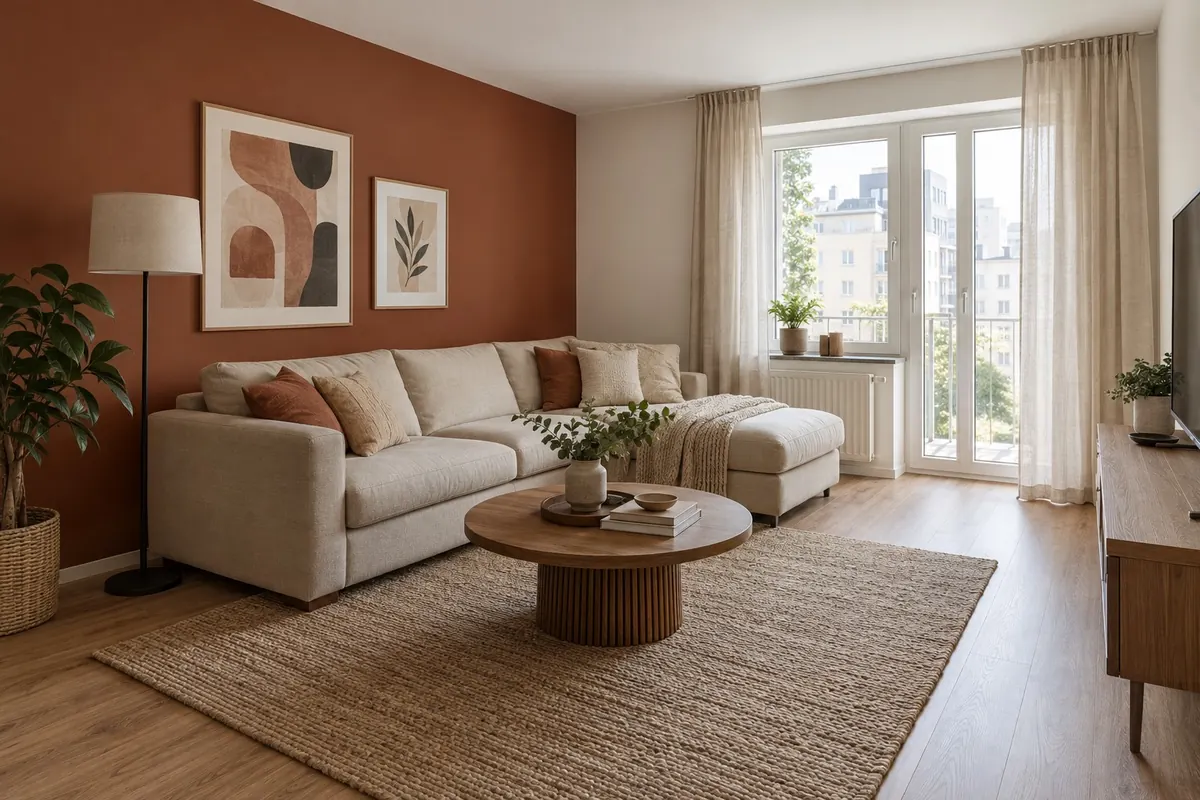
Run the color boundary along an inside corner of the room, not across the middle of a wall. A saturated wall casts its color onto the walls next to it, so the white beside a terracotta wall will look slightly warmer. Which wall to choose and how to finish it is covered in our article on wall design, and dark walls in the one on dark interiors.
What wall color works for a small room and a low ceiling?
A small room usually gets light walls and an even lighter ceiling. For a small room short on light, Finntella recommends walls with an LRV of 68-78 and a ceiling of 82-90. To make the ceiling look higher, the LRV difference between walls and ceiling should be at least 15-20 units. At a difference of 8-10 units, the ceiling blends into the walls (Finntella, in Russian).
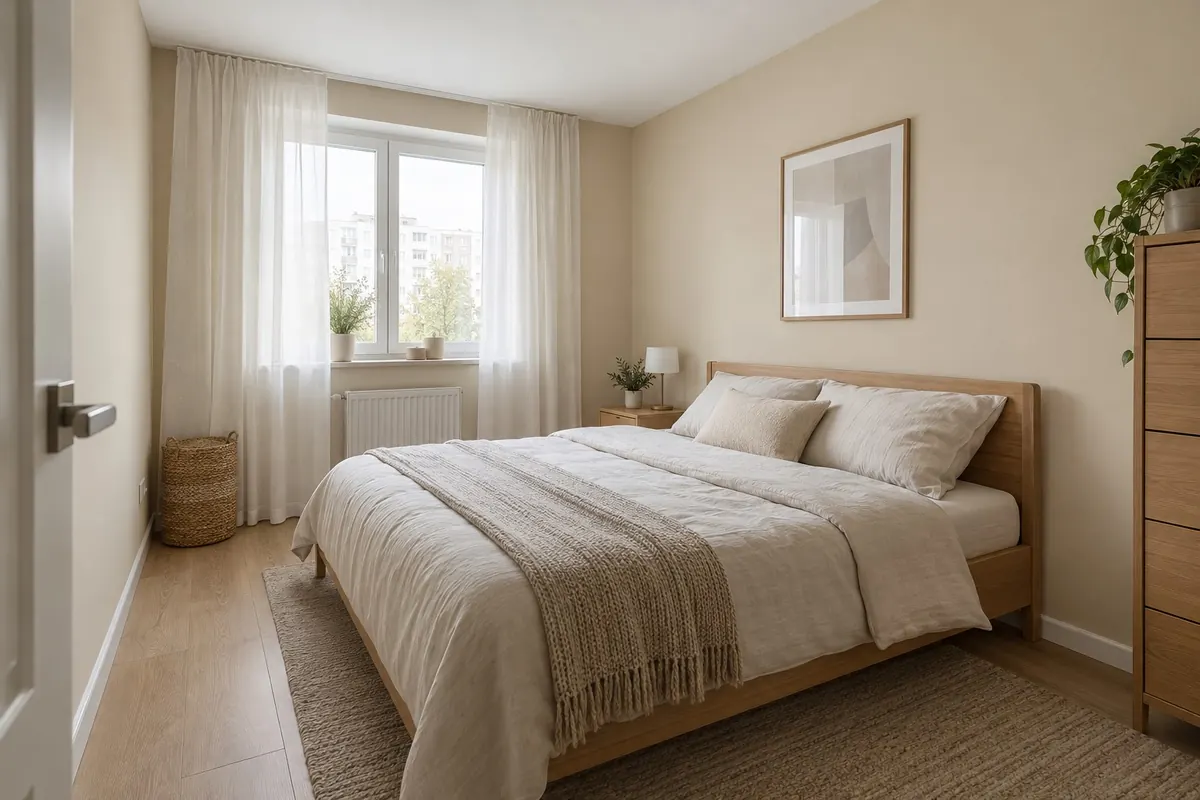
What else helps a room with a ceiling of 2.5-2.7 m (about 8 ft 2 in to 8 ft 10 in):
- Wall color all the way to the ceiling. A wide crown molding or a white band at the top of the wall cuts off height.
- No horizontal stripes. A border or a color change halfway up splits the wall in two, and the room looks lower.
- Baseboards in the wall or floor color. A white baseboard on a colored wall draws one more line.
- Curtains from the ceiling. A curtain rod right under the ceiling stretches the wall upward.
A dark color in a small room is also possible: walls and ceiling in one dark color blur the corners. People choose it for a cozy bedroom or home office, but it will not make the room lighter or roomier. How to make a small bedroom feel bigger is covered in our article on small bedroom design.
How do you avoid mistakes with paint samples?
A color you liked on a card in the store often looks different at home.
Why color looks different in the store and at home
Two samples that match under one light can stop matching under another. This is called metamerism (Wikipedia), in Russian). In the store the card is lit by the sales floor lamps; at home it is lit by your window and your lamps. So choose the color only in your own room.
The testing order
- Compare 2-3 colors on a photo of the room. In Smart Edit one edit costs 7 credits and usually takes less than a minute. The Free plan gives you free credits once at sign-up, enough for several comparisons. Smart Edit works in a desktop browser; it is not available on phones yet.
- Buy samples of the finalists. Paint a patch at least 50×50 cm (about 20×20 in) in two coats. If the old wall is dark or colored, paint the patch white first, or the old color will show through.
- Make two sample patches. One by the window, the other in the darkest corner. The color on these two walls usually looks noticeably different.
- Look only after it is fully dry. Wet paint looks different from dry paint. Judge the sample separately in daylight and under lamps.
- Check it in the evening under your own lamps. A warm bulb shifts the color toward yellow, a cool one toward blue.
- Have the whole amount tinted at once. With hand tinting, every batch comes out a slightly different tone, and matching a shade in parts is almost impossible (Kraski.ru, in Russian). Machine tinting by code is more precise, but it is still safer to order the paint for a room in one go. Keep a little paint after the renovation for touch-ups.
The picture shows how a color works with your floor and furniture, but a screen cannot show the exact shade. So the final choice is made by the sample on the wall.
Frequently asked questions
What is the most versatile wall color?
Most often light warm neutrals: off-white, warm white, light greige. They rarely clash with either an orange-toned or a gray floor and depend on the direction of the window less than other colors. For a north-facing room, pick a shade with a warm undertone.
What color should you paint bedroom walls?
A bedroom usually suits muted mid-tones: gray-green, dusty blue, taupe, warm gray. The bedroom is usually empty during the day, so it can be darker than the living room. Keep the wall facing the bed calm.
What wall color goes with gray laminate?
Light grays, gray-beige and whites without a yellow undertone. Warm yellow and peach walls next to a cold gray floor often look dirty. Test the pair on a photo of your room before you buy paint.
Can you paint the walls of one room in different colors?
Yes, usually as one wall in a different color. The safest choice is the same color 2-3 shades darker or a color from the room's textiles. Run the boundary along an inside corner.
In short
- Choose wall color by the light in the room: muted cool shades for a sunny one, warm light shades for a north-facing one, muted mid-tones for a bedroom.
- First write down what stays: the floor, doors, large furniture. Make the wall noticeably lighter or darker than the floor, and pair orange-toned wood with muted cool shades.
- For one wall in a different color, the safest choice is the same color 2-3 shades darker, with the boundary at a corner.
- A small room with a low ceiling needs a ceiling clearly lighter than the walls and wall color all the way up.
- Compare 2-3 colors on a photo of your room in Smart Edit, then paint 50×50 cm samples by the window and in a dark corner, and have the whole amount tinted at once.