Dark interiors in an apartment: where dark colors work, where they don't, and how to light them
Dark colors in an apartment interior: which rooms can take dark walls, one wall or the whole room, three lighting scenes, matte vs. gloss, and black.
Dark colors in a small apartment work best where you spend mostly evenings: the bedroom, a corner of the living room, the lower kitchen cabinets. Start with one dark wall. Paint the whole room dark only if the window faces south or west and you have enough lamps for three lighting scenes. In a north-facing room where people work or kids play during the day, keep dark color for furniture and textiles.
General color theory, including the 60-30-10 rule, LRV and window direction, is covered in the article on interior color combinations. This one answers a simpler question: can your room handle a dark color, and how do you keep it from feeling gloomy? Don't confuse a dark interior with the Dark Academia style. That style means bookcases, a leather armchair and a globe, and it is covered in the article on rare interior styles.
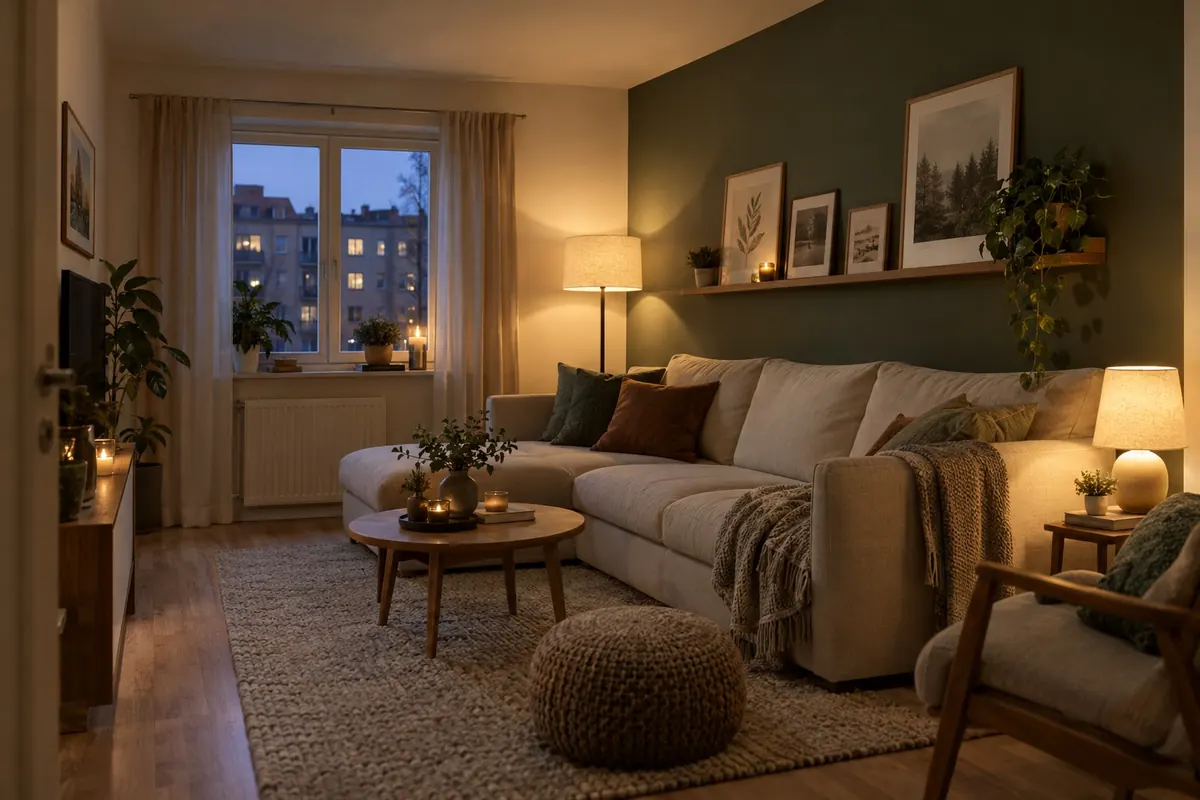
Will a dark interior suit your room?
Dark paint reflects little light. Finntella groups graphite, deep blue and olive as dark shades with a light reflectance value (LRV) of 10-24%, and charcoal and near-black at 0-9% (Finntella, in Russian). Light whites and grays are at 65-84%, though the exact figure differs for every paint and the manufacturer lists it. So the size of the room matters less than how much light it gets and what time of day you use it.
Answer four questions. Every "no" is a reason to keep one wall dark and the rest light.
| Question | If "yes" | If "no" |
|---|---|---|
| Does the window face south or west, with no trees or nearby building shading it? | dark walls take less of the daylight | dark color on one wall, ideally with a warm undertone |
| Is the room empty during the day? | go bolder: darkness feels cozy in the evening | a light background is easier for work and play |
| Are the floor and ceiling light? | dark walls get something to rest on | a dark floor plus dark walls will close the room in |
| Can you add 3-4 light sources? | the dark room will feel alive at night | one ceiling light leaves the corners in shadow |
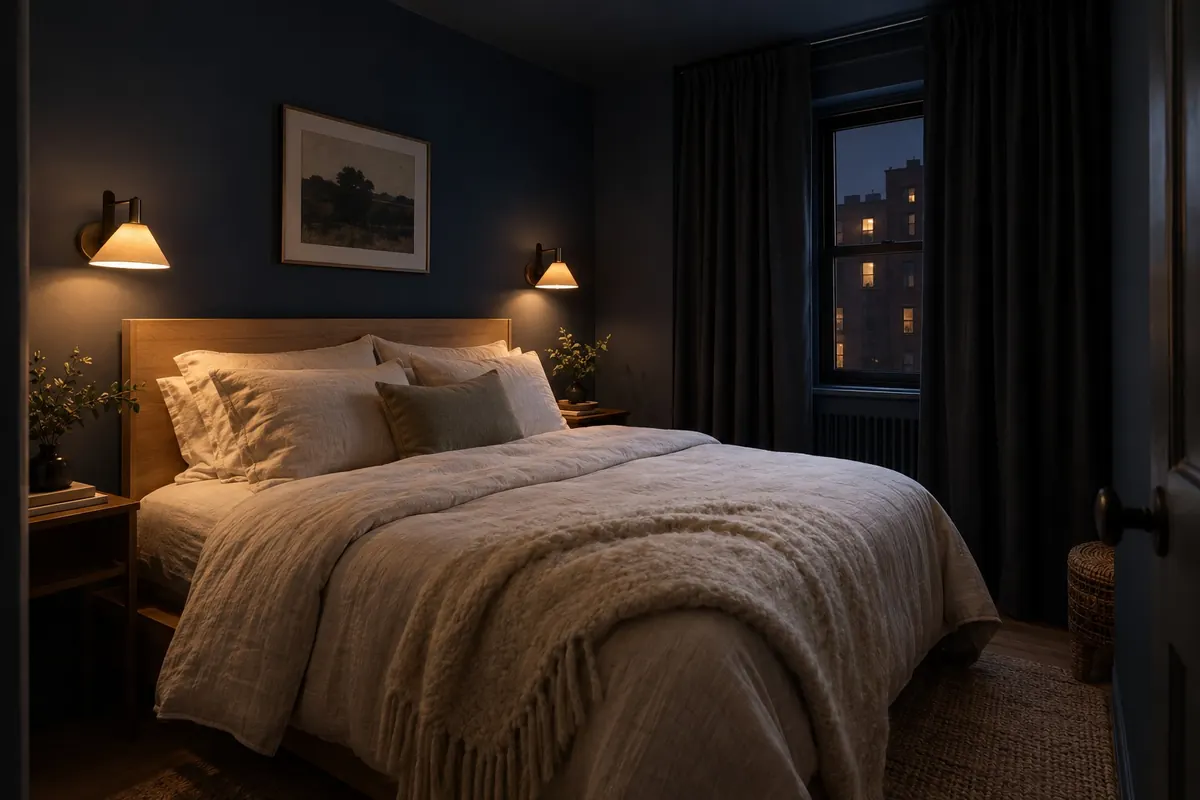
Finntella advises against a dark accent wall in a north-facing room, since it absorbs what little light there is. The bedroom is the exception: nobody is there during the day, so a north window hardly matters.
Some rooms are dark on their own, with a window facing the building next door. White walls in a room like that still look gray on a cloudy day. In that case you can accept the darkness: a deep warm color, light textiles and plenty of lamps.
One dark wall or a fully dark room?
The cost of a mistake differs. You can repaint one wall over a weekend; a whole room is a renovation.
One dark wall
For a small apartment this is the safest option. Paint the wall people look at: behind the sofa, behind the headboard, behind the TV. Behind a TV, a dark wall also hides the black screen when it is off.
The window wall works well too. It sits in shadow during the day anyway, so dark paint there takes very little light, and the view outside looks like a framed picture. Other materials for an accent wall are covered in the article on wall design.
The whole room in one dark color
The walls, the ceiling and sometimes the doors go one dark color. The corners stop reading, and a small room often feels deeper rather than smaller. You need a light floor or a light rug and warm lamp light for this. With an 8-9 ft ceiling, a white ceiling over dark walls usually looks like a lid, so paint it the wall color or a couple of shades lighter.
Dark below, light above
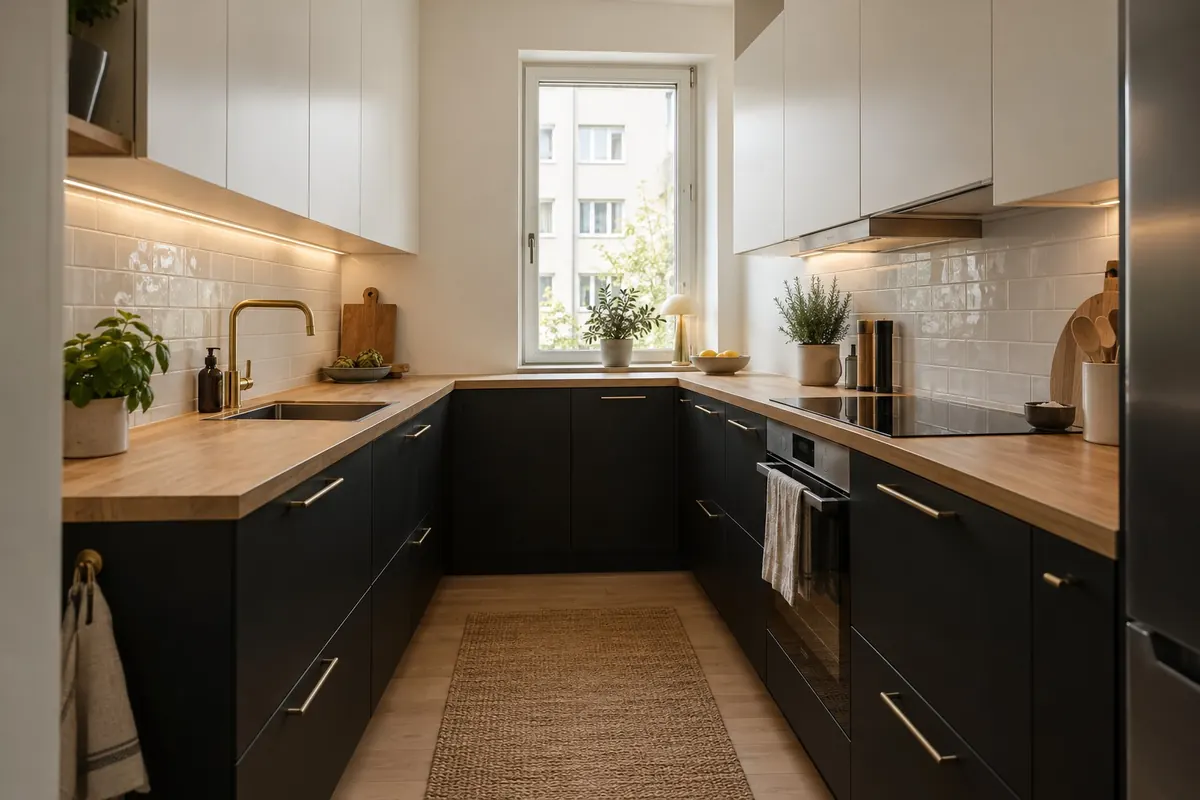
Only the lower part goes dark: kitchen base cabinets, wall panels up to mid-height, a dresser, a sofa. The upper part stays light, so the room loses almost no light. In a 65-95 sq ft kitchen this is the easiest way to get a dark kitchen.
How to light a dark interior: three scenes
In a light room, the ceiling light bounces off the walls into the corners. Dark walls absorb it, so one ceiling fixture isn't enough. Build the lighting from three scenes, each on its own switch.
- General. A ceiling fixture or recessed lights for cleaning and getting ready. Aim them at the light floor and furniture: light that hits a dark wall barely comes back into the room.
- Evening. Floor lamps, sconces and table lamps at eye level with warm 2700-3000 K light. This is the main scene in a dark interior: the walls fall into shadow and the pools of light hold the room together.
- Accent. Lighting for shelves, artwork, the kitchen work area, a niche by the headboard. Without it, a dark wall looks like a hole at night.
Matte or gloss: which finishes to choose?
How a dark color looks in real life depends heavily on sheen. One classification of coatings has six gloss levels: dead matte is 0-3% of the reference standard, matte 4-19%, semi-matte 20-36%, and gloss and high gloss over 50% (Russian Wikipedia, "Gloss"). Paint brands use their own scales, so check the number on the can, not just the word "matte."
| Surface | How it looks in a dark color | Where it fits | What to watch |
|---|---|---|---|
| Dead matte paint | velvety, no glare, the color looks deeper | bedroom and living room walls | hand marks show on dark matte, choose a washable paint |
| Semi-matte paint | a slight sheen, the color looks a bit lighter | hallway, kitchen, doors | catches glare on an uneven wall |
| Gloss fronts, lacquer | reflect lamps and the window | one surface: cabinet fronts, a side table | shows dust and fingerprints |
| Velvet, wool, linen | soft and warm | sofa, curtains, throw | dark velvet collects lint and dust |
| Wood, brass, stone | pattern and warm highlights | furniture, lamps, handles | without them a dark room looks flat |
Mix the finishes. A matte wall, a velvet sofa, a wooden table and a brass lamp all have different sheen, and the eye reads depth even in low light.
Black in interiors
Black paint falls into the darkest group, with an LRV of 0-9%, and in an apartment people rarely paint every wall black. More often black works as a line: window and partition frames, furniture legs, handles, lamps, a countertop, one wall behind the TV. For a dark wall, graphite, anthracite or a brown-leaning black are easier; pure black looks harsher in evening light.
What colors go with black in an interior:
- warm white and cream: a clean pair without the harshness of cool white;
- light and mid-tone wood: takes the edge off;
- brass and bronze: warm highlights against the dark;
- terracotta, ochre and olive: earthy colors that don't fight with black;
- gray: only with wood or textiles nearby, or the room starts to feel like an office.
Dark living room, bedroom and kitchen
Dark living room
The living room is used during the day too, so people usually make one wall or a reading corner dark. Keep the sofa and rug light and the floor no darker than mid-tone oak. Room layout is covered in the article on living room design.
Dark bedroom
Nobody uses the bedroom during the day, and many people find a dark bedroom cozier at night, so dark color fits here best. With a north window, start with the wall behind the headboard. Light, gray and dark bedrooms are compared in the article on bedroom design.
Dark kitchen
In a small kitchen, dark below and light above is the safer choice; keep a fully dark kitchen for a large room with a good window. Without task lighting, dark upper cabinets cast shadows on your hands. Layouts and cabinet color pairings are in the article on kitchen design.
Pick the exact shade in the series articles: dark gray, dark green, navy and chocolate brown.
How to try a dark color on a photo of your room?
Repainting a wall just to test it is expensive, and other people's photos mislead: they have a different window and a different size. Start with a photo of your own room.
- Take a daytime photo in normal light from the spot where you usually see the room. How to shoot a room so the AI understands it is covered in the article on photographing a room.
- In Smart Edit, select one wall and repaint it in a dark color. Only the selected area changes, usually in under a minute.
- Compare two or three shades on the same shot. One edit costs 7 credits, and the free credits on the Free plan cover several. Smart Edit works in a browser on a computer.
- Check the finalist with a sample patch and look at it in the evening under lamp light.
If you like dark walls together with bookcases, wood and leather, try Redesign with the Dark Academia style. It redraws the whole room, furniture included, for 10 credits. To change only the wall color and keep your own furniture, use Smart Edit.
Frequently asked questions
Does a dark interior work in a small apartment?
Yes, if there isn't much dark color or the room is used mostly in the evening. The safest options are one dark wall, dark kitchen base cabinets or a dark bedroom. Rooms where people work during the day are better kept light.
Which dark color should I choose for walls?
For a north-facing room, pick a warm undertone: chocolate, olive, warm graphite. In a south-facing room, cool shades work too: navy, blue-green. Test the color on a photo of your room and with a sample patch; a paint fan deck in the store won't tell you how it will look.
What ceiling goes with dark walls?
With an 8-9 ft ceiling, paint it the wall color or two or three shades lighter. A white ceiling over dark walls emphasizes the edge and makes the ceiling look lower.
Can I paint my walls black?
You can, but in an apartment black is usually kept for one wall and details. For a whole room, people more often choose graphite or anthracite: they are almost as deep but softer in evening light.
Is a dark interior the same as the Dark Academia style?
No. You can have dark walls in any style. Dark Academia is a separate style with books, wood and leather, covered in the article on rare interior styles.
Key takeaways
- Dark colors work where you spend evenings: the bedroom, a living room corner, the lower kitchen cabinets.
- In a north-facing room used during the day, keep dark color for furniture and textiles.
- One dark wall is a safe start. A fully dark room needs a light floor and warm light.
- A dark interior needs three lighting scenes: general, evening and accent.
- Mix matte paint, velvet, wood and metal: different sheen creates depth.
- First repaint a wall on a photo of your room in Smart Edit, then do a sample patch.