Wall design for your apartment: how to finish bedroom and living room walls and try a material on a photo
Wall design ideas for an apartment: finishes compared by cleaning, repair and labor cost, bedroom and living room walls, accent walls and testing on your photo.
The easiest way to plan wall design in an apartment is by how hard each room is on its walls. In the living room and kitchen, walls get rubbed, bumped and washed, so washable paint, panels or slats make sense there. A bedroom takes far less wear, which makes it the place for patterned wallpaper. A room usually needs only one accent wall, and you check a material before buying it on a photo of your room and with a sample on the wall.
Search for wall finishes and you mostly get lists of ten materials with photos of other people's apartments. They are good for ideas but hard to choose from: the materials differ in cleaning, in repair and in labor cost. Below, all of that sits in one table, followed by the bedroom, the living room and the accent wall. Color is mostly left out here: palette rules are in our article on interior color combinations.
What can you finish apartment walls with?
Five options cover most apartments: paint, wallpaper, decorative plaster, wall panels or slats, and moldings over paint. In a catalog photo they look about equal; the difference shows after a year of living with them. So the table compares how each material cleans and what you do when it gets a chip or a stain.
| Material | Where it works | Cleaning | Repairing a spot | Labor, from |
|---|---|---|---|---|
| Paint | any room, kitchen, hallway | washable paint handles damp cleaning, deep matte handles it worse | you can touch it up, but the patch often shows; repainting the wall corner to corner is safer | 250 ₽/m² |
| Wallpaper | bedroom, kids' room, accent wall | per the symbol on the roll: from a damp sponge to a brush | the whole strip is replaced, so you need a spare roll from the same batch | 400 ₽/m² |
| Decorative plaster, microcement | living room, accent wall, entryway | washable with a protective wax or varnish, absorbs dirt without it | a patch usually shows, so the whole surface is redone | 850 ₽/m², microcement 1,210 ₽/m² |
| Wall panels, slats | TV wall, headboard wall, entryway | vacuum the dust between slats with a brush nozzle | one panel or slat is replaced if you kept spares | by estimate |
| Moldings over paint | bedroom, living room in classic or neoclassical style | dust collects on the top edge of the profile | the damaged piece is replaced and painted with the wall | 430 ₽ per linear meter |
The last column shows starting labor prices in Moscow without materials, from the 2026 price pages of Profi.ru, a Russian marketplace for contractors (in Russian): painting, wallpapering, decorative plaster, moldings. Checked on November 14, 2026. The final price depends on the condition of the walls, the scope of work and the city. Those price lists do not include installing wall panels or slats, so we give no price for it: it depends heavily on the material and the fastening.
How to read the symbols on wallpaper
The symbol on the roll tells you how the wallpaper handles cleaning. According to the guide from Petrovich.Znaet (in Russian), one wave means dirt can be removed with a slightly damp sponge, and two waves mean the wallpaper can be washed with a wet sponge. Three waves can take washing with a mild cleaner, and a wave with a brush also allows brushing. One or two waves are enough for a bedroom; for a kitchen or hallway, look for three waves or the brush symbol.
Kitchen and hallway
In a kitchen, the backsplash covers the wall by the stove and sink, while the other walls get dirty around the table and light switches. In a hallway, walls get bumped by bags and strollers. Washable paint or wallpaper with three waves or the brush symbol works here, and in a hallway you can cover the lower part of the wall with panels. More about kitchens is in our article on kitchen design.
Why you should keep spares
Wallpaper and paint from different batches can differ slightly in shade. So after the renovation, keep a roll of wallpaper, a can of paint or a couple of slats. A year later, replacing a damaged strip will be easier than hunting for the same color in a store.
How do you design bedroom walls?
Bedroom walls hardly get dirty, so this is where patterned wallpaper belongs, including paper and non-woven types without a washability symbol. A common choice is wallpaper on the wall behind the bed and calm paint on the other three. The pattern is visible from the door but stays out of the way at bedtime: lying in bed, you look at the opposite wall, and it is better left plain.
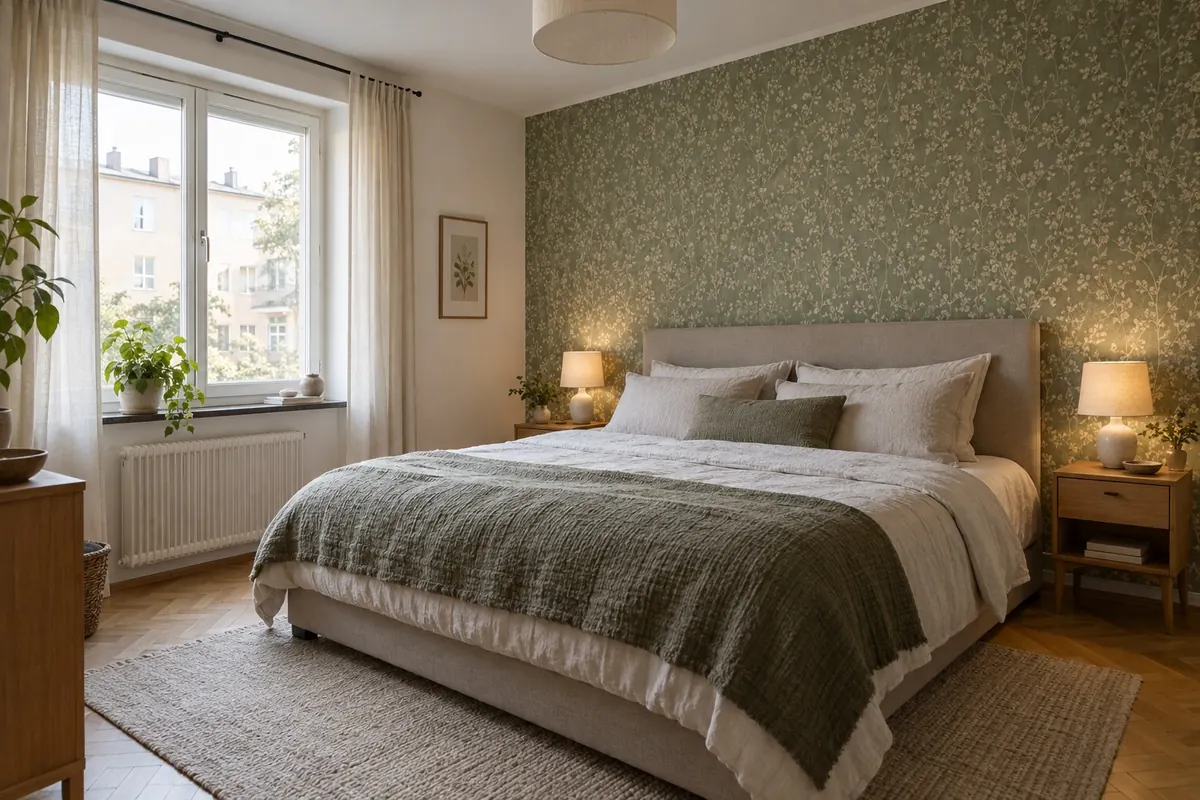
The wall behind the headboard wears faster than the rest: pillows and the headboard rub against it, and the paint gets shiny over time. Without a tall headboard, washable wallpaper, upholstered panels or slats help here, and delicate wallpaper is better kept for the free walls.
A small bedroom suits a small pattern on a light background. A large pattern on a narrow wall gets cut off at the edges, and instead of a design you see random fragments. More about the room itself is in our article on bedroom design.
How do you design living room walls?
The living room is one of the hardest-working rooms: people sit on the sofa, pull up chairs and run cables to the TV. So the base for the walls is washable paint, and the character comes from one or two textured surfaces: the TV wall or the wall behind the sofa.
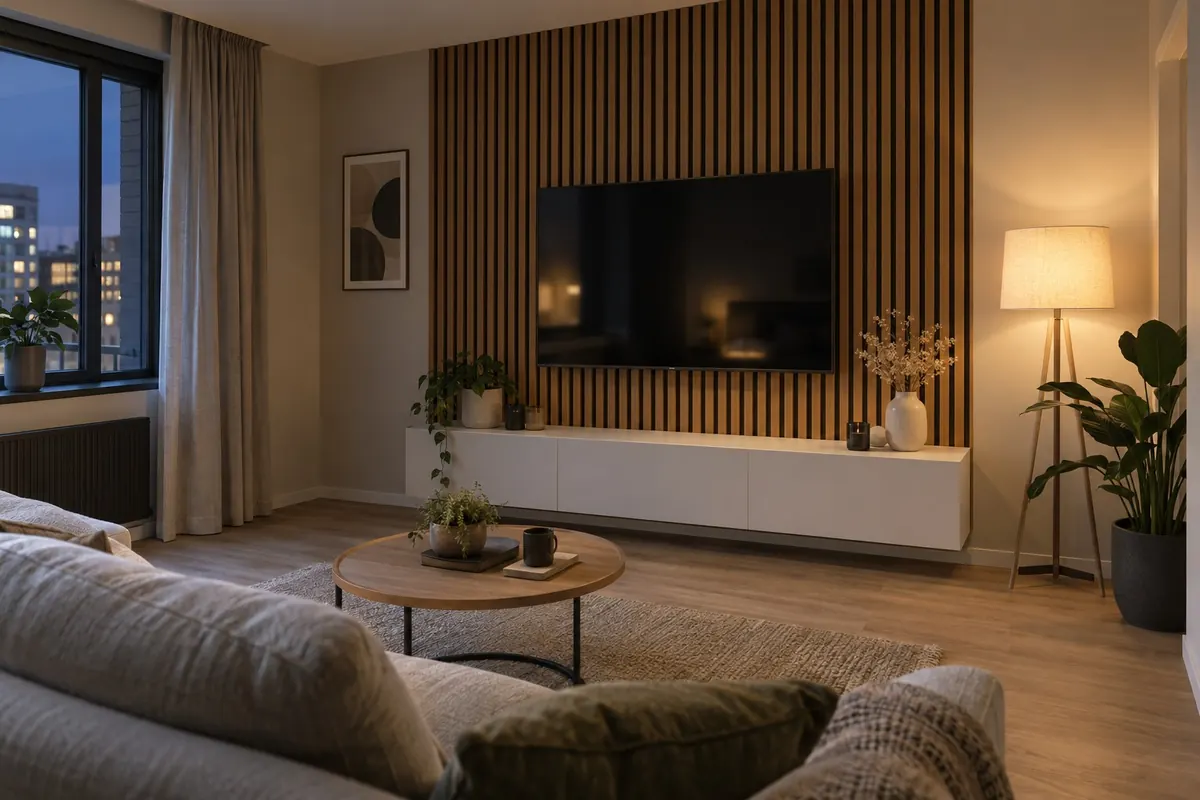
The TV wall
For a TV wall, people often choose slats or panels. They hide a cable channel if you plan it before installation, and they bring warm wood into a gray or white room. A TV that is off shows up as a black rectangle on a white wall; on slats or dark paint it stands out less. If the TV hangs opposite a window, glossy panels will reflect glare, so pick matte ones.
The wall behind the sofa
Decorative plaster or a deep paint color works well behind a sofa. The sofa back hides the lower part of the wall, and the upper part is visible from the door. Pull the sofa a few centimeters away from the wall, otherwise its back will rub a stripe into the plaster over time. More ideas for the room are in our article on living room design.
How many accent walls does a room need?
Usually one. Two bold walls in a 15-18 m² (160-195 sq ft) room compete with each other, and neither looks like the main one. The exception is a studio or a room with zones: there you can highlight one wall per zone. How to divide such a room is covered in our article on zoning.
Which wall to choose:
- The wall people look at. Behind the headboard in a bedroom, behind the sofa or the TV wall in a living room.
- The end wall in a narrow room. A dark color or texture on the short wall visually brings it closer, and a long room looks better proportioned.
- Not the wall with the window. Light falls away from it, not onto it, so color and texture read worse there.
- Not the wall behind a tall wardrobe. If furniture covers it, nobody will see the accent.
Any material from the table above can work for an accent. If you want to try a bold idea without spending much, start with paint: it is the easiest to redo.
How do you test a material on a photo of your room?
It is convenient to test a finish in two steps: first on a photo of the room, then with a sample on the wall. The photo shows how the material works with your floor, furniture and light. The sample shows the exact color and texture, which a screen cannot convey.
- Take a photo of the room in daylight. Shoot from the doorway so the whole wall is in the frame. How to shoot a room so the AI understands it is covered in our article on photographing a room.
- Open Smart Edit. In Smart Edit, select the wall and describe the finish: "vertical oak slats", "sage green wallpaper with a small botanical print", "limewash-style decorative plaster". The rest of the room stays unchanged.
- Compare 2-3 options. One edit costs 7 credits and usually takes less than a minute. The Free plan gives you free credits once at sign-up, enough for several comparisons. Smart Edit works in a desktop browser; it is not available on phones yet.
- Check the finalist in real life. Get a wallpaper cutting or a paint sample from the store, and ask your contractor for a plaster sample board. Look at it in the morning and in the evening under lamps.
The picture helps you rule options out before you buy anything: you can usually see right away that slats make a small room feel heavy or that a wallpaper pattern clashes with the rug. The exact product and shade are chosen from the sample.
Frequently asked questions
Which is better for apartment walls: paint or wallpaper?
Paint is more practical in high-wear rooms: the living room, kitchen and hallway. It is easier to wash and repaint. Wallpaper gives you pattern and texture that paint cannot, and it does well in a bedroom and on an accent wall.
What wallpaper should you choose for a bedroom?
Non-woven or paper wallpaper with one or two waves on the roll works for a bedroom: walls there are rarely washed. The pattern usually goes on one wall behind the bed, and for a small room you pick a small print on a light background.
What can you finish a TV wall with?
Most often slats, wall panels or deep-colored matte paint. Slats and panels are handy because you can hide a cable channel behind them if you plan it before installation.
Can the wall with the window be the accent wall?
It can, but it is usually a poor choice. Window light falls on the other walls, while the window wall itself gets less light, so color and texture read weaker on it than on the walls opposite or to the side.
How do you know whether a material will suit your room?
First compare 2-3 options on a photo of your room in Smart Edit, then check the finalist with a sample on the wall in daylight and under lamps.
Key takeaways
- Choose apartment wall design by wear: washable paint, panels and slats in the living room and kitchen, patterned wallpaper in the bedroom.
- Compare materials not only by looks but by cleaning, spot repair and labor cost.
- Keep spare wallpaper, paint and slats from the same batch so a damaged area is easier to replace.
- One accent wall is usually enough: behind the bed, behind the sofa or the TV wall, but not the wall with the window.
- Test 2-3 finishes on a photo of your room in Smart Edit, and check the finalist with a sample on the wall.